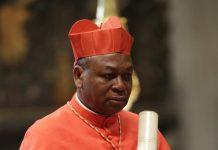


















Cardinal Robert Sarah calls on Europe to respect Africa’s cultural sovereignty, warning against ideological pressure in EU-Africa relations.
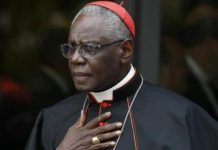
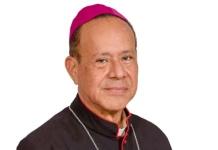
Newsroom (16/07/2026 Gaudium Press ) Cardinal Robert Sarah delivered a forceful appeal for a reassessment of Europe’s relationship with Africa during a conference at the European Parliament, arguing that genuine cooperation must be founded on respect for Africa’s religious, cultural, and family traditions rather than on what he described as ideological pressure from European institutions.
The Guinean cardinal spoke at the “Europe and Africa” conference in Brussels, an event organized by a group of Members of the European Parliament from the European Conservatives and Reformists (ECR) group. Archbishop Bernardito Auza, Apostolic Nuncio to the European Union, also participated in the gathering, which focused on the future of European-African relations.
At the center of Sarah’s address was what he called a “crisis of language” affecting dialogue between Europe and Africa. According to the cardinal, key concepts related to rights, life, education, and family are increasingly being used in ways that obscure their meaning rather than clarify it.
“We defend the freedom of a continent that helped forge the Christian logos, a logos that Europe risks forgetting,” Sarah declared, framing his remarks within a broader reflection on the relationship between truth, reason, and public policy.
A Warning About the Power of Words
Sarah argued that the language employed in modern international agreements and policy frameworks often carries ideological assumptions hidden behind seemingly neutral terminology.
“In relations between the European Union and Africa, words are used today not to reveal reality, but to conceal it, and even to turn it upside down,” he said.
The cardinal cited remarks made by Pope Leo XIV during a January 9 meeting with members of the diplomatic corps accredited to the Holy See. Referring to the pope’s call for clearer language, Sarah emphasized the need for “words anew to express unambiguous realities clearly and distinctly.”
For the cardinal, the issue extends far beyond semantics. Ambiguous terminology in treaties, resolutions, and action plans can become, he argued, a mechanism for imposing external cultural values on African societies.
“A treaty, resolution, or action plan that uses ambiguous vocabulary is not a tool for cooperation, but for cultural and economic neocolonialism,” he said.
Drawing on Benedict XVI’s Vision of Reason
To explain what he views as the deeper roots of the problem, Sarah turned to the teachings of Pope Benedict XVI, particularly the late pontiff’s 2006 Regensburg address, which emphasized the relationship between faith and reason.
According to Sarah, Europe is experiencing not only a crisis of language but also a crisis of reason itself.
Quoting Benedict’s assertion that acting irrationally is contrary to God’s nature, Sarah warned against legal and political systems that detach themselves from what he described as objective truths about the human person.
“When Europe constructs laws detached from the truth about humanity, reason itself becomes distorted,” he said, arguing that reason risks becoming an instrument of power rather than a means of discovering truth.
He questioned whether European legislation that presents itself as neutral while promoting a specific vision of human identity may be drifting toward the irrationality against which Benedict XVI warned.
Echoing Francis on “Ideological Colonization”
The cardinal also drew on the teachings of Pope Francis, particularly the late pope’s repeated criticisms of what he termed “ideological colonization.”
Sarah referenced Francis’s 2015 remarks in Manila, where the pope warned against external attempts to reshape societies and family structures through ideological influence. Francis had described such efforts as forms of colonization because they originate outside a community’s own cultural and spiritual traditions.
Building on that theme, Sarah argued that some African leaders have faced pressure to adopt particular social policies as a condition for receiving financial assistance or international support.
Such practices, he suggested, undermine authentic partnership and weaken national self-determination.
Defending the Right of Nations to Preserve Their Traditions
A major theme of Sarah’s address was the collective dimension of human dignity and religious freedom.
While acknowledging universal human rights, he insisted that nations also possess the right to preserve and transmit their religious, cultural, and family heritage.
“Human dignity and religious freedom also have a communal and historical dimension,” Sarah said. “A nation has the right to live, preserve, and transmit its own religious, cultural, and family tradition.”
He rejected the idea that defending Africa’s traditions amounts to cultural isolationism or opposition to universal values. Instead, he presented Africa as an important contributor to Christian and human civilization.
Invoking influential figures from early Christian history, including Tertullian, Cyprian of Carthage, Athanasius, and Augustine of Hippo, Sarah argued that Africa has played a foundational role in shaping Christian thought and continues to offer valuable spiritual insights to the world.
“The history of the Church teaches us that the gift of faith has always been mutual and that Africa has as much to give as it has received,” he said.
Subsidiarity and the Limits of External Influence
Sarah also appealed to the principle of subsidiarity, a cornerstone of Catholic social teaching articulated by St. John Paul II in the encyclical Centesimus Annus.
The principle holds that higher authorities should support rather than replace the functions of lower-level communities and institutions.
Applying this concept to international relations, Sarah argued that the European Union should not attempt to reshape the legal and educational systems of sovereign African nations.
“The task of the European Union is not to rewrite the family law, criminal law, and educational systems of sovereign African states,” he said.
Any effort to centralize such decisions at an external level, he maintained, would contradict the very principle of subsidiarity and amount to ideological interference.
A Call for Partnership Instead of Pressure
Speaking as “a son of the African Church,” Sarah criticized what he described as attempts by some Western powers to promote “false values” through political and financial leverage.
He specifically pointed to cases in which African governments have been encouraged to establish institutions devoted to gender theory in exchange for financial support.
Instead of ideological conditions, Sarah argued that Africa needs practical cooperation focused on reconciliation, justice, peace, healthcare, agriculture, and education.
He called for renewed efforts toward debt relief, greater sharing of health and agricultural technologies, and strengthened support for the extensive networks of schools and healthcare facilities operated by the Catholic Church across Africa.
Europe Must Listen, Sarah Says
Concluding his address, Cardinal Sarah urged European leaders to adopt a more respectful and reciprocal approach toward Africa.
“Listen to Africa. Respect its cultural sovereignty. Offer free cooperation, unconstrained by ideological agendas,” he said.
He argued that the relationship should not be one-sided. While Africa seeks partnership and solidarity, Europe, he suggested, also has much to gain.
According to Sarah, Africa can offer a continent struggling with questions of identity a powerful witness of faith, family, and community.
“Be ready to receive from Africa what it can still offer to a weary West,” he concluded, “the testimony of a living faith and the value of the family, which can help Europe rediscover its logos.”
- Raju Hasmukh with files from Vatican News and Poland.us
Related Images: