









A look at famous excommunications in Church history and the emerging controversy surrounding the Transalpine Redemptorists.
Newsroom (03/07/2026 Gaudium Press ) Excommunication remains one of the most striking and severe penalties in Catholic canon law. Although often associated with dramatic conflicts between religious and political authorities, its application has evolved over centuries, reflecting changing historical circumstances and ecclesiastical priorities. From monarchs and revolutionaries to theologians and dissident clergy, the list of notable figures who have faced excommunication offers a revealing window into the tensions that have shaped Catholic history.
Today, a new controversy appears to be unfolding in traditionalist Catholic circles, where an episcopal consecration planned without papal authorization has raised concerns of yet another rupture with Rome.
Famous Excommunications of the Modern Era
During the twentieth century, excommunication was frequently associated with disputes involving politics, ideology, and ecclesiastical authority.
Several bishops in China were excommunicated after joining the Patriotic Association and participating in episcopal ordinations conducted without papal approval. These cases underscored the Vatican’s insistence that the appointment and consecration of bishops remain under papal authority.
One of the most widely remembered cases involves Cuban leader Fidel Castro. According to longstanding accounts, Pope John XXIII excommunicated Castro in 1962 based on the principles established by Pope Pius XII’s 1949 decree against communism. Castro had aligned himself with communist ideology and government structures, actions considered incompatible with Catholic teaching under the norms then in force.
Other prominent figures met a similar fate for very different reasons. Romolo Murri, a leading figure among Italian Catholic democrats, was excommunicated after openly criticizing papal policies. Haitian ruler François Duvalier was excommunicated following his expulsion of foreign bishops from Haiti. French priest and theologian Alfred Loisy, associated with the Modernist movement, was excommunicated in 1908 after becoming one of the most prominent figures in a theological current condemned by the Church.
Loisy’s case was particularly severe. He received the status of vitandus, a form of excommunication intended to isolate the individual from the wider Catholic community. Such measures reflected the gravity with which ecclesiastical authorities viewed doctrinal challenges at the time.
Spain also saw notable cases. In 1933, priest and politician Luis López Dóriga was excommunicated by Pope Pius XI for supporting the Constitution and legislation of the Second Spanish Republic, particularly the 1932 divorce law.
Meanwhile, Clémente Domínguez and Manuel Alonso were excommunicated for founding what became known as the Palmarian Church, a separate ecclesial body claiming legitimacy outside Roman authority.
In Argentina, former president Juan Domingo Perón was excommunicated after the expulsion of the Bishop of Buenos Aires during the political crisis that ultimately contributed to his overthrow.
From Joan of Arc to Napoleon
Some of history’s most famous excommunications involve figures whose reputations later underwent dramatic transformations.
Joan of Arc was captured, handed over to her enemies, convicted of heresy, and excommunicated before being burned at the stake in 1431. Among the accusations against her was the wearing of male attire while leading military forces. Yet only twenty-five years later, in 1456, Pope Callixtus III ordered a retrial. The original judgment was overturned, Joan was cleared of the charges, and she would eventually be canonized as Saint Joan of Arc.
Another celebrated clash pitted the papacy against one of history’s most powerful rulers. In 1809, Pope Pius VII excommunicated Napoleon Bonaparte after the French emperor occupied Rome and annexed papal territory. Napoleon responded by imprisoning the pope and compelling him to surrender much of his authority. Pius VII spent years in captivity before returning to Rome in 1814 following Napoleon’s defeat and exile.
No discussion of excommunication would be complete without Martin Luther. His denunciation of Pope Leo X, whom he labeled the Antichrist, combined with his public burning of Catholic books, deepened the breach between reformers and Rome. His excommunication in 1521 became one of the defining moments of the Protestant Reformation, permanently altering the religious landscape of Europe.
The Church and Communism
Among the most consequential disciplinary measures of the twentieth century was the Catholic Church’s response to communism.
In 1949, the Holy Office issued the Decree against Communism, approved by Pope Pius XII. The decree declared that those who professed communist doctrine could incur excommunication as apostates from the Christian faith.
A further clarification issued in 1959 and ratified by Pope John XXIII made the decree’s provisions more specific. It stated that Catholics were also prohibited from voting for parties that supported communists. According to the material available, no subsequent ruling has revoked these measures, and the decree is therefore considered to remain in force.
A Potential New Schism in the Scottish Islands
While the historical cases involve emperors, presidents, and ideological movements, a much smaller but potentially significant dispute is now attracting attention within traditionalist Catholic circles.
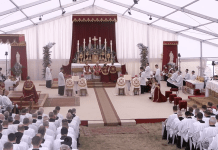
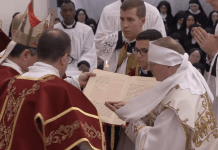
On July 25, Father Michael Mary, superior general of the Sons of the Most Holy Redeemer—commonly known as the Transalpine Redemptorists—is expected to be consecrated bishop on Papa Stronsay, an island in Scotland’s Orkney archipelago. The ceremony is reportedly planned without papal mandate.
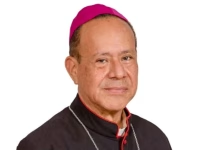
The consecration is expected to be performed by Canadian sedevacantist bishop Pierre Roy, assisted by Rodrigo Ribeiro da Silva and Fernando Altamira as co-consecrators.
The Diocese of Aberdeen, which holds jurisdiction over the territory, has already warned that such an action would constitute an illicit act and a grave act of disobedience. The diocese has additionally noted that those involved reject the legitimacy of Pope Leo XIV.
The Ideological Break
The dispute reflects a broader theological conflict over the legacy of the Second Vatican Council and developments within the modern Church.
In a public letter addressed to bishops, priests, religious, and lay Catholics, the group argued that the traditional Catholic faith can no longer be reconciled with what it describes as the “new Church” that emerged after Vatican II.
The letter rejects several major developments and documents associated with recent pontificates, including Amoris Laetitia, Traditionis Custodes, Fiducia Supplicans, the Document on Human Fraternity, and the concept of a synodal Church. In May 2026, the publication of a declaration titled The Dogma We Must Follow further clarified and intensified the group’s position.
From Reconciliation to Renewed Separation
The origins of the community trace back to December 8, 1987, when it was founded with the blessing of Archbishop Marcel Lefebvre and the support of Cardinal Édouard Gagnon, who was then serving as papal visitor to the Society of Saint Pius X.
In August 1988, shortly after the controversial episcopal consecrations at Écône, a young Redemptorist priest, a seminarian from the Society of Saint Pius X, and several aspirants established a monastic community dedicated to the traditional Roman liturgy and the spirituality of Saint Alphonsus Liguori.
Relations with Rome improved significantly following Pope Benedict XVI’s motu proprio Summorum Pontificum. In 2008, the community returned to full ecclesial communion with the Catholic Church.
The reconciliation culminated on August 15, 2012, when Bishop Hugh Gilbert of Aberdeen formally established the community as a diocesan-right clerical religious institute under the official name Sons of the Most Holy Redeemer.
Now, however, the planned episcopal consecration threatens to reopen questions that have accompanied the Church throughout its history: the limits of authority, the consequences of dissent, and the enduring significance of excommunication in Catholic life.
- Raju Hasmukh with files from Infovaticana
Related Images: