










The Word of God often encounters obstacles to taking root in our souls. Let us be attentive when receiving this seed, especially in the Eucharist.
“A sower went out to sow…” (Mt 13:3).
Through His divine teaching, Our Lord Jesus Christ spoke to the crowds using images familiar to the society of His time. Yet in the age of machines, where the image of a man sowing seeds by hand seems like an ancient tale, does this parable still hold relevance for people’s lives?
Yes, because if “the word of God endures forever,” its fruitfulness is eternal. The only question is whether the soil of our hearts is fertile as well.
Three Dangers
In the Gospel for this 15th Sunday in Ordinary Time, we can identify three dangers that keep us away from the Kingdom of God: hardness of heart, superficiality, and attachment.
The seeds that fell along the path symbolize impenetrable hearts. The soil bordering the road remains compact and hard. These are distracted souls—many of whom have even received catechesis—but who have forgotten the truths of the faith and no longer pray. Why? Because their hearts have become hardened.
Like grain exposed to the elements, such people are vulnerable to the temptations of disordered passions and of the devil, running the risk of being trampled underfoot or devoured at any moment. Applying this metaphor to our own time, how often is the precious seed of God’s grace surrounded by countless birds of prey? In the past, simply going out into the street could make one a potential victim; today, however, the danger is often within arm’s reach.
Superficial Souls
Those represented by the rocky ground are superficial souls. They may receive the Word of God with pleasure and joy, but because they lack a genuine interior life and firmness of purpose, grace finds no fertile soil in which to grow. They are distracted people, more attached to trivialities than to supernatural life, and they do not possess a deep horror of sin.
And what about the thorns? Just as they prevent air and light from entering, excessive concern for worldly goods, money, and everything fleeting and superficial can suffocate even the most extraordinary graces. Let us remember that it was only thirty pieces of silver that led Judas to stifle his own vocation and betray the Savior.
“What good is it for someone to gain the whole world, yet forfeit their soul?”
Hearts surrounded by thorns are constantly focused on what is merely concrete and material—on prestigious, advantageous, romantic, or self-serving relationships.
What Is the Remedy?
In every case: vigilance, prayer, and confession. Yet each problem also has its particular remedy.
If I find myself on the edge of the path and desire the seed to penetrate my heart, I must not only listen but also seek to understand the meaning of the Word that has been sown and apply it to my daily life.
If the ground is rocky, it is not enough to receive the Word with joy; it must be translated into action, adapting whatever in us is not in harmony with it.
If thorns are choking the divine seed, let us remember the Lord’s words:
“Seek first the kingdom of God and His righteousness, and all these things will be given to you as well” (Mt 6:33).
We must concentrate our efforts on our sanctification, for the soul is immortal and everything else is passing away.
The Seed of the Eucharist
While the seed symbolizes the Word of God that reaches us through human words and examples, through apostolate and preaching, we must remember that Our Lord Jesus Christ is “the Father’s one, perfect and unsurpassable Word. In Him, the Father has said everything, and there will be no other word than this one” (Catechism of the Catholic Church, 65).
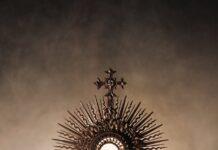
Indeed, every day the Divine Sower goes out to sow and seeks good soil to receive His Divine Seed. This seed is the Divine Word made present in the Holy Eucharist, every day and on every altar throughout the world. The Lord of the Universe, out of love for us, chose to become the Divine Prisoner in every tabernacle.
What do I do when this seed of immeasurable value comes to me?
How it must grieve the Heart of Jesus when people count the seconds until the end of that heavenly communion which is the Holy Mass! How many arrive late and how many leave early, failing to give proper thanks for the Real Presence!
Sadly, the divine seed often finds hardened hearts along the path, distracted and superficial souls, and—alas—thorns that prefer money, pleasure, and sin to the grace of the Eternal God.
Let us ask for the intercession of Our Lady of the Blessed Sacrament—She who was the first tabernacle of God when He dwelt hidden within her for nine months—that she may obtain for us the grace to receive her Divine Son worthily, as though each Eucharist were our first, our only, and our last Holy Communion.
By Marcus Yip
The post “The Divine Seed – Commentary on the Sunday Gospel” first appeared on Gaudium Press Español.
Related Images: