



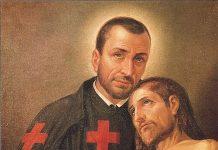




Little is known about Bonaventure’s early years, except that he was born in Bagnoregio, Italy, perhaps in 1217, and that his given name was Giovanni Fidanza.
Editorial (07/15/2026, Gaudium Press) Today we celebrate the great St. Bonaventure, as today marks the memorial of his burial.
Little is known about his early years.
It is only known that he was born in Bagnoregio, Italy, perhaps in 1217, and that his given name was Giovanni Fidanza. It is not clear how he came to exchange his given name (John) for Bonaventure, although a tradition that has come down to our day holds that, when he was a child, he was taken to the Seraphic Father, St. Francis, to be cured of a serious illness, and that when the saint saw him he exclaimed, “Bonaventure,” prophetically foreseeing the good he would do for humanity.
He entered the Order of the Seraphic Father, St. Francis, and later went to study at the University of Paris, where he had as his tutor the famous Alexander of Hales.
Hales’ pupil was brilliant, and he himself became an instructor at his alma mater, teaching theology and the Bible between 1248 and 1257. But not everything is a bed of roses in anyone’s life, and even less so in the lives of saints: the strong and organized opposition of secular professors to the mendicant orders forced him to leave the University of Paris.
However, this opposition also gave rise to light and wonders. Influenced by the campaign against the friars, Guillaume de Saint-Amour published The Perils of the Last Times, a work that fiercely attacked these mendicant monks. This prompted Bonaventure to write The Poor of Christ in response.
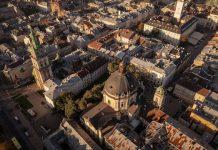
Paris
While in Paris, he composed his famous Commentary on the Sentences of Peter Lombard, which is a true summa of Scholastic theology. He also wrote his treatise On the Life of Perfection, intended for Blessed Isabella of France, sister of St. Louis the King. What marvelous times those were, with holy professors, holy writers, holy princesses, and holy kings. Also worthy of mention is his work Itinerarium Mentis in Deum (The Journey of the Mind to God), a magnificent work of contemplation.
He was not yet 36 years old when he was elected head of the Franciscans, taking charge of the Order at a time when there was great division between those who wished to relax the Rule somewhat and those who preached inflexibility. The still young superior wrote to the provincials demanding perfect observance of the Rule and the correction of the lax, while avoiding a descent into Pharisaical rigorism.
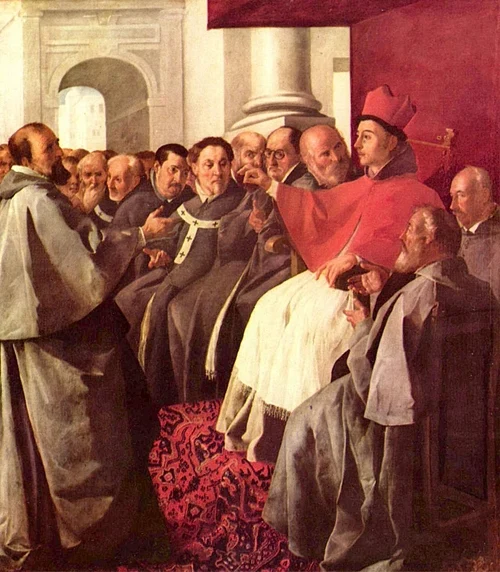
He presided over five general chapters of the Franciscan community, during which St. Bonaventure greatly influenced the course of the Order. This great Doctor began writing the life of St. Francis of Assisi. While engaged in these labors, he was visited by the great St. Thomas Aquinas, who, upon seeing him in his cell immersed in contemplation, withdrew, uttering the beautiful phrase that has echoed through the ages:
“Let us leave one saint to work for another saint.”
It appears that St. Bonaventure was, if not the author, at least the principal inspiration behind the practice of praying the Angelus, for he prescribed that, at the fall of evening, a bell should be rung in Franciscan convents in honor of the Annunciation.
He governed his Order for 17 years, and for this reason he is called its second founder.
Reluctant to Receive Honors
Already famous throughout the Catholic world, Pope Clement IV wished to make him Archbishop of York, a position of great dignity, but our saint dissuaded the Pope from doing so. Nevertheless, Gregory X made him Cardinal Bishop of Albano and obliged him to accept the office.
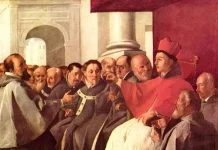
He was entrusted with preparing the matters to be discussed at the Ecumenical Council of Lyon, and when the great assembly began, although the Pope presided, he entrusted the direction of the deliberations to St. Bonaventure, particularly assigning him the thorny matter of dealing with the Greeks concerning the points related to the renunciation of their schism. To a great extent, it was due to the initiative of St. Bonaventure and the friars he sent to Constantinople that the Greeks accepted union, which was formalized on July 6, 1274.
He lived in an exemplary manner the evangelical counsels of poverty, obedience, and chastity. He is known as the “Seraphic Doctor” because of the virtue that permeated his learning, a virtue that seemed angelic, that of a seraph, in imitation of his Seraphic Father, St. Francis.
While engaged in the work of the Council of Lyon, St. Bonaventure died on the night of July 14-15, 1274. The exact cause of his death is unknown, although his secretary, Peregrine of Bologna, maintained that he had been poisoned.
The panegyric of the saint was delivered by a Dominican who would later become Pope Innocent V. He said of him in the homily:
“All who knew Bonaventure respected and loved him. Simply hearing him preach was enough to be moved to take him as a counselor, for he was a gracious, courteous, humble, affectionate, compassionate, prudent, chaste man, adorned with every virtue.”
His teacher, Alexander of Hales, used to say that Bonaventure seemed to have escaped the curse of Adam’s sin. He was one of the highest flowers of the great Middle Ages, embodying in the highest degree the virtues characteristic of that era: piety, contemplation, wisdom, among many others.
He was canonized in 1482 and declared a Doctor of the Church in 1588.
With information from Catholic.net and ACI Prensa – Catholic Encyclopedia.
The post “St. Bonaventure, Doctor of the Church, a Colossus Who Seemed Free from Original Sin” first appeared on Gaudium Press Español.
Related Images: