









Pope Leo XIV visits Lampedusa, urging Europe and the United States to protect migrants, confront indifference, and uphold human dignity.
Newsroom (06/07/2026 Gaudium Press ) Thirteen years after Pope Francis made his historic first papal journey to the Mediterranean island of Lampedusa, Pope Leo XIV returned to the symbolic gateway between Africa and Europe with a stark warning: the thousands who have died crossing the Mediterranean are victims not only of actions taken, but also of actions avoided.
“Those who have lost their lives in this sea are victims both of decisions that were made and of decisions that were not made,” the pontiff declared during a visit that combined pastoral reflection, political challenge and humanitarian appeal.
The southernmost island of Italy has long stood at the centre of Europe’s migration debate, serving both as a landing point for desperate migrants and as a memorial to those who never reached shore. Leo XIV’s visit deliberately echoed Pope Francis’s landmark 2013 trip, which brought global attention to the plight of migrants and refugees crossing one of the world’s deadliest migration routes.
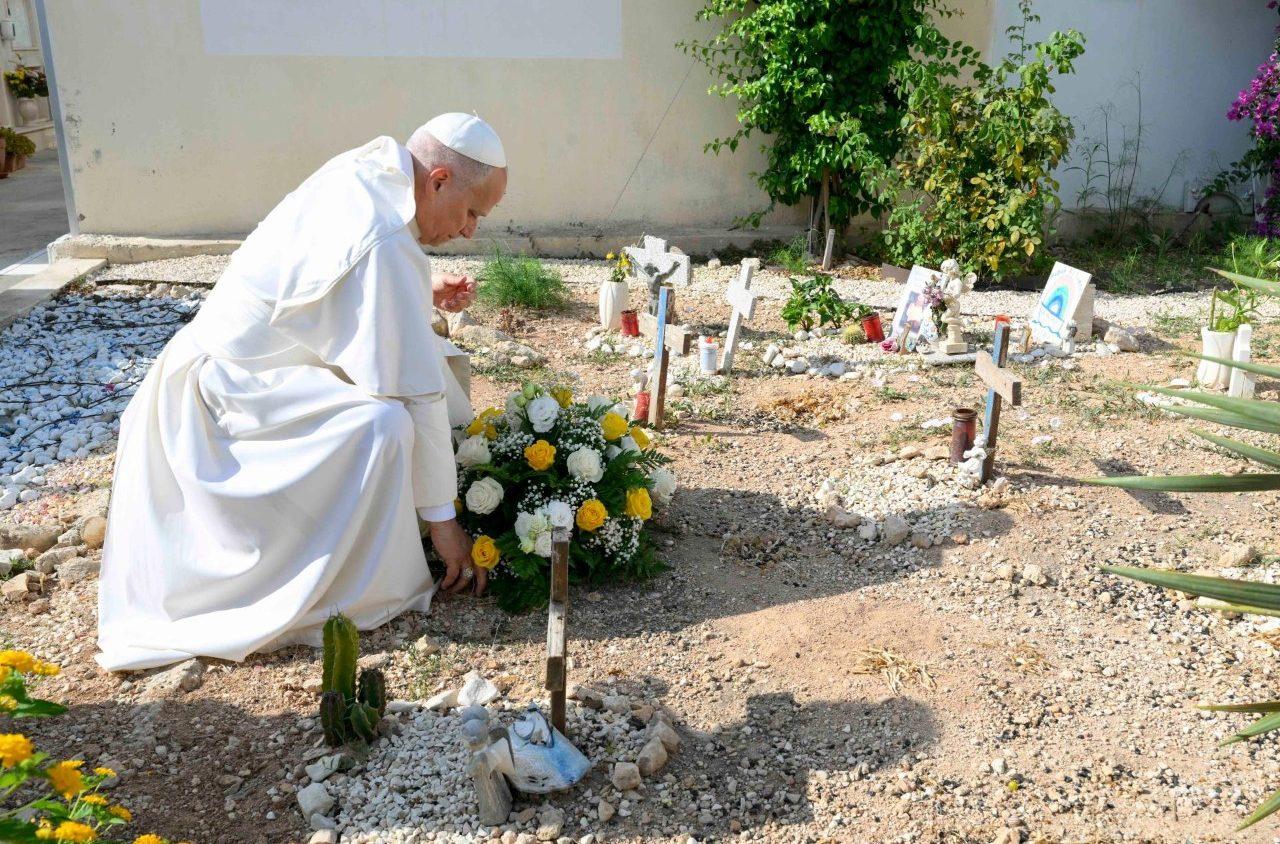
Arriving early in the morning, Leo first visited the island cemetery, where he laid floral tributes on the graves of migrants who perished attempting the Mediterranean crossing. He then proceeded to the “Porta d’Europa” monument, overlooking the sea, before praying at Favaloro Pier, the island’s principal landing point, now renamed in honour of Pope Francis.
The pope later met migrants accompanied by the Red Cross before celebrating Mass at the La Salina sports complex.
“I have not come to make speeches,” he told local authorities and residents. “I have come to celebrate the Eucharist,” describing Christ’s breaking of bread as the foundation for acts of solidarity and sharing.
The Good Samaritan and the Migrant Journey
Throughout the visit, Leo framed migration through the lens of the Gospel parable of the Good Samaritan. He argued that the ancient road from Jerusalem to Jericho, where a wounded man was ignored by passers-by before being rescued by a stranger, now passes through Lampedusa and every migration route in the world.
According to the pope, modern societies face the same moral choice found in the biblical story: whether to walk away from human suffering or to stop and help.
“Here you have seen not just one, but thousands of human beings fallen into the hands of robbers,” he said. “The sea has claimed the lives of others — those who did not manage to reach their hoped-for destination.”
For Leo, the suffering of migrants transcends ideology and political debate. The simple encounter with people “stripped of everything,” he argued, requires a human response before any intellectual or political calculation.
A Tribute to Lampedusa’s Solidarity
The pontiff repeatedly praised the people of Lampedusa for years of assistance offered to migrants arriving on the island’s shores.
“Yes, it is love that has taken shape among you,” he said, highlighting the compassion shown by residents toward those rescued at sea.
He also noted that migrants themselves frequently become agents of solidarity, recalling how many people on migration routes assist others who are even more vulnerable than themselves.
Yet his message carried a warning. Love, Leo emphasized, is never automatic; it is always a choice. In contrast to compassion, indifference remains a persistent reality.
He identified a range of forces contributing to migration tragedies, including corruption in countries of origin, economic systems that produce poverty and exclusion, fear-driven prejudice, criminal networks that profit from human suffering, and the failure to move beyond emergency responses toward long-term solutions.
A Challenge to Europe
From what he described as a “far-flung corner of Europe,” Leo XIV delivered one of the clearest appeals of his pontificate on migration policy.
He argued that Europe possesses unique historical, cultural and institutional resources that give it both the capacity and the responsibility to address migration comprehensively.
Rather than relying solely on emergency measures, the pope called for a coordinated strategy that would combine humanitarian assistance with long-term planning.
“Europe is capable of addressing the crisis in a comprehensive manner,” he said, advocating policies that receive, protect, support and integrate migrants while simultaneously helping developing nations so that migration is not a necessity imposed by poverty or instability.
The approach, he stressed, must maintain respect for the dignity of every person and involve not only governments but also civil society and religious communities.
Rejecting Fear and Division
Leo also challenged attitudes that portray migrants as threats and warned against allowing religious identity to become a source of discrimination.
“Unfortunately, in every age there are those who fear being ‘contaminated’ by contact with others,” he said.
Such fears, he argued, deny both the shared origin of humanity in God and the inherent dignity of every person.
The pope insisted that faith should never justify exclusion. Instead, religious belief should be understood as a universal call that breaks down divisions rather than reinforces them.
“There is no love of God without love of neighbor,” he said, adding that genuine neighborliness requires drawing near to those in need rather than keeping a safe distance.
Building a “Civilization of Love”
Central to Leo’s message was his call for what he described as a “civilization of love,” a concept previously championed by Pope Paul VI and now a cornerstone of Leo’s own vision.
He argued that the modern world must give tangible expression to this ideal through spiritual, cultural, legal, political and economic structures.
The scale of suffering witnessed in places such as Lampedusa, he said, should compel societies to rethink their priorities and embrace models based on solidarity, justice and fraternity.
The pope also addressed concerns that migration could threaten Lampedusa’s thriving tourism industry. Rather than viewing tourists and migrants as existing in separate worlds, he urged residents and visitors alike to reject “an invisible wall” between holidaymakers and those arriving after traumatic journeys.
“Have the courage to think differently,” he urged.
Message to the United States at 250 Years
On the same day as his Lampedusa visit, Leo XIV turned his attention to his homeland, the United States, marking the 250th anniversary of the Declaration of Independence.
Invoking the principle of human dignity that inspired the nation’s founding, the first American-born pope called for renewed commitment to protecting life and welcoming the vulnerable.
He specifically highlighted immigrants, whose “hopes, sacrifices and contribution” have shaped American society since its earliest days.
Those who came seeking “freedom, opportunity and a place to belong,” he said, helped define the national identity of the United States. Welcoming them with compassion and generosity, he argued, is fundamentally an affirmation of human dignity.
Concluding his twin messages to Europe and America, Leo warned that today’s global challenges cannot be faced in isolation.
“Building a world in which everyone can flourish requires shared responsibility and courage,” he said. “We need one another.”
From the shores of Lampedusa, where countless migration stories begin or end, the pope’s appeal was clear: fear and indifference cannot be the final answer to one of the defining humanitarian challenges of the modern era.
- Raju Hasmukh with files from Asianews.it
Related Images: