







Las Cruces Diocese opposes federal land seizure for border wall, citing risks to Mount Cristo Rey pilgrimage site and religious heritage.
Newsroom (01/07/2026 Gaudium Press ) In the arid borderlands of southern New Mexico, a legal and symbolic battle is unfolding between the U.S. federal government and the Diocese of Las Cruces—one that blends immigration policy, property rights, and religious heritage.
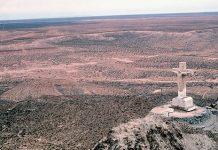
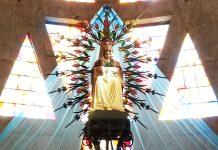
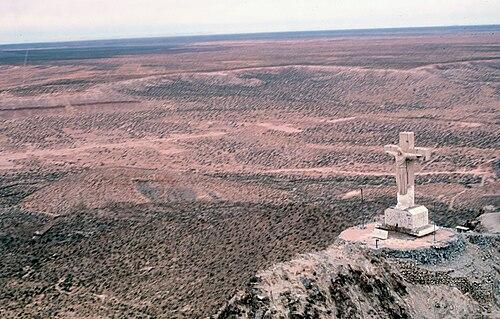
At the center of the dispute is a stretch of diocesan-owned land near El Paso, Texas, and the iconic Mount Cristo Rey, a pilgrimage site crowned by a nearly century-old statue of Jesus Christ. Federal authorities are seeking to seize the land through eminent domain to construct a more substantial border wall, a move the diocese is actively contesting in court.
Deacon Jim Winder, chancellor of the Diocese of Las Cruces, has pushed back against claims that the Church opposes border security. “We’ve been accused of that, and it’s not correct,” Winder said in an interview with EWTN News. He pointed to a 2021 agreement—renewed in 2023—that allowed federal immigration officials to build an access road and install motion sensors on Church land.
“They’ve had that ever since,” Winder said. “We think that’s adequate. I don’t think any people can get through there with that system.”
Despite this cooperation, the federal government is pursuing full control of the land. The diocese argues that the proposed wall is unnecessary in a region already naturally difficult to traverse.
Mount Cristo Rey itself serves as a formidable geographic barrier. “It’s really rough,” Winder explained. “To try to go over the mountain to get in the United States—it’s a pretty effective barrier in and of itself.” He added that the surrounding terrain, though flat for miles, is already under active patrol, with vehicles stationed along the border.
“I don’t think it’s a real high-volume place,” he said of illegal crossings in the area.
Beyond practical concerns, the diocese views the wall as a political gesture rather than a security necessity. “We see the border wall as more of a political tool—something that the administration wants to do to show that they’re tough on immigration,” Winder said.
The stakes are heightened by the cultural and religious significance of Mount Cristo Rey. The 29-foot-tall limestone statue at its summit, dedicated in 1940, has long drawn pilgrims from across the region. The monument traces its origins to 1933, when Father Lourdes Costa envisioned a statue atop the mountain after gazing out from his residence in nearby Smeltertown, a town that has since vanished.
Today, the site remains a powerful symbol of unity—geographically and spiritually. Situated in a unique corner of New Mexico bordered by both Texas and Mexico, the mountain overlooks El Paso and Ciudad Juárez. Winder likened it to the “Four Corners” region, where multiple states converge.
“This is a place where there’s this unity of two nations and two states,” he said. “There’s a symbolism of that unity in Christ the King standing above it.”
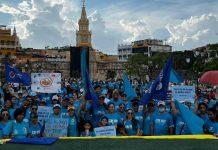
That symbolism was on full display on June 28, when Bishop Peter Baldacchino celebrated Mass at the summit. Despite intense summer heat, approximately 400 people made the climb, traveling from across the diocese and beyond.
“It wasn’t meant as a protest,” Winder emphasized. “It was a Mass. It was meant for prayer, to bring people together, to practice unity, to pray for the Church, and to pray for government leaders.”
Still, the timing underscored the tension surrounding the site. Earlier in June, a federal district court allowed the government to place a six-figure deposit on the land, a step toward potential acquisition. The legal battle continues, with another hearing expected in late July.
For the diocese, the issue is not only legal but deeply symbolic. Winder described the visual contrast that could emerge if the wall is built.
“If you go to the mountain and hike to the top, you’ll see a 30-foot-tall image of Christ the King,” he said. “And if the government builds this wall, and you turn your head slightly, you’ll see a 30-foot ‘Keep Out’ sign below.”
“It’s an affront,” he added.
As the case progresses, the Diocese of Las Cruces finds itself at the intersection of faith, politics, and national policy—defending both its land and what it views as the sacred character of a site that has drawn pilgrims for generations.
- Raju Hasmukh with files from EWTN News
Related Images: