






















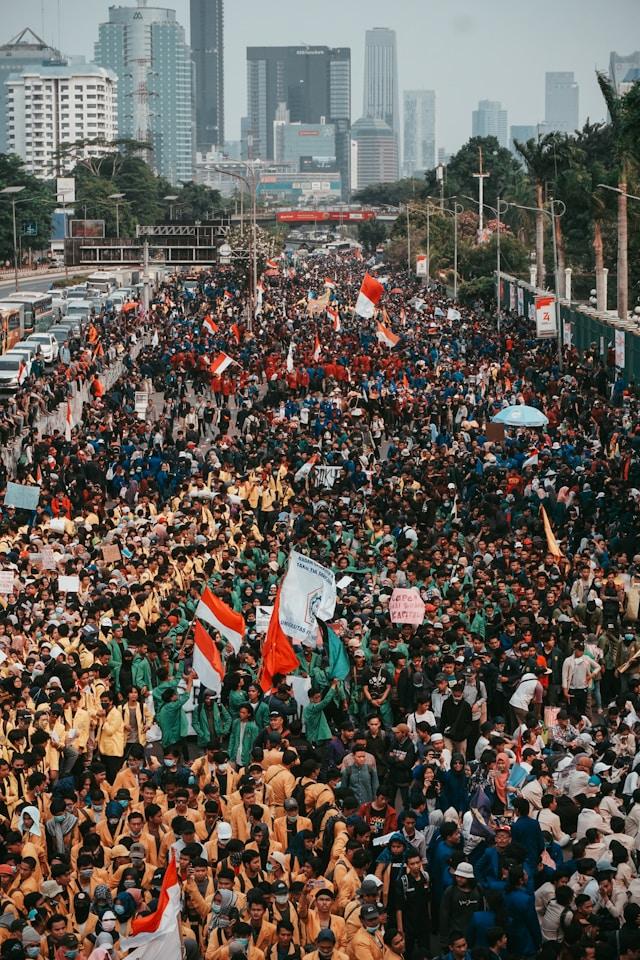
Indonesian Archbishop Paulus Budi Kleden warns of growing militarization in Flores as residents oppose new army bases amid land disputes and poverty.
Newsroom (06/07/2026 Gaudium Press ) A prominent Indonesian archbishop newly appointed to a Vatican dicastery has voiced strong concerns over the rapid expansion of the country’s military presence in Flores, warning that the scale of deployment appears disproportionate to any genuine security threat and risks deepening social tensions across the island.
Divine Word Archbishop Paulus Budi Kleden of Ende, East Nusa Tenggara province, said the ongoing expansion of the Indonesian Army’s territorial command structure under President Prabowo Subianto has become increasingly visible throughout his archdiocese, one of the regions most affected by the government’s plans.
“The increase in personnel, the increase in facilities — all of it is becoming increasingly real, very concerning,” Archbishop Kleden told UCA News on July 4. “That’s why I think I had to speak.”
His comments came shortly after Pope Leo XIV appointed him to the Vatican’s Dicastery for Evangelization on June 30. The archbishop first publicly addressed the issue in an exclusive interview published by Flores-based independent media outlet Floresa on July 2. His remarks quickly gained widespread attention on social media and sparked renewed debate over the military’s growing footprint in the region.
Church Support for Community Concerns
According to Archbishop Kleden, opposition to the military expansion originated within local communities long before he publicly commented on the matter.
He pointed specifically to Tonggurambang village in Nagekeo Regency, where more than 1,000 residents are contesting military claims over land they say they have cultivated for decades. Despite the unresolved dispute, construction activities have continued, heightening tensions between villagers and authorities.
“The plan also isn’t only for Nagekeo. It’s for every other location in Flores too,” the archbishop said.
He emphasized that his position is consistent with the Indonesian Bishops’ Conference’s pastoral statement issued in May, which criticized increasing militarization and warned against policies that place military expansion ahead of community welfare.
Expansion Across Flores
The military expansion forms part of a nationwide program scheduled for completion by 2029. The initiative includes the establishment of new regional commands, infantry brigades, and dozens of territorial battalions across Indonesia.
Critics have drawn comparisons to the military’s influential role during the era of former President Suharto, when the now-defunct dwifungsi doctrine formally integrated the armed forces into civilian governance. That doctrine was abolished in 1998 following Indonesia’s democratic reforms.
Flores is expected to receive a significant share of the planned expansion. The island is slated to host two regional military commands, five infantry brigades, and approximately eight battalions distributed across its eight regencies.
For Archbishop Kleden, the scale of the deployment appears difficult to justify.
“Our regencies’ populations aren’t large, maybe 300,000 to 400,000 each, some as low as 100,000 to 150,000,” he noted. “Stationing an infantry battalion there has a very different impact than in a regency with millions.”
He questioned whether such a substantial military presence reflects a perception that ordinary citizens pose a threat.
“It is as if society is being viewed as a threat. Yet we are loyal citizens,” he said.
The Church’s Responsibility
Archbishop Kleden argued that the Catholic Church cannot remain silent when policies have significant social consequences for local communities.
“The Church does not live separate from reality,” he said.
“If the Church chooses to remain silent, it is denying the very core of its own teaching.”
Rather than prioritizing military infrastructure, he urged policymakers to focus on empowering local communities through economic development, education, and human resource investment.
“The strategic position of Flores will not improve simply because of military presence,” he said. “It will improve if we develop its people, build its economic resilience and strengthen its human resources.”
Villagers Cite Poverty and Infrastructure Challenges
Local residents have echoed many of the archbishop’s concerns, arguing that Flores faces urgent development challenges that military deployments are unlikely to solve.
Hendra Bayu Saputra, a Muslim resident of Tonggurambang, rejected the characterization of Flores as an area requiring large-scale military reinforcement.
“Flores is not a region in a state of armed conflict,” he said.
Instead, he argued that the military build-up has intensified agrarian disputes and threatened livelihoods by targeting farmland that families have cultivated for 46 years.
“Militarization is not the answer to what the people of Flores need. We reject it,” he said.
Similar concerns have emerged in Nanga Meje village in East Manggarai Regency, another location designated for a future battalion.
Resident Florentianus Nadriyani Mbey said Flores is grappling with persistent social and economic problems rather than security threats.
“Flores is not an island marked by war or conflict,” he said.
He pointed to ongoing challenges including extreme poverty, child malnutrition, and limited public services. In his village, poor road conditions and unreliable telecommunications remain everyday realities.
Describing the planned deployment as “deeply ironic” and “a foolish policy,” Mbey argued that government resources would be better directed toward infrastructure improvements, education programs, and support for local agriculture.
Civil Society and Military Responses
Support for the archbishop’s intervention has also come from civil society organizations.
Franciscan Father Charles Lelu Umbu Sogar Ame Talu, who leads the civil society alliance FORKASI and has been active in organizing resistance efforts in Tonggurambang, praised the archbishop’s stance.
He described the statement as “an oasis amid the parched, ambiguous stance of other members of the faithful” and called it a rallying point for solidarity among communities concerned about militarization.
Military officials, however, maintain that the expansion will bring benefits to local regions.
Lieutenant Colonel Imam Subekti, the military commander overseeing Nagekeo Regency, argued that the establishment of new bases would stimulate local economic activity and urged residents to continue dialogue with authorities.
As construction plans move forward and land disputes remain unresolved, Flores is emerging as a focal point in Indonesia’s broader debate over the role of the military in civilian life. The dispute reflects a growing tension between state security priorities and community demands for development, infrastructure, and protection of long-held land rights.
- Raju Hasmukh with files from UCA News
Related Images: