

















A detailed history of the Sacred Heart devotion, its early origins, Saint Margaret Mary, and the pivotal but unanswered appeal to King Louis XIV.
Newsroom (12/06/2026 Gaudium Press ) The devotion to the Sacred Heart of Jesus, often associated with the revelations to Saint Margaret Mary Alacoque, is far older than the 17th century. Its foundations reach back to the earliest days of the Church, nurtured by saints, mystics, and theologians who contemplated the mystery of Christ’s love.
Figures such as Saint Gertrude, Saint Bonaventure, Saint Matilda, Saint Bernard, Saint Francis of Assisi, Saint Catherine of Siena, Thomas à Kempis, and Saint Francis de Sales all contributed to its growth. Among them, Saint John Eudes stands out for giving the devotion a structured liturgical form. In 1672, he established an office and Mass dedicated to the Sacred Heart—an unprecedented step that united devotion to the Hearts of Jesus and Mary and gave the practice public expression within the Church.
Yet it was not until the events at Paray-le-Monial that this devotion would take on its definitive shape and begin its expansion across the universal Church.
Saint Margaret Mary and the Message of Paray-le-Monial
Born in 1647 in Burgundy to a prominent family—her father a royal notary and judge—Margaret Mary Alacoque grew up immersed in Catholic teaching. From early childhood, she showed extraordinary spiritual inclination, even taking a vow of virginity at the age of five.
Her life soon took a difficult turn after her father’s death, when relatives seized control of the family home and treated its rightful members harshly. Despite these trials, Margaret found refuge in prayer, receiving religious instruction in a noble household and spending long hours in a chapel.
As a young woman, she briefly drifted toward worldly distractions under social pressure. One night, after attending a ball, she experienced a powerful vision: Christ appeared to her wounded, covered in blood, and reproached her for her vanity and unfaithfulness. Overcome with remorse, she renewed her vow and resolved to consecrate her life fully to God.
After overcoming numerous obstacles, she entered the Visitation convent at Paray-le-Monial at the age of 24. There, beginning in 1673, she received a series of apparitions in which Christ revealed the depths of His love and sorrow over human ingratitude.
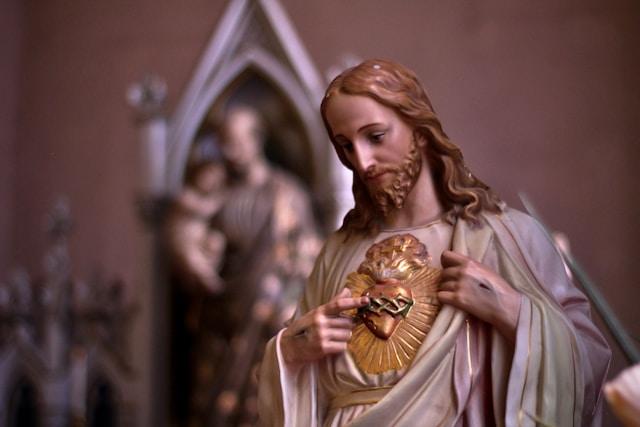
In one of the most significant moments, on December 27, 1673, she described a mystical “exchange of hearts” with Jesus. He asked that the faithful honor His Sacred Heart, particularly by receiving Holy Communion on the first Friday of each month in reparation for sins.
Opposition, Validation, and Rapid Expansion
Margaret Mary’s experiences were initially met with suspicion. Some within her community believed her visions to be deceptive or even diabolical. This opposition might have suppressed the devotion were it not for the arrival of Saint Claude de la Colombière.
A Jesuit priest of remarkable virtue, Claude became her confessor and recognized the authenticity of her experiences. His support proved decisive. Through him and the wider Jesuit Order, the devotion began to spread widely, gaining credibility and adherents.
In 1675, Christ appeared once more, requesting the establishment of a feast dedicated to His Sacred Heart, specifically for reparation. This request would eventually be fulfilled when Pope Pius IX, in 1856, extended the feast to the entire Church, fixing it on the first Friday after the octave of Corpus Christi—a practice that continues today.
The Appeal to Louis XIV: Majesty, Power, and Refusal
Among the most striking elements of Margaret Mary’s revelations was a message directed to King Louis XIV of France, a ruler whose stature embodied the height of absolute monarchy.
Known as the “Sun King,” Louis XIV reigned from 1643 to 1715 and was admired for his “virile and majestic beauty,” noble bearing, and carefully curated appearance. His intelligence was described as clear, methodical, and balanced, while his will was so forceful that it overcame nearly all obstacles. These qualities made him one of the most powerful and influential monarchs of his era.
However, his greatness was accompanied by significant moral failings. He was criticized for sins of pride and lust and for political decisions that scandalized many, including an alliance with Muslim powers against the Holy Roman Empire. Despite these faults, he also rendered notable services to the Church, among them the revocation of the Edict of Nantes, which had granted extensive freedoms to Protestants.
In 1689, Christ, appearing to Margaret Mary, made a profound request: the king was to consecrate France to the Sacred Heart and have its image placed on the royal standards. This act was not intended as a mere symbolic gesture but as a sincere and transformative consecration requiring repentance and moral renewal.
Remarkably, the message addressed Louis XIV with great respect. Despite his failings, Christ referred to him as the “beloved son of my Heart,” demonstrating what has been described as the “infinitely respectful Heart of Jesus.” There was no public reproach of his sins, only a call to conversion and fidelity.
The message was transmitted to the king through intermediaries connected to the saint. Yet Louis XIV did not respond. The consecration was never carried out.
This refusal had profound consequences. By turning away from what was seen as a providential source of grace, the kingdom continued along a path of moral decline and irreligion. This trajectory culminated in the French Revolution, which overthrew the monarchy and unleashed a broader spirit of rebellion.
A Devotion for Personal and Universal Renewal
Beyond historical episodes, the devotion to the Sacred Heart has been presented as a path to individual holiness and societal healing. Saint Margaret Mary herself taught that consecration to the Divine Heart is the surest and shortest path to spiritual perfection and happiness.
It invites believers into an intimate relationship with Christ, encouraging love, gratitude, and fidelity. At the same time, it addresses humanity collectively, offering a remedy to selfishness, indifference, and moral confusion.
Through contemplation of Christ’s suffering—the Agony in the Garden, the Cross, and the Eucharist—the devotion seeks to remind the world of a love that is both infinite and ever-present. In this Heart, it is said, doubts become certainty, anxiety turns to peace, and sorrow to joy.
Death, Recognition, and Enduring Legacy
Saint Margaret Mary died on October 17, 1690, after receiving the sacraments and pronouncing a final appeal for divine mercy. Her canonization came much later, in 1920, delayed by theological opposition and historical upheaval.
She has since been regarded as a figure closely united to the Virgin Mary, chosen as a channel through which Christ revealed His Heart to humanity.
Today, devotion to the Sacred Heart remains a central element of Catholic life. It is not merely a practice of piety but a comprehensive spiritual vision—one that calls individuals and nations alike to rediscover divine love and respond with faithfulness.
At its core lies a simple yet profound message: a Heart that has loved humanity without measure continues to call it back, offering mercy, reconciliation, and hope.
- Raju Hasmukh with files from Gaudiumpress.org