























Faith leaders in Chhattisgarh warn new anti-conversion law may target minorities, raising fears of misuse, legal challenges, and unrest.
Newsroom (17/04/2026 Gaudium Press ) Faith leaders across India’s central state of Chhattisgarh have expressed deep concern following the swift enactment of a new anti-conversion law, warning that the legislation could unsettle minority communities and open the door to misuse.
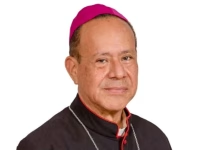
“Christians in the state are highly disturbed by the new law,” said Bishop Paul Toppo of Raigarh, articulating a sentiment echoed by several religious and civil society figures. He pointed to fears that the law could be exploited by vested interests, particularly those aligned with the ruling establishment.
The legislation, formally titled the Chhattisgarh Freedom of Religion Act, received gubernatorial assent on April 7 from Governor Ramen Deka, less than three weeks after it was passed by the State Assembly on March 19. The pace of its approval has itself become a point of contention.
“We did not expect the governor to sign the bill so soon. It was approved in an unusual haste,” Bishop Toppo told UCA News on April 17.
The new law replaces a 1968 statute enacted when the region was still part of Madhya Pradesh, prior to Chhattisgarh becoming a separate state in 2000. It introduces stricter regulatory measures and imposes harsher penalties for religious conversions deemed forced or fraudulent by authorities.
Growing Anxiety Among Minorities
Christian leaders, who represent less than two percent of Chhattisgarh’s nearly 30 million residents, say the implications of the law extend beyond its stated intent.
Bishop Toppo noted that awareness campaigns are already underway to educate Christian communities about the law’s provisions and potential consequences. Plans are also being developed to organize peaceful protest marches and to formally appeal to Chief Minister Vishnu Deo Sai, a member of the pro-Hindu Bharatiya Janata Party (BJP), to reconsider the legislation.
Concerns are not limited to Christian groups. Muhammad Sahib, a Muslim activist based in the state capital Raipur, warned that the law raises “serious concerns” and could signal “a hidden agenda to target and harass minority communities, particularly Christians and Muslims.”
Sunil Minj, a Christian activist and tribal leader from the state, highlighted what he described as the law’s most immediate threat: the potential criminalization of routine religious practices.
“Even regular prayer gatherings on Sundays and festival days could be branded as conversion activities,” Minj said.
Legal Challenges Loom
Opposition to anti-conversion laws is already being tested at the national level. India’s Supreme Court is currently hearing multiple petitions filed by Christian organizations, including the 107-year-old All India Catholic Union, challenging similar laws enacted in more than a dozen states—most governed by the BJP.
On February 2, the court acknowledged an additional petition and issued notices to both the federal government and the states involved, directing them to respond within four weeks. The court also indicated that a three-judge bench would hear the matter, underscoring its constitutional importance.
Minj confirmed that activists in Chhattisgarh are preparing to pursue legal recourse as well. “We plan to approach the Supreme Court of India,” he said.
Claims of Discrimination
In a statement released on April 8, the Progressive Christian Alliance—a network comprising pastors, church leaders, and social workers—described the new law as “unconstitutional and discriminatory.”
“This is not about protecting religious freedom,” the statement asserted, “but about systematically restricting and criminalizing the legitimate expression of minority faiths, particularly Christianity, in Chhattisgarh.”
As tensions mount, the law has become a focal point in the broader national debate over religious freedom, minority rights, and the balance between regulation and constitutional protections in India’s diverse society.
- Raju Hasmukh with files from UCA News
Related Images: