





















As World Cup excitement grips Mexico, families of more than 134,000 missing people and Catholic nuns demand attention to a national crisis.
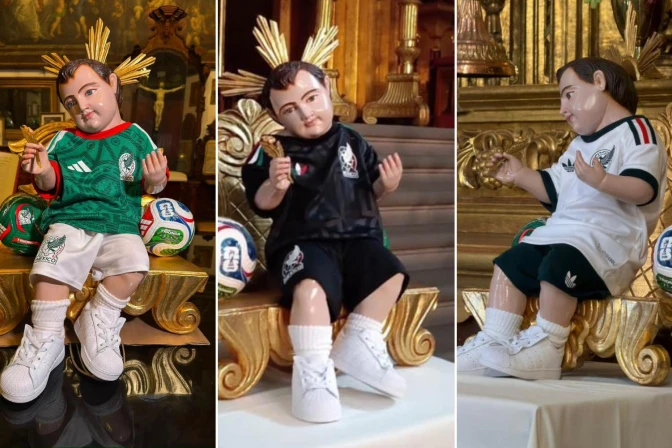
Newsroom (17/07/2026 Gaudium Press ) Mexico’s passion for soccer is woven deeply into the country’s cultural identity. During the World Cup, that enthusiasm becomes impossible to ignore. At Mexico City’s Metropolitan Cathedral, even the baby Jesus statue is dressed in a miniature national team jersey. Television broadcasts of matches echo from homes and businesses, while fans proudly display their support, sometimes extending the celebration to pets dressed in the green, white and red colors of the Mexican squad.
But as the country embraces World Cup excitement, families of Mexico’s more than 134,000 disappeared people are asking for the same level of national attention to be directed toward a far different cause: the search for missing loved ones.
Across the country, family members of the disappeared have intensified efforts to bring visibility to a crisis they fear is being overshadowed by the tournament. In that struggle, many have found support from Catholic religious sisters who provide practical assistance and emotional care while helping amplify calls for justice and action.
Faith Communities Stand With Searching Families
Several congregations of Catholic nuns, including Comboni Sisters, Franciscans, Carmelites, and the Apostolics of the Sacred Heart, have become key allies for families of the disappeared.
Their support extends far beyond advocacy. Sisters have offered food, lodging, companionship, guidance on filing missing persons reports, and emotional support to families enduring years of uncertainty. They have accompanied relatives as they participate in demonstrations and memorial events designed to draw attention away from World Cup celebrations and toward the ongoing crisis.
In Guadalajara, one of the host cities for the World Cup and Mexico’s second-largest metropolitan area, religious communities have joined families searching common graves and highlighting the stories of missing relatives. Some campaigns have incorporated soccer imagery, portraying disappeared loved ones in Mexico’s national team jersey to connect the country’s passion for soccer with the urgent demand for answers.
The contrast between celebration and tragedy has become particularly striking in Guadalajara. Months before the tournament, authorities reported the discovery of hundreds of bags containing human remains within a 10-mile radius of Akron Stadium, one of the World Cup venues.
A Different Question About Coming Home
Mexico, which has hosted the World Cup twice before, has promoted the tournament with the slogan, “The ball has come home.”
For families of the disappeared, however, a different question resonates.
“When will our loved ones come home?” asked Sr. María Dolores Ramírez Ramírez of the Carmelites of the Sacred Heart, whose ministry serves families affected by disappearances in Guadalajara.
Her question reflects the anguish experienced across Jalisco, the state widely considered the epicenter of Mexico’s disappearance crisis. More than 16,000 disappearances have been recorded there, making it one of the hardest-hit regions in the country.
Understanding the Crisis
The reasons behind disappearances are complex and varied.
Some cases are linked to drug cartels and organized criminal groups. Others involve migrants or young people who were recruited by criminal organizations and allegedly killed after refusing to join. Human trafficking is also believed to play a significant role.
According to religious leaders working closely with affected families, the crisis often disproportionately impacts vulnerable populations. Sr. Clara Malo Castrillón, provincial of Mexico’s Society of the Sacred Heart, said many of the disappeared come from poor communities, making it easier for society to overlook their cases.
Families frequently confront damaging assumptions about their missing relatives. Sr. Maria Refugio Chávez Valle of the Apostolics of the Heart of Jesus said relatives often encounter suggestions that a disappearance must somehow be connected to criminal activity.
Such attitudes deepen the suffering of families already grappling with uncertainty and loss.
The Mothers Who Search
Among the most visible faces of the movement are the madres buscadoras — “mothers who search.”
These women spend countless hours distributing flyers, investigating leads, participating in searches, and organizing public demonstrations in hopes of finding answers about their missing children.
During World Cup matches in Guadalajara, sisters have accompanied these mothers to Masses dedicated to the disappeared and supported them after peaceful protests outside soccer venues.
Chávez described witnessing their exhaustion after long days posting photographs and appeals across the city, hoping that among the crowds of tourists and soccer supporters, someone might recognize a face or provide a clue.
Their message has been direct and difficult to ignore.
On July 8, a banner displayed at the base of Mexico City’s iconic Angel of Independence declared: “The world sees us celebrating, [but more than] 134,000 Mexican families are still searching for their loved ones. And you? What are you doing to find them?”
Mourning Amid Celebration
For many families, the challenge is not opposition to soccer or the World Cup itself. Instead, they are asking society to acknowledge a painful reality that continues regardless of national festivities.
Rosa Rivera, a mother searching for two missing sons in Guadalajara, said it is difficult to express grief when the broader public is focused on celebration.
“It’s hard to tell others you’re in mourning when everyone wants to celebrate” the World Cup, she said.
Yet Rivera said she has found solace among fellow buscadoras and the religious sisters who accompany them. Shared experiences of loss and uncertainty have created a community of support that helps families endure a journey that often lasts years.
Church Leaders Add Their Voice
As Mexico’s national team advanced to the tournament’s round of 16 and public excitement intensified, the country’s bishops issued a statement recognizing the suffering of families of the disappeared.
“We are well aware of the efforts made by the madres buscadoras to bring to light — during the World Cup events — a wound that bleeds within our people: their missing children,” the bishops wrote on June 25.
The statement emphasized that national celebrations and national sorrows coexist, and that the suffering of families searching for loved ones should not be forgotten amid sporting triumphs.
Seeking a Different Kind of Victory
As the World Cup concludes on July 19, supporters of the disappeared hope the attention generated during the tournament will leave a lasting impact.
Families, activists, and religious sisters are calling for greater commitment from both government authorities and ordinary citizens to prioritize the search for missing people and address the conditions that allow disappearances to continue.
For Sr. Ramírez and many others, the ultimate measure of national success extends far beyond achievements on the soccer field.
“Families of the disappeared say it’s easy to organize something like the World Cup,” she said. “But the real victory will be to have their children come home.”
- Raju Hasmukh with files from UCA News and Global Catholic
Related Images: