






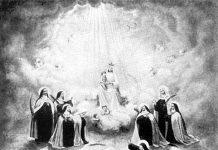














The Church honors the Carmelite Martyrs of Compiègne, 16 nuns executed in 1794 and later canonized for their witness of faith.
Newsroom (17/07/2026 Gaudium Press ) Today, the Church celebrates the feast of the Carmelite Martyrs of Compiègne, the sixteen Discalced Carmelite nuns executed during the French Revolution on July 17, 1794. Their steadfast fidelity to their religious vocation in the face of persecution has made them enduring symbols of courage, faith, and religious conviction.
For more than a century, the Carmelites of Compiègne have occupied a unique place in Catholic memory. Their story, marked by political upheaval, religious suppression, and ultimate martyrdom, has inspired generations of believers as well as artists, writers, and musicians. Their witness remains one of the most striking examples of Christian perseverance during the violence of the French Revolution.
Religious Persecution During the French Revolution
The martyrdom of the Carmelite nuns unfolded against the backdrop of the French Revolution, a period that saw revolutionary authorities suppress religious communities and confiscate Church property. Monasteries and convents were dissolved, and members of religious orders were compelled to abandon communal religious life.
The Carmelites of Compiègne, however, continued to live their faith despite the restrictions imposed upon them. Although deprived of their convent and forbidden from maintaining their religious community, they secretly remained faithful to their consecration and continued to renew their commitment to God.
Their refusal to abandon their vocation ultimately brought them under suspicion. In June 1794, they were arrested and accused of “fanaticism,” a charge commonly used during the Revolution against those whose religious convictions were perceived as opposition to revolutionary ideals.
Trial and Condemnation
The nuns were subjected to what has often been described as a sham trial. Their principal offense was not a political conspiracy or violent action, but their determination to remain faithful to their religious calling.
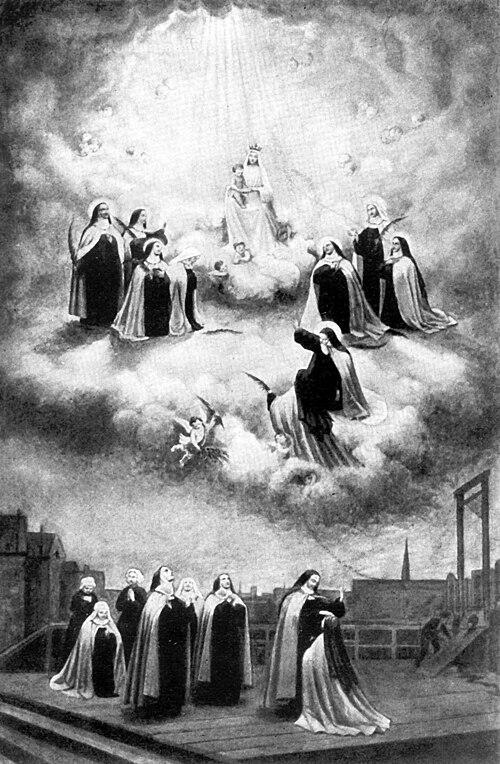
Condemned to death, the sixteen sisters were sentenced to the guillotine and transported through Paris to the Place de la Révolution, where countless victims of the Reign of Terror had already met their end.
Their final journey would become one of the most memorable episodes of Christian martyrdom in modern history.
A Procession of Faith to the Scaffold
Accounts of the execution describe an extraordinary atmosphere of serenity and prayer.
According to historian Mary G. Santa Eulalia, the sisters rode to their execution while singing sacred hymns. As crowds watched, some mocking and others admiring, the Carmelites remained focused on prayer rather than the hostility surrounding them.
They sang the Miserere and the Salve Regina. Upon reaching the foot of the guillotine, they intoned the Te Deum, a hymn of thanksgiving, followed by the Veni Creator Spiritus. Before their deaths, they renewed both their baptismal promises and their religious vows.
One of the most moving moments involved the young novice Sister Constance. Kneeling before the prioress, Mother Teresa of Saint Augustine, she requested a final blessing and permission to die, just as she would have sought permission for any act within convent life. She then ascended the scaffold while singing Laudate Dominum omnes gentes.
One by one, the remaining sisters followed the same ritual. Each received the blessing of the prioress before approaching the guillotine. After witnessing the deaths of all her spiritual daughters, Mother Teresa of Saint Augustine herself stepped forward and surrendered her life, placing her head into the hands of the executioner.
The executions took place on the afternoon of July 17, 1794.
Enduring Legacy in Literature and the Arts
The dramatic final hours of the Carmelites have inspired numerous artistic works. Their story became widely known through literary, theatrical, and musical adaptations, most notably Dialogues of the Carmelites by French composer Francis Poulenc.
The work, later adapted for film, portrays the spiritual struggle, courage, and ultimate sacrifice of the sisters. The image of the nuns singing as they approach the guillotine has become one of the most powerful scenes in modern religious drama.
Through these artistic interpretations, the witness of the Carmelite martyrs has reached audiences far beyond the Church.
Beatification and Recognition as Martyrs
The Church formally recognized the Carmelites of Compiègne as martyrs who died in odium fidei—out of hatred for the faith.
Pope Pius X beatified them on May 27, 1906, acknowledging that their deaths resulted directly from religious persecution. Their beatification ensured that their memory would be preserved within the Church’s liturgical and devotional life.
For decades they were honored as Blessed Teresa of Saint Augustine and Companions, remembered especially by Carmelite communities and those devoted to the history of Christian martyrdom.
Canonization Through an Extraordinary Process
In a significant development, Pope Francis authorized the direct inscription of Blessed Teresa of Saint Augustine and her fifteen companions into the catalogue of saints through a process known as equipollent, or equivalent, canonization.
The decision was included among new decrees promulgated by the Dicastery for the Causes of Saints on December 18. Through this act, the Pope recognized the longstanding and continuous veneration of the martyrs by the faithful.
Equivalent canonization differs from the ordinary canonization process. Rather than requiring the full procedural pathway normally followed for sainthood causes, the Pope formally recognizes and extends universal public veneration to individuals whose holiness and devotion have already been firmly established over time within the life of the Church.
A Witness That Continues to Resonate
More than two centuries after their deaths, the Carmelite Martyrs of Compiègne continue to embody a profound testimony of fidelity under persecution. Their final moments, marked by prayer, mutual encouragement, and unwavering trust in God, have become a lasting symbol of spiritual courage.
As the Church celebrates their feast on July 17, the sixteen Carmelite nuns remain remembered not only for the manner of their deaths but also for their determination to remain faithful to their vocation when that fidelity carried the ultimate cost. Their story stands as one of the most remarkable accounts of martyrdom from the era of the French Revolution and continues to inspire believers around the world.
- Raju Hamukh with files from Infocatholica
Related Images: