





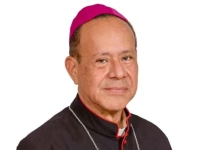




Archbishop Ettore Balestrero denounces prenatal discrimination and calls for full dignity and rights for people with Down syndrome.
Newsroom (24/03/2026 Gaudium Press ) In a strong moral appeal delivered in Geneva, Archbishop Ettore Balestrero, Permanent Observer of the Holy See to the United Nations and Other International Organisations, urged an end to what he described as “deeply discriminatory practices” targeting babies diagnosed with Down syndrome. His remarks came at an event held by the Jérôme Lejeune Foundation, a French organisation known for its research and advocacy on genetic intellectual disabilities.
Addressing an audience of diplomats, medical specialists, and bioethicists, Archbishop Balestrero called for an unwavering commitment to what he termed the “inherent dignity, fundamental rights, and transcendent value of all persons at every stage of life.” He emphasised that individuals with Down syndrome “are more than a diagnosis, more than a condition, and certainly more than the limits others may imagine,” asserting that each person bears “the same sacred value, intentionally and lovingly imprinted by the Creator from the very first moment of conception.”
Condemnation of “Eugenic” Practices
Archbishop Balestrero expressed deep concern over the growing prevalence of prenatal screening practices that, in many countries, have led to steep declines in births of babies with Down syndrome. He criticised what he called “eugenic practices linked to prenatal screening” and the “selective termination of pregnancies,” saying such actions must be “firmly rejected.”
His comments reflect a broader apprehension among faith and disability rights groups about the social and ethical consequences of widespread non-invasive prenatal testing (NIPT), introduced in 2011. Once seen as a medical advance, the testing’s adoption has led to a dramatic rise in the number of pregnancies terminated following a Down syndrome diagnosis.
A Troubling Global Trend
The archbishop’s intervention comes amid growing international concern about declining birth rates of children with Down syndrome. In Nordic countries such as Iceland and Denmark, where prenatal screening is routinely offered to all expectant mothers, reports suggest that almost no children with the condition are born.
Icelandic geneticist Kári Stefánsson observed that his country had “basically eradicated, almost, Down syndrome from our society.” The grim statistics have prompted the United Nations to urge Iceland to “take immediate and effective steps to combat discrimination against persons with disabilities” and to strengthen awareness campaigns affirming the rights and dignity of all individuals, regardless of genetic condition.
The data reveal a similar pattern in the United Kingdom, where prenatal testing has been widely available since 2012. Between 2011 and 2015, the number of babies born with Down syndrome declined by more than half—falling 54 percent. Britain’s abortion law, which permits termination up until birth in cases of fetal disability, has been repeatedly criticised by activists as inherently discriminatory.
Disability Advocates Welcome Vatican Statement
In the wake of Archbishop Balestrero’s remarks, advocacy groups welcomed renewed Vatican engagement on the issue. Lynn Murray, spokesperson for Don’t Screen Us Out, a UK-based campaign representing people with Down syndrome and their families, praised the archbishop’s comments as “a welcome intervention.”
“This is a welcome intervention on this issue,” Murray said. “Our current law that allows abortion up to birth if a baby has a disability including Down’s syndrome is deeply discriminatory.” She cited official statistics showing that in England and Wales, approximately 90 percent of babies diagnosed with Down syndrome are aborted.
“We rightly recognise that discrimination against people with Down’s syndrome is unacceptable after birth, but our abortion law allows direct discrimination before birth,” she said. “People with Down’s syndrome are not defined by a diagnosis. They are loved, valued, and cherished members of our families and communities, and their lives are of equal worth.”
A Call for Legal and Cultural Reform
Murray also shared her personal perspective as a mother of a daughter with Down syndrome, describing the “unique joy” her child brings. “This law sends a message that some lives are less worthy of protection than others,” she said. “It is discrimination, and it is a message we should firmly reject.”
Both the Holy See and advocacy groups argue that societies must move beyond medicalised or utilitarian frameworks when discussing disability and prenatal diagnosis. Archbishop Balestrero’s call serves as a challenge to re-examine the ethical boundaries of reproductive choice and equality itself.
“We also hear time and again from parents who say that, after receiving a diagnosis, abortion was repeatedly presented to them as the solution,” Murray added. “Families deserve better than that. If we are serious about equality, dignity, and inclusion, our laws should reflect those values too.”
The archbishop’s words, grounded in Catholic teaching on the sanctity of life, echoed far beyond the diplomatic halls of Geneva. For those listening, his message was clear: societies that claim to uphold equality cannot turn a blind eye to discrimination before birth.
- Raju Hasmukh with files from Catholic Herald
Related Images: