







New Custos of the Holy Land Francesco Ielpo urges Jerusalem to resist hatred, amid war, shuttered shrines, settler violence and Lebanon’s displacement crisis.
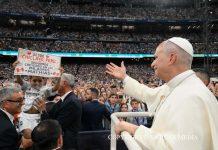
Newsroom (24/03/2026 Gaudium Press ) On the eve of an Easter overshadowed by regional war, shuttered shrines and empty pilgrimage routes, the new Custos of the Holy Land, Friar Francesco Ielpo, insists that Jerusalem must remain a voice for those who refuse to “surrender to the logic of violence, revenge or hatred.” From Gaza to southern Lebanon, from the West Bank to Iran, he sees a land where “no single area is spared from violence, injustice and pain,” yet still scattered with “points of light” in men and women who reject vengeance. For him, prayer, concrete solidarity and the stubborn decision to stay are the thin, fragile line holding back despair.
Easter under closed skies
For the Custos, this year’s Easter feels less like a passage from death to life and more like “a perpetuation of Good Friday, of the Passion.” The Holy Land is “living in a time of war, therefore suffering,” he says, with the spiritual climate “marked by uncertainty about the future” and a pervasive “weariness.” Holy places that usually throb with pilgrims are now closed or heavily restricted, after the February 28 strikes by Israel and the United States on Iran triggered new security measures and cancellations of long‑planned celebrations. In the days leading to the holiest feast of the Christian year, the very geography of redemption—Gethsemane, Calvary, the Holy Sepulchre—is difficult or impossible to access for the local faithful.
The consequences reach far beyond liturgical logistics. Since late February, schools have been closed and pushed into distance learning, a solution that exposes the inequalities of a society already battered by years of conflict and the Covid‑19 pandemic. Not every family can afford devices, adequate internet or the space to support multiple children online, and the strain falls hardest on those who were only just recovering from earlier crises. For many Christians whose livelihoods depend on religious tourism, the fragile economic rebound has stalled; what once seemed like “timid signs of recovery” now “loom a return to the abyss.” For the Custos, the deepest wound may be invisible: “It’s hard to imagine a future,” he admits, describing the psychological toll of restrictions, frustration and the inability to fully live the rites that anchor identity and hope.
A new Custos, an old cross
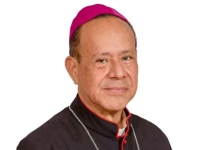
On June 24, Pope Leo confirmed the election of Francesco Ielpo, a 55‑year‑old priest born in the province of Potenza on May 18, 1970, as Custos of the Holy Land and Guardian of Mount Zion. Ordained in 2000, he has long moved between classroom and governance: he taught religion, served as Provincial Definitor of the Lombardy Province from 2007 to 2010, joined the Board of Directors of the Pro Terra Sancta Association in 2014, and since 2022 has presided over the Holy Land Foundation. In taking up the role, he succeeds Brother Francesco Patton, who concluded a nine‑year mission at the head of the Custody.
Ielpo assumes office at one of the most volatile moments in the region’s recent history. He insists that “the consequences of this latest conflict affect everyone,” not only combatants or any single people. Yet, he notes, Christians “maintain a great desire for hope, which is nourished by faith” and by “not feeling abandoned by Christians around the world.” The image he returns to is that of a shared Via Crucis: this war, he says, has become “this latest cross” that the small Christian communities of the Holy Land cannot carry alone. They need believers elsewhere to know, to pray and to stand close.
“Living stones” under strain
Local Christians are often described as the “living stones” of the Holy Land—a human counterpart to the stones of churches and shrines. In Ielpo’s telling, these communities still harbor “a great desire to remain in their land, to be able to live in peace, and raise their children in a serene environment.” The desire to stay is not romantic but costly, especially as war generates “truly intense tension” and corrodes any sense of normal family life. Parents who want only stability and dignity find themselves explaining sirens, closures and uncertainty to children who have never known anything else.
The war’s impact is layered. Economically, Christian families face the collapse of tourism‑dependent jobs as pilgrim flows evaporate again, after years in which Gaza’s cycles of violence and the pandemic had already hollowed out incomes. Socially, the closures erode community participation; gatherings that once offered mutual support are curtailed, leaving isolation and anxiety in their wake. Spiritually, the inability to attend liturgies freely, especially at Easter, is more than an inconvenience: it is “a source of fatigue, frustration, and discouragement,” a steady drip that can hollow out resilience over time. Behind Ielpo’s careful words is a blunt reality: when people cannot pray together, educate their children or work with dignity, their attachment to place is severely tested.
Small signs in Bethlehem and beyond
Even in this context, the Custody continues to invest in education and youth. “For the Custody of the Holy Land, education certainly remains a priority, in addition to remaining close to the faithful,” Ielpo stresses. On March 22 he travelled to Bethlehem for the inauguration of a new gymnasium, a sports and recreational center for the city’s youth. In a landscape of closures, the opening of a gym might sound minor, but he calls such initiatives “small signs that serve to restore hope,” precisely because they create spaces of encounter where young people and families can meet beyond the confines of fear.
These seemingly modest projects carry a deeper strategic vision. Schools and youth centers are not only educational; they are one of the few remaining engines of social cohesion in communities fragmented by checkpoints, economic precarity and political polarization. By keeping doors open to children of different backgrounds, the Custody tries to model a future in which coexistence is learnt on playgrounds and in classrooms, long before formal dialogue at the political level. In Ielpo’s view, the Church in the Holy Land is called not just to preserve sanctuaries but to be “a voice of hope” rooted in daily life.
Jerusalem’s prophetic voice
Asked where he sees the “prophetic” dimension of Jerusalem today, the Custos answers with stories rather than abstract theology. “The prophecy remains true, concrete, because in all this darkness there continue to be points of light, men and women who do not surrender to the logic of violence, revenge, or hatred,” he says. One such light shines from Gaza, where he recalls the testimony of Christians visited by Latin Patriarch Pierbattista Pizzaballa: despite the devastation, they insist, “there is no poison, no hatred in our blood.” In the midst of siege and grief, they refuse to allow resentment to define them.
Another example he highlights is “Parents’ Circle,” which brings together Palestinian and Israeli families who have lost relatives in the conflict yet choose reconciliation over revenge. For Ielpo, such initiatives are “a prophetic source of hope” precisely because they emerge from people who have every reason to hate yet decide not to. Men and women “who continue not to give up, who don’t stop at the logic of evil, who don’t fall into the trap of hatred, resentment, bloodshed,” become living parables of the Jerusalem he believes in. In a city where political statements often drown out quiet gestures, these choices of conscience keep the Gospel’s voice audible.
Settler violence and a “silent” West Bank
If there is a note of anger in the Custos’s voice, it surfaces when he speaks of the West Bank. Alongside the conflicts with Iran and in Gaza and Lebanon, he singles out the “spiral of settler violence” that is intensifying, including attacks that target Christians, as in the village of Taybeh. “This is currently one of the situations that most worries me,” he says, denouncing “truly serious acts against people, not just Christians, who simply want to live in peace in their own land and with their own work.” What shocks him is not only the violence itself but “the silence surrounding the violence that is being perpetuated in an increasingly violent and gratuitous manner.”
The West Bank he describes is a place where fear has become routine, where families who want nothing more than to cultivate their fields, run small businesses or attend church live under the shadow of impunity. The lack of visibility for these attacks deepens the wound, convincing many that their suffering is of no interest to the outside world. By speaking plainly, Ielpo tries to pierce that silence, insisting that Jerusalem’s prophetic vocation includes naming injustice wherever it occurs, even when it is politically inconvenient. To ignore this, he suggests, is to risk turning religious language about peace into empty ritual.
Southern Lebanon’s displaced and a Church on the move
Just before the interview, the Custos returned from a brief but searing trip to southern Lebanon, where he visited communities on the border and saw the human cost of escalating violence. If he looks for a “positive aspect” there, it is in the speed and generosity of the local Church’s response. “It’s truly beautiful to see the Christian community, the various Catholic rites, working to respond to this emergency,” he notes, describing how parishes and institutions have mobilized to shelter and assist those fleeing bombardments.
Yet the scale of displacement is staggering. He speaks of “hundreds of thousands of displaced people living in cities and villages” and nearly 600 shelters activated, even as “many people still don’t have access, while the bombing continues.” The image is one of a saturated safety net: schools turned into dormitories, churches into distribution points, all under skies that cannot be trusted. For Ielpo, Lebanon’s crisis is not separate from the Holy Land’s; it is part of the same regional vortex in which civilians are uprooted faster than humanitarian structures can adapt. The Church’s response, he suggests, must be equally border‑crossing.
Fragile dialogue and grassroots encounters
When asked how the war has affected interreligious relations among Jews, Christians and Muslims, Ielpo hesitates, calling the question “sensitive” and admitting that it is “difficult to answer.” His reluctance suggests the fragility of formal dialogue at a time when each community feels injured and defensive. High‑profile encounters and joint declarations can easily be derailed by new violence or misread by traumatized populations as betrayal.
Instead, he returns to the long, patient work “from a lower level, from individuals, from the grassroots.” In his view, genuine coexistence does not begin at conference tables but in neighborhoods, schools and workplaces where people of different faiths continue to meet, even if only to solve practical problems. The Parents’ Circle is one such grassroots space; the new gym in Bethlehem is another. Each small project or encounter, he suggests, can be a seed of mutual recognition in soil often poisoned by fear.
A collection that keeps presence alive
In this landscape of need, the annual Good Friday collection for the Holy Land takes on heightened significance. For Ielpo, it is more than an envelope passed along parish pews; it is “a gesture that involves all Christians worldwide and becomes a concrete expression of solidarity.” The funds, he explains, support not only the Custody but “the entire Church of the Holy Land” in its pastoral and social outreach. Parishes, schools, charitable organizations, health centers, and the maintenance of shrines all depend on the solidarity expressed in this single day’s giving.
Behind the institutions are thousands of families whose livelihoods are directly tied to the Church’s work. Thanks to the collection, the Custody can continue providing “a living wage to thousands of families who work for the Church and the Custody,” he says, calling this “essential because it represents a concrete form of support.” In a region where jobs evaporate with each new escalation, the stability of Church employment can mean the difference between staying and emigrating. To contribute, therefore, is not only to preserve stones and memories, but to help ensure that the “living stones” do not disappear.
Prayer as resistance to despair
Through every answer, the Custos threads one insistence: prayer is not a pious afterthought but an “essential” path to a peace that “comes from above.” He acknowledges the sense of impotence many feel when faced with images of bombed neighborhoods, displaced families and seemingly endless cycles of retaliation. “Because, faced with all this evil, the question that always arises spontaneously is: ‘What can we do?’” he says. Often, people “don’t have the tools” or “don’t know what to do,” and activism alone can feel inadequate.
Prayer, in his understanding, “always reminds us who is the true guide of history” and, even when its effects are not immediately visible, “helps change hearts.” The logic is both spiritual and historical: “When people’s hearts change, history changes too, over time.” For Ielpo, to kneel in the dark before the crucified and risen Christ is to refuse the fatalism that says hatred is inevitable. His appeal to Christians worldwide is stark and simple: do not abandon the Holy Land, but “bear this latest cross together”—through intercession, material support, and a shared refusal to let vengeance have the last word
- Raju Hasmukh with files from Asianews.it
Related Images: