











A fresco restoration in a historic Roman church stirs debate after an angel’s face draws uncanny resemblance to Italy’s Prime Minister Giorgia Meloni.
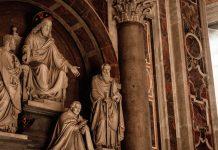
Newsroom (04/02/2026 Gaudium Press ) A newly restored fresco inside one of Rome’s oldest churches has ignited an unexpected national conversation—blurring the fine line between sacred art, politics, and pop culture. At the Church of San Lorenzo in Lucina, just steps away from the Spanish consulate and a short walk from the Italian Parliament, an angel’s face has become the city’s latest sensation for resembling none other than Italian Prime Minister Giorgia Meloni.
The angel, one of two flanking a marble bust of Umberto II—the last King of Italy—holds a scroll bearing the map of the nation. Beneath it, the inscription reads solemnly, “Christianly resigned to the divine will.” Yet, the fresco’s divine calm has been overshadowed by a very earthly debate.
From Restoration to Viral Sensation
The fresco’s recent restoration was intended to revive a painting completed in 2000 as part of a funerary monument installed fifteen years earlier. Time and wear had dulled its colors, prompting the church’s octogenarian sacristan, Bruno Valentinetti, to bring it back to life with brushes and faith.
Valentinetti, an 83-year-old self-taught painter, told Italian media he never meant to evoke Meloni’s likeness. “It’s pure coincidence,” he insisted, denying any political intent. Despite his explanations, the similarity was undeniable to visitors—and soon the angel’s face was circulating across social networks, spawning a flurry of memes that swapped medieval sainthood for modern satire.
Prime Minister Meloni herself responded with characteristic irony. On Instagram, she posted a short message accompanied by a smiling emoji: “No, I certainly don’t look like an angel.”
View this post on Instagram
Her lighthearted comment only amplified the story’s reach. The Church of San Lorenzo in Lucina, a 4th-century structure rich in Roman Baroque heritage, suddenly found itself transformed into a mini tourist attraction. Curious visitors poured in, many more interested in snapping photos than lighting candles.
The Church Reacts
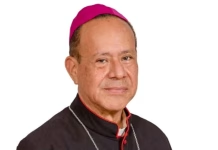
At first, the controversy seemed benign. Parish priest Daniele Micheletti admitted he could see the resemblance but urged calm. However, the atmosphere quickly changed after Cardinal Baldassare Reina, vicar of the Diocese of Rome, issued a formal statement expressing “deep sorrow” over the incident.
In his declaration, he reaffirmed the Church’s stance on the sanctity of sacred art: “It is firmly reiterated that images of sacred art and Christian tradition cannot be subject to improper use or instrumentalization, as they are intended exclusively to sustain liturgical life and personal and communal prayer.” His swift intervention underscored how swiftly such cultural curiosities can turn into ecclesiastical matters of principle.
A Face Painted Over
By Tuesday night, the controversy had reached its quiet resolution. For the hundreds who came daily just to see the “Meloni angel,” there was disappointment: Valentinetti, the restorer, had painted over the face entirely with a layer of white paint.
According to Father Micheletti, the decision came reluctantly. “There was a constant stream of people entering just to see it—not to pray or attend Mass. It was no longer possible to continue like this,” he explained.
The angel, now faceless once again, returns the chapel to its original serenity. Yet for Rome’s art world and political observers, the episode remains a telling modern fable—where the restoration of a 21st-century fresco became a mirror reflecting Italy’s blend of reverence, irony, and spectacle.
- Raju Hasmukh with files from ACI Prensa
Related Images: