






After meeting St. John Paul II and Mother Teresa, Father Vijay Kiran is creating a museum and library in Bangalore to inspire faith.
Newsroom (17/07/2026 Gaudium Press ) Father Vijay Kiran wears two lapel pins on his clerical jacket, one bearing the image of St. John Paul II and the other of St. Teresa of Kolkata. For the Indian-born priest, they are more than symbolic tributes. They represent personal relationships with two of the most revered Catholic figures of the modern era, encounters that have shaped his vocation and inspired an ambitious project he hopes will leave a lasting spiritual legacy.
As he prepares to retire from active ministry in July and return to his hometown of Bangalore, Father Kiran is focused on a mission years in the making: establishing a museum dedicated to the Blessed Virgin Mary, St. John Paul II and Mother Teresa. The museum will showcase an extensive collection of religious and cultural artifacts gathered over the past decade from around the world.
For Father Kiran, the collection is far more than memorabilia. It is a testament to faith, memory and the enduring influence of two saints whose examples continue to guide his life.
A Personal Connection to Future Saints
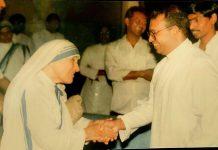
While many Catholics would consider themselves fortunate to have seen a future saint in person, Father Kiran had the rare opportunity to interact repeatedly with both St. John Paul II and Mother Teresa during his formative years in India.
Ordained for the Archdiocese of Madras and Mylapore on July 23, 1986, Father Kiran’s association with the future pope-saint began even before his priesthood. As a deacon, he served as one of two organizing secretaries for Pope John Paul II’s visit to Madras on Feb. 5, 1986.
Photographs preserved in his collection capture the young deacon walking alongside the pope while carrying a 35mm camera. Later that day, the group traveled to a hilltop traditionally recognized as the site where St. Thomas the Apostle was martyred after bringing Christianity to India.
Father Kiran recalls the visit as a significant moment not only for Catholics but also for religious freedom in India. During the trip, Pope John Paul II spoke about the importance of religious liberty and the right of all people to profess and share their faith, a message delivered in a nation where Christians remain a small minority.
Witnessing Service and Humility
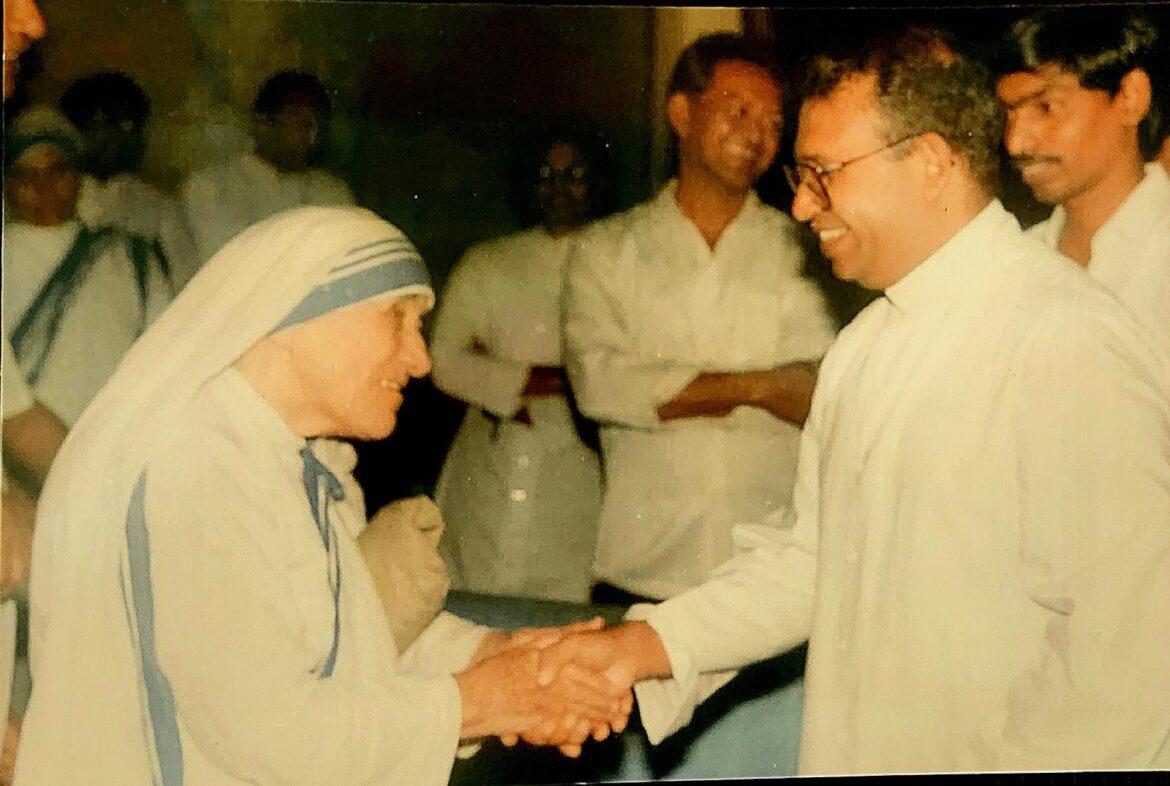
Father Kiran’s memories of Mother Teresa are equally vivid. Over several encounters, he came to know the missionary whose work among the poor, sick and dying in Calcutta earned her worldwide admiration and the title “Saint of the Gutters.”
“She was a very simple person, always concerned about the poor and the needy,” he recalled.
One exchange particularly stayed with him. On multiple occasions, Father Kiran asked Mother Teresa for her blessing. Each time, she declined.
Instead, she would bow and remind him of the dignity of his priesthood.
“You are a priest, you must bless me,” she would tell him. “You have consecrated hands; you will have to bless me.”
The gesture reflected the humility that became one of Mother Teresa’s defining characteristics and left a profound impression on the young priest.
Building a Collection With Personal Sacrifice
Over the past decade, Father Kiran has dedicated himself to preserving the memory and legacy of the two saints. The result is a vast collection that includes stamp and coin sets, books, photographs, paintings, statues and even a relic of St. Teresa displayed within a monstrance.
During his years serving in the United States, including ministry assignments in Rhode Island, he steadily expanded the collection. While residing at Blessed Sacrament Church in Providence and serving as a full-time hospital chaplain, he carefully cataloged and arranged hundreds of artifacts.
The project has been funded entirely through his own earnings as a priest.
“Everything I have earned as a priest is gone,” he said.
Yet Father Kiran remains convinced the investment has been worthwhile. He believes the collection can communicate faith in ways that words alone often cannot.
As items are acquired, they are packed into large shipping boxes and sent by container ship to India, a process that can take months. Many of the artifacts are already waiting in storage for the museum’s opening.
A Museum and Library for Future Generations
The museum will be located in a modest 2,000-square-foot building next to his brother’s home in Bangalore. His brother, supported by their mother, purchased the property through a loan to help make the project possible.
Beyond the museum exhibits, Father Kiran is creating a substantial research library intended for seminarians and women religious. Bangalore is home to two major Catholic seminaries, dozens of religious formation houses for men and more than 120 congregations of sisters.
To support those studying the lives and teachings of the saints, Father Kiran has already assembled an impressive collection of books.
“So far I have collected 1,250 books on Saint John Paul II and more than 550 books on Mother Teresa,” he said.
The enthusiasm generated by a preview exhibition has reinforced his conviction that the museum will serve an important purpose. During a visit to Bangalore last year, he organized a temporary display featuring statues of the Blessed Virgin Mary and educational materials explaining their significance. Long lines of schoolchildren and visitors attended the exhibition, offering evidence of public interest in the larger project.
A Silent Witness to Faith
Father Kiran sees the museum as more than a historical or cultural institution. He views it as a response to contemporary challenges facing Christians in India.
With anti-conversion legislation enacted in several states and restrictions surrounding religious conversion, he believes traditional evangelization has become increasingly difficult.
“In India today we cannot directly evangelize. We cannot preach anymore, officially,” he said.
Under current requirements, individuals seeking to become Christian must formally declare their decision before civil authorities.
For Father Kiran, the museum offers another path.
“My museum, and this little library, will be a silent evangelization,” he explained. “People can come there to talk, visit and pray.”
He estimates that approximately $56,000 is still needed to complete the museum and prepare it for visitors. Donors who help bring the project to fruition will be recognized on a commemorative plaque.
As retirement approaches, Father Kiran is preparing to return home with a lifetime of memories and a collection built through personal sacrifice. Inspired by his experiences with St. John Paul II and Mother Teresa, he hopes the museum will serve as a quiet but enduring witness to faith, preserving the legacy of two saints whose lives transformed millions and whose influence continues to shape his own.
- Raju Hasmukh with files from OSV News
Related Images: