











A detailed account of the largely forgotten 1982 assassination attempt on Pope John Paul II at the Fatima sanctuary in Portugal.
Newsroom (13/05/2026 Gaudium Press ) Just hours before the anniversary of the 1981 assassination attempt in St. Peter’s Square, Pope Saint John Paul II faced another threat to his life—this time far from Rome, at one of Catholicism’s most revered pilgrimage sites.
On the night of May 12, 1982, during a visit to the Sanctuary of Our Lady of Fatima in Portugal, the pontiff was targeted in a second assassination attempt. Unlike the widely known shooting by Mehmet Ali Agca a year earlier, this incident remained largely concealed from public knowledge for years.
A Pilgrimage of Gratitude Turned Dangerous
John Paul II’s journey to Fatima from May 12 to 15, 1982, was deeply personal. According to Cardinal Stanislaw Dziwisz—his longtime secretary and collaborator—the pope had insisted on making the pilgrimage to commemorate his survival of the 1981 attack.
“He wanted to thank [Mary] for saving his life,” Dziwisz recalled in the documentary Testimony. As a symbol of this gratitude, the pope brought the bullet that had wounded him to Fatima, where it was later placed in the crown of the Virgin Mary.
The visit, intended as a moment of spiritual thanksgiving, would instead become the backdrop for another violent episode.
The Attacker: Juan Fernández Krohn
The assailant was Juan Fernández Krohn, a 32-year-old Spanish priest at the time. Ordained three years earlier by Bishop Marcel Lefebvre—founder of the Society of Saint Pius X—Krohn was associated with a traditionalist movement that rejected the reforms of the Second Vatican Council and would eventually enter into schism with the Catholic Church in 1988.
Krohn had traveled from Paris to Fatima with a singular purpose: to kill the pope. Disguised in clerical attire, he concealed a 37-centimeter bayonet in a leather bag and positioned himself among the faithful awaiting the traditional candlelight procession.
The Attack at the Altar
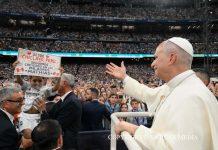
Details of the attack remained suppressed for years. While contemporary images captured only Krohn’s arrest by security forces, Cardinal Dziwisz later revealed the full extent of the incident.
“During his stay in Fatima, there was another assassination attempt, and it happened right in front of the altar,” Dziwisz said. As the procession returned, Krohn lunged toward the pope, attempting to stab him.
The attack did manage to wound John Paul II, though not severely enough to halt the ceremony. It was only after returning to his quarters that the seriousness of the incident became apparent.
“When we returned to his room, we realized that his cassock was stained with blood and that the bayonet had wounded him,” Dziwisz recounted.
A Culture of Silence—and Fear
At the time, Church authorities chose not to disclose the full details of the attack. The shadow of the 1981 shooting still loomed large, and public awareness of a second attempt could have intensified fears surrounding the pope’s safety.
Cardinal Dziwisz recalled the atmosphere following the incident as one of deep unease. “We were all trembling with fear,” he said, particularly when John Paul II resumed public appearances shortly afterward in St. Peter’s Square.
Yet the pope himself refused to retreat into caution. “He decided that he could not live in fear,” Dziwisz noted—a decision that would define his public ministry in the years that followed.
A Troubled Past Revealed
Krohn was not an unknown figure to some journalists even before the attack. Spanish reporter Martín Descalzo, writing in ABC on May 14, 1982, recalled having previously published statements from Krohn that were “so aggressive against the Church and the Vatican” that they required explanatory context.
Those writings had already signaled a deep hostility, one that escalated into violent intent in Fatima. Following his arrest, Krohn was expelled from the Society of Saint Pius X. During his imprisonment, he abandoned the priesthood and later entered into a civil marriage.
Legacy of an Overlooked Incident
The 1982 Fatima assassination attempt occupies a curious place in modern Church history—significant in its implications but largely overshadowed by the dramatic events of the previous year.
Nonetheless, the episode reveals both the vulnerability of a global religious leader and the resilience that defined John Paul II’s papacy. Despite repeated threats, he remained steadfast in his commitment to engage with the public, refusing to let fear dictate his actions.
In a life marked by confrontation with violence, the events at Fatima underscore a recurring theme: survival, faith, and an unwavering resolve to continue his mission.
And just moments later, on May 12, 1982, a Spanish Sedevacantist priest attempted to assassinate Pope John Paul II in Fatima. Fr. Juan María Fernández y Krohn had previously been expelled from the SSPX due to mental instability and unacceptable criticism of Archbishop Lefebvre. pic.twitter.com/mYTWatBulX
— Catholic Sat (@CatholicSat) May 12, 2020
- Raju Hasmukh with files from ACI Digital
Related Images: