



















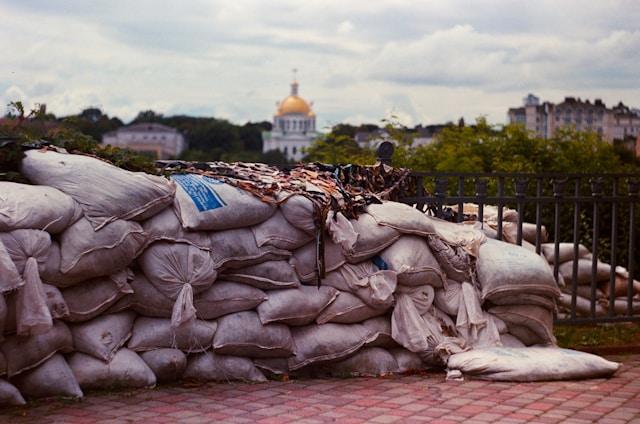
Thousands of Ukrainians fleeing occupied areas travel via Russia and Belarus, relying on aid groups at the Mokrany–Domanove crossing.
Newsroom (27/05/2026 Gaudium Press ) For thousands of Ukrainians fleeing territories occupied by the Russian Federation, the journey back to government-controlled areas is marked by hardship, uncertainty, and paradox. Instead of crossing directly into Ukraine, many must travel thousands of kilometres through Russia and Belarus—an exhausting and bureaucratic route that ends at a single functioning humanitarian corridor: the Mokrany–Domanove border crossing in the Volyn region.
This crossing, located on the border with Belarus, remains the only open gateway for Ukrainian citizens navigating their way out of occupied regions. By the time they arrive, many are physically drained and psychologically scarred after days of travel, repeated checks, and prolonged periods of uncertainty.
Over the past year, more than 2,500 displaced people have received assistance at this crossing, with humanitarian organisations playing a critical role in ensuring their safe onward journey and immediate well-being.
Meeting Immediate Needs at the Border
Since February 2025, Caritas Ukraine has been among the leading organisations providing support at Mokrany–Domanove. According to Hryhorii Seleshchuk, Vice President of Caritas Ukraine, the organisation’s approach begins with understanding the conditions in which people arrive.
“Our work begins with people’s needs,” Seleshchuk explained. Initially, those needs were largely practical. Many arrivals reached the border with no means of transportation or financial resources to continue their journey.
To address this, Caritas organised travel logistics—particularly for elderly individuals travelling alone and those with reduced mobility. The journeys to reach the crossing often last three to five days and involve multiple transfers, making assistance essential.
Ensuring dignity has remained central to the organisation’s response. “It was essential to respond while respecting people’s dignity, so that they would feel welcomed and acknowledged,” Seleshchuk said.
Human Stories of Loss and Survival
Beyond logistical challenges, the crossing has become a point of convergence for deeply personal tragedies. Many arrivals carry not only the burden of displacement but also the trauma of loss and uncertainty.
Seleshchuk recalled the case of a woman who fled with her two teenage children after her husband died in occupied territory. All of their documents had been destroyed. When she arrived at the border, she had no identification, no clear destination, and no resources.
Stories like hers are not uncommon. In such cases, Caritas case managers and crisis counsellors step in to provide immediate support. This includes arranging temporary accommodation, initiating legal processes to recover documentation, and searching Ukrainian archives to help confirm identities.
Waiting, Hunger, and Small Acts of Care
For many displaced individuals, the ordeal does not end upon reaching the border. Long waiting times for onward transportation—sometimes lasting up to seven hours—add another layer of hardship.
To alleviate this, Caritas provides hot meals and snacks, offering not just sustenance but also a sense of care and hospitality. For individuals who have endured days of uncertainty, such gestures can be a crucial first step in regaining a sense of stability.
Financial assistance is also provided, enabling people to purchase tickets and meet immediate needs as they continue their journeys within Ukraine.
Psychological Support for Deep Trauma
While logistical and material aid is essential, the psychological toll of displacement is equally significant. Many individuals arriving at Mokrany–Domanove experience severe anxiety and disorientation.
Some have not been in government-controlled Ukraine for years. To reach the crossing, they often undergo multiple checks and filtration procedures, leaving them in a state of heightened fear and tension.
“Psychological support is essential,” Seleshchuk stressed. Caritas provides crisis counselling to help individuals process their experiences and begin rebuilding a sense of security.
Coordinated Humanitarian Response
Caritas Ukraine operates in close collaboration with the Office of the Ombudsman, which helps identify particularly vulnerable individuals, including those in need of medical assistance or those with reduced mobility.
This networked approach allows for more effective responses, as organisations share information and responsibilities. Funding constraints remain a challenge, but cooperation between humanitarian actors helps ensure continuity of support. When one organisation faces shortages, others step in to fill the gap.
“For a small team of four people, it is an enormous undertaking,” Seleshchuk noted.
Focus on Children and the Future
The humanitarian situation at the crossing has drawn international attention. On 19 May, a delegation representing around 30 embassies visited the site, led by Ukraine’s Human Rights Commissioner, Dmytro Lubinets, with participation from senior officials of UNHCR and UNICEF.
A key focus of the visit was the situation of children and young people. Among Caritas beneficiaries alone, nearly 400 are minors.
In response, Caritas Ukraine, in partnership with Save Ukraine, is implementing projects aimed at facilitating the safe return and integration of children from occupied territories. These initiatives include document recovery, access to education, and broader support for reintegration into daily life.
“The goal is to help them build their future in Ukraine,” Seleshchuk explained.
A Corridor of Necessity
The Mokrany–Domanove crossing stands as both a lifeline and a symbol of the challenges facing displaced Ukrainians. It represents the only open path for many—but also underscores the complex and often paradoxical realities of displacement in the region.
For those who pass through it, the journey is rarely straightforward. Yet with the support of humanitarian organisations and coordinated international efforts, it also becomes a place where new beginnings are made possible, even after immense hardship.
- Raju Hasmukh with files from Vatican News
Related Images: