












Quebec’s Bill 9 limits public worship, yet Montreal permits major Catholic processions, highlighting tensions between secular law and tradition.
Newsroom (29/05/2026 Gaudium Press ) Despite the Quebec government’s move to reinforce secularism through Bill 9, recent events in Montreal suggest that longstanding religious traditions continue to find space—albeit cautiously—within the province’s evolving legal framework.
Passed on April 2, Bill 9 broadly prohibits collective prayer and religious practices in public spaces. However, the legislation grants municipalities discretion to allow exceptions, creating a nuanced and sometimes inconsistent application of the rules across the province.
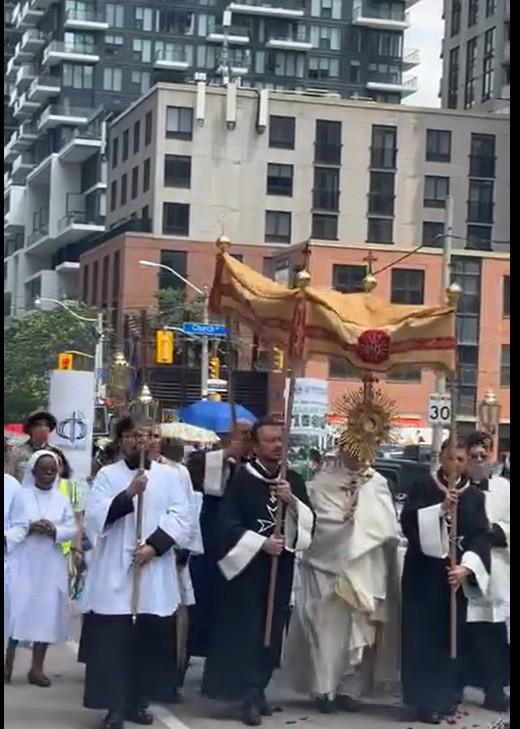
In Montreal, that flexibility became evident when the Archdiocese received approval to proceed with its annual Corpus Christi procession, a significant public demonstration of Catholic faith that has taken place for more than 25 years.
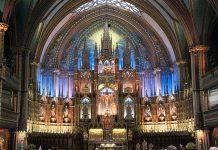
The June 4 event will begin with a 7:30 p.m. Mass at Mary, Queen of the World Cathedral. From there, participants are expected to walk through city streets to St. Patrick’s Basilica, culminating in the Benediction of the Blessed Sacrament. Organizers anticipate approximately 2,000 participants.
Crucially, the procession has been structured to comply with the limits imposed by Bill 9. According to diocesan director of communications Maribel Mayorga, no prayers will be recited during the march itself, a detail that appears to align with the law’s restrictions on public religious expression.
“As in previous years, the Montréal police has been informed and will accompany the procession to help ensure the safe and orderly movement of participants,” Mayorga said. She added that the archdiocese is grateful the event can continue as part of Montreal’s “longstanding religious heritage.”
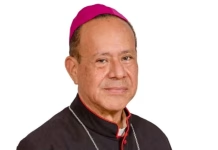
Montreal Archbishop Christian Lépine has underscored both the cultural and spiritual importance of the procession. He noted that over its decades-long history, the event has not resulted in any issues, and he credited the archdiocese’s positive relationship with local law enforcement as a factor in securing approval.
“Actually, the police are even glad of being there for us when we do processions,” Lépine said, expressing confidence that cooperation between religious organizers and civic authorities can continue under the new legal environment.
A similar balance between regulation and tradition was visible in another major religious event earlier in May. Montreal’s Portuguese Catholic community held its annual Santo Cristo procession on May 17, preserving a 60-year local tradition rooted in a 326-year-old devotion originating in the Azores, Portugal.
Although the event initially faced a setback with the denial of a permit, the situation evolved. Plateau-Mont-Royal police ultimately approved the procession and committed to accompanying participants, a decision confirmed publicly by borough mayor Cathy Wong on May 16.
The Santo Cristo procession, like the Corpus Christi march, avoids direct conflict with the law by maintaining a silence during the parade. There are no audible prayers or religious chants, even as participants express devotion through presence, music, and ritual movement. Philharmonic bands accompany the procession, reinforcing its dual identity as both a cultural and religious event.
“For 60 years, the procession has brought together families, entire generations, neighbours of the Plateau,” Wong wrote. “The procession is not a problem to deal with. It’s a tradition to be accompanied with sensitivity and respect.”
Attendance figures mirror those of the Corpus Christi event, with roughly 2,000 participants gathering annually in a demonstration that blends faith, heritage, and community cohesion.
Yet, these successful events also highlight ongoing uncertainty surrounding the implementation of Bill 9. Santo Cristo organizer Emanuel Linhares pointed to inconsistencies in how different boroughs interpret and enforce the law. He emphasized the need for clearer, city-wide guidelines to avoid confusion and ensure fairness.
According to Linhares, the coming year will be critical in establishing more uniform rules governing religious and cultural processions. Without such clarity, organizers may continue to navigate a patchwork of decisions that vary from one jurisdiction to another.
For now, Montreal’s experience suggests that while Quebec’s commitment to secularism remains firm, space still exists for public expressions of faith—provided they are adapted to meet legal constraints. The absence of spoken prayer during these processions has emerged as a key compromise, allowing traditions to endure while respecting the letter of the law.
As municipalities continue to interpret Bill 9, the coexistence of secular policy and religious heritage in Quebec will likely remain a subject of careful negotiation, shaped as much by local relationships and historical precedent as by legislation itself.
- Raju Hasmukh with files from Catholic Register
Related Images: