





















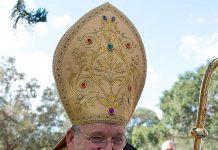

Italian Bishop Antonio Suetta calls for evangelization alongside aid for Muslim migrants, stressing faith as the highest act of Christian charity.
Newsroom (29/05/2026 Gaudium Press ) As debates surrounding immigration continue to intensify across Europe, a forceful pastoral intervention from an Italian bishop has reignited discussion on the core mission of the Catholic Church. Bishop Antonio Suetta of Ventimiglia-San Remo, in a Pentecost letter titled “There Is No Greater Love,” has called on Christians to reconsider the balance between humanitarian aid and evangelization—particularly in their engagement with Muslim migrants.
Drawing from decades of experience in a diocese shaped by migratory flows from North Africa and the Middle East, Bishop Suetta begins with a grounded observation: Catholic communities have consistently responded with generosity, offering material assistance, shelter, and social support to newcomers. Yet a question posed by a Caritas volunteer forms the centerpiece of his reflection: why does the Church provide aid without offering what it holds most precious—its faith?
For the bishop, this question cuts to the heart of the Christian vocation. While affirming the necessity of charitable works, he warns against a reductionist view of the Church’s mission—one that limits its role to social service. Charity, in his view, cannot be severed from its spiritual dimension. The Church’s mandate, rooted in Christ’s command to “go and make disciples of all nations,” remains universal and non-negotiable.
Bishop Suetta argues that a widespread misunderstanding has taken hold in some Catholic circles, particularly in Western societies shaped by pluralism and interreligious engagement. According to this perspective, explicitly proclaiming Christ in the context of dialogue—especially with Muslims—is often seen as inappropriate or even disrespectful. Suetta challenges this assumption. He insists that evangelization does not contradict authentic dialogue but rather completes it.
Quoting Cardinal Giacomo Biffi, he underscores that the Church’s evangelizing mission is inherently inclusive: it cannot deliberately exclude any group, including Muslims. The universality of the Gospel, he contends, demands that it be offered to all, without exception.
At the same time, the bishop is careful not to dismiss interreligious dialogue. On the contrary, he affirms its importance for fostering peaceful coexistence and mutual respect. However, he draws a clear distinction between dialogue and relativism. Recognizing shared values or common ethical ground does not imply that all religions are equal in truth. For Christians, he emphasizes, Jesus Christ remains the definitive revelation and the Savior of the world.
This distinction becomes central in Suetta’s critique of certain modern interpretations of interfaith engagement. He suggests that in some cases, dialogue has been stripped of its deeper purpose—the pursuit of truth—and reduced to a purely diplomatic exercise. True dialogue, he argues, must retain openness to the possibility of conversion, while always respecting individual freedom.
To illustrate his point, Bishop Suetta revisits the historical example of Saint Francis of Assisi, whose encounter with the Sultan of Egypt in 1219 is often cited as a model of peaceful interreligious dialogue. While acknowledging the absence of coercion or hostility in Francis’ approach, Suetta emphasizes that the saint’s intention was nonetheless missionary. Francis sought to bear witness to Christ and offer the Gospel message, not merely to build bridges devoid of spiritual content.
The bishop extends this analysis to contemporary readings of Nostra Aetate, the Second Vatican Council’s declaration on relations with non-Christian religions. While the document emphasizes respect and dialogue, Suetta insists that it does not call for abandoning evangelization. Instead, he presents dialogue and proclamation as complementary dimensions of a single mission.
At the core of his pastoral letter lies a theological reflection on charity. Drawing from Saint Paul’s teaching that love is the greatest of virtues, Suetta asks what constitutes the highest form of love. His answer is unequivocal: the greatest charity is that which leads to eternal salvation. In this framework, sharing the knowledge of Christ is not an imposition but an act of profound love.
This perspective leads to one of the letter’s most striking assertions. On Judgment Day, Bishop Suetta suggests, Muslims might ask Christians why they were never told about Christ. The statement, while provocative, encapsulates his conviction that silence cannot be justified as a higher form of respect if one truly believes in the salvific power of the Gospel.
Ultimately, Bishop Suetta’s message challenges a prevailing tension in many Western societies: can Christians engage in humanitarian aid without bearing witness to their faith? Can they participate in dialogue without proclamation?
For the Bishop of Ventimiglia-San Remo, the answer is clear. The Church must refuse this false dichotomy. True Christian charity, he concludes, does not choose between material assistance and evangelization—it unites them. Feeding the hungry remains an essential act of mercy. But offering what Christians believe to be the light of Christ, he insists, is the greatest gift they can give.
In a cultural and political climate often marked by caution and ambiguity, Suetta’s pastoral letter stands as a direct and uncompromising reaffirmation of the Church’s enduring mission—one that, in his view, must remain as universal and as bold as it was two millennium ago.
- Raju Hasmukh with files from Tribune Chretienne
Related Images: