














Vatican envoy calls for hope amid Nigeria’s kidnapping crisis as Catholic leaders advance climate resilience and sustainable energy initiatives.
Newsroom (13/07/2026 Gaudium Press ) The Vatican’s representative in Nigeria has called on families affected by the country’s persistent kidnapping crisis to remain steadfast in Christian hope, insisting that despite the pain and uncertainty caused by insecurity, evil will ultimately be overcome through Christ.
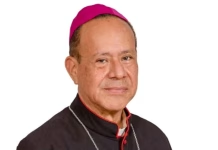
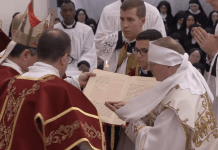
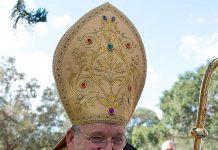
Speaking to ACI Africa during celebrations marking the first anniversary of Pope Leo XIV’s Pontificate at the Apostolic Nunciature in Abuja, Archbishop Michael Francis Crotty condemned kidnapping as a grave moral evil that continues to devastate individuals, families, and communities across Nigeria.
“The scourge of kidnapping is evil. It is an evil that has to be denounced,” the Apostolic Nuncio said during a July 8 interview.
Archbishop Crotty expressed particular concern for victims held in captivity and the families left behind, emphasizing the lasting psychological and emotional consequences of abduction.
“We have to pray, of course, for the people who are suffering it, particularly the families that are separated from their loved ones,” he said. “We think of the trauma that is for young people and what they must endure while they are kidnapped and after they are released, maybe the trauma that goes on for many years.”
Hope in the Midst of Adversity
Acknowledging the anguish caused by the continued abduction of schoolchildren and other citizens, the Vatican diplomat stressed that hope becomes most meaningful during moments of hardship.
“We have to be always mindful of hope,” Archbishop Crotty said, adding that hope is often more necessary during crises than in times of comfort and stability.
“Hope is important not when things are going well but perhaps more important when we are faced with crisis, when we are faced with adversity, when we are faced with human situations which are seemingly hopeless,” he noted.
For Christians confronting insecurity and uncertainty, the Nuncio pointed to Christ as the ultimate source of strength and perseverance.
“We need to focus all our intentions on the message of Christ, who is for us the ultimate anchor of hope,” he said.
While recognizing the reality of evil and suffering, Archbishop Crotty encouraged believers not to yield to fear or despair.
“We have to focus on the hope that lasts, that goes beyond mere human hope. The most important thing is that we focus on the hope in Christ that will triumph over all evil and give us the courage to live with evil, as we must, unfortunately,” he said.
Reaffirming a central Christian conviction, he added: “Despite the evil in the world, it will be conquered by goodness, because goodness will always conquer over evil.”
Franciscan Year Inspires Renewal and Service
Beyond addressing Nigeria’s security challenges, Archbishop Crotty reflected on the significance of the Franciscan Year, describing it as an opportunity for Catholics and other Christians to rediscover the enduring legacy of St. Francis of Assisi.
The Nuncio highlighted the saint’s commitment to simplicity, care for the poor, and stewardship of creation, values that continue to resonate far beyond the Catholic Church.
“St. Francis is a particularly important saint. He is revered not just within the Catholic Church. Many other Christian denominations have a great love of St. Francis, his charisms, his identity for caring for the poor, and his commitment to living a very simple life,” he said.
According to Archbishop Crotty, Nigeria’s participation in the Franciscan Year strengthens the nation’s connection to the wider Christian community and offers believers a model for faithful living amid contemporary challenges.
“I think it’s also important for Nigeria just to be a part of the communion of saints and to have the inspiring story of St. Francis as an example for the life in which we live,” he said.
Diocese of Bauchi Launches Climate Resilience Initiative
In a separate development reflecting the Church’s commitment to environmental stewardship, the Justice, Development, and Social Cohesion Initiative (JUDSCI) of the Catholic Diocese of Bauchi has launched a project aimed at reducing deforestation and promoting sustainable energy alternatives in northeastern Nigeria.
The initiative, titled “Promoting Community Leadership for Climate Resilience through Sustaining Fuel Alternatives,” is being implemented in selected communities across Bauchi and Gombe states.
Speaking to ACI Africa on July 9, JUDSCI Coordinator Fr. Anthony Leonard Lokshiya said the program seeks to reduce dependence on charcoal and firewood by encouraging the adoption of briquettes made from agricultural waste.
“Bauchi Diocese comprises Bauchi and Gombe states, and we are implementing this project in both states,” he explained.
The priest warned that indiscriminate tree felling continues to contribute significantly to environmental degradation and climate-related challenges.
“The aim is to discourage people from cutting down trees without replacement because it is affecting the environment. We have the mandate to take care of our environment, and once the environment is being taken care of, humanity is happy,” he said.
Fr. Lokshiya urged communities to adopt sustainable forestry practices, recommending that multiple trees be planted to replace every tree removed.
“If you are cutting when it is necessary, ensure that you plant three or four trees before you cut down a tree,” he advised.
Sustainable Alternatives and Community Engagement
Recognizing the widespread reliance on charcoal for household cooking, Fr. Lokshiya stressed that environmental conservation efforts must be paired with realistic alternatives.
“You cannot ask people to avoid cutting down trees if you do not provide an alternative for them, so briquettes are a sustainable alternative,” he said.
Although changing long-standing cooking habits remains challenging, he reported positive initial responses from communities testing the alternative fuel source.
“Those who have tried it are actually testifying that they are enjoying it,” he noted.
The initiative also seeks to improve climate resilience by reducing pressure on forests and encouraging adaptation measures in vulnerable communities.
“We are only adjusting to climate change, which is not the best. But if it can be regulated, it will go a long way,” Fr. Lokshiya said.
To broaden the campaign’s reach, the Diocese has organized training sessions for religious, political, and traditional leaders, who are expected to promote environmental awareness and conservation practices within their communities.
“We organise the programme for religious leaders, political leaders, and traditional leaders because they are more in touch with the people,” he explained.
Funded by Missio Germany, the project reflects the Catholic Church’s ongoing commitment to environmental stewardship inspired by Pope Francis’ encyclical Laudato Si’, which calls on communities worldwide to care for creation and pursue sustainable development.
Together, Archbishop Crotty’s appeal for hope amid Nigeria’s security challenges and the Diocese of Bauchi’s environmental initiatives underscore the Church’s dual focus on addressing both human suffering and long-term social and ecological well-being.
- Raju Hasmukh with files from ACi Africa
Related Images: