


















King Charles III has effectively abandoned the historic “Defender of the Faith” title, embracing a broader role in Britain’s multi-faith society.
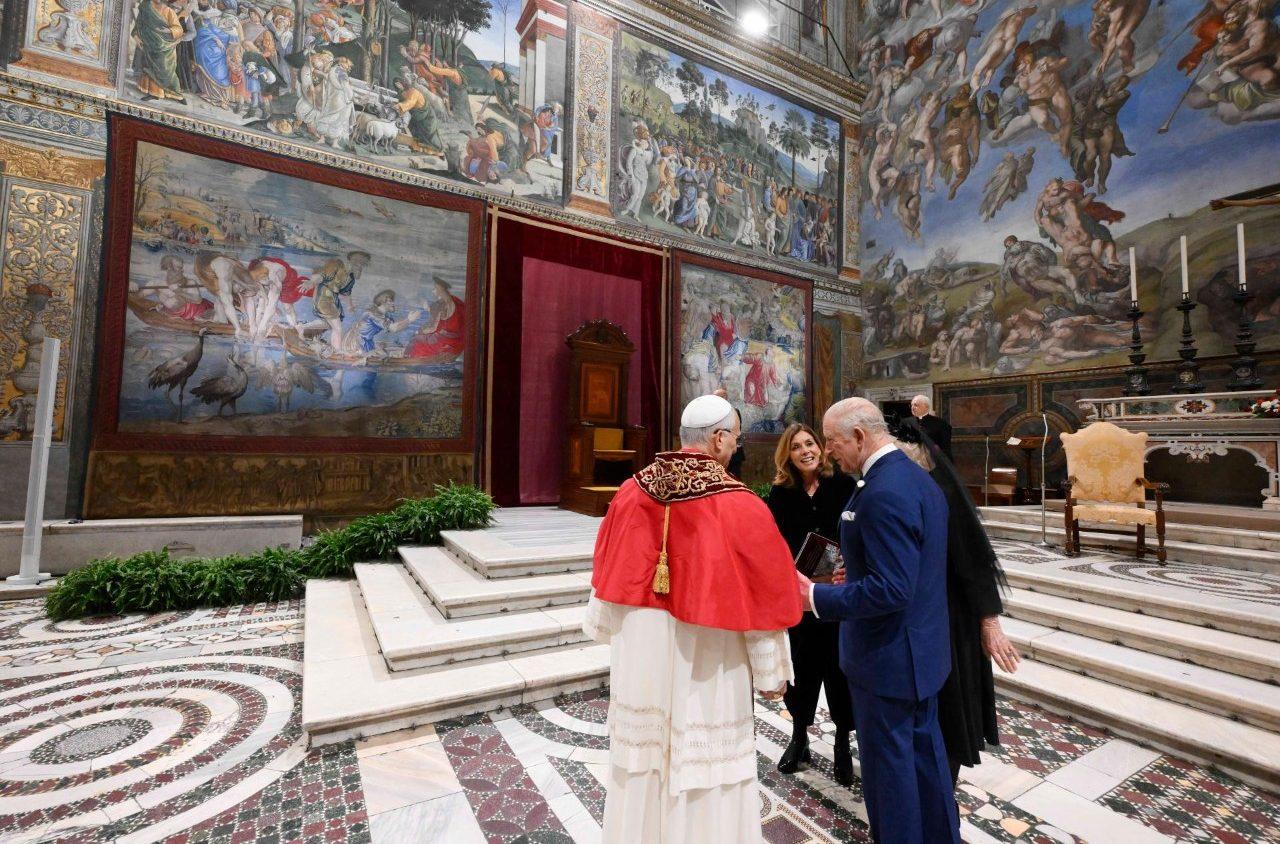
Newsroom (13/07/2026 Gaudium Press ) King Charles III has taken another significant step in redefining the relationship between the British monarchy and religion, with the Royal Household’s latest annual report describing the monarch not as the traditional “Defender of the Faith” but as the “protector of the space for faith in a multi-faith nation.”
The change, reported by British media on July 9, reflects a position Charles has advocated for decades and signals a continuing effort to adapt one of the monarchy’s oldest religious roles to the realities of modern Britain.
While the centuries-old Latin title Fidei Defensor remains formally associated with the Crown, the language used by the Royal Household highlights the King’s long-held belief that the sovereign’s religious responsibilities should extend beyond the Church of England to encompass all faith communities across the United Kingdom.
A Long-Held Conviction
Charles’s discomfort with a narrow interpretation of the title is far from new. As early as 1994, when he was still Prince of Wales, he publicly argued that the role of the monarch should be understood in broader terms.
Rather than serving solely as a defender of the Christian faith represented by the Church of England, Charles suggested that the sovereign should act as a protector of all religions practiced within the Kingdom. He maintained that such an approach was consistent with the spirit of the title and even floated the possibility that the language of the coronation ceremony could one day be revised to reflect this interpretation.
Over the years, these remarks generated substantial public debate, particularly among religious conservatives who viewed the title as inseparable from England’s Christian heritage.
The latest shift in official language has renewed those discussions.
Critics See a Break with Tradition
Among the most outspoken critics is Gavin Ashenden, a former chaplain to Queen Elizabeth II. Ashenden described the move as a “betrayal of the faith,” arguing that it undermines the historic Christian foundations of the monarchy.
Ashenden, who left the Church of England and later converted to Catholicism, represents a more traditional strand of Christian thought that views the title “Defender of the Faith” as a specific commitment to Christianity rather than a broader endorsement of religious pluralism.
Similar concerns were raised by Ciarán Kelly, head of the conservative evangelical organization The Christian Institute. Kelly argued that Christianity remains central to England’s laws, institutions, and cultural identity. He criticized the King’s approach as reducing the historic role of the monarchy to what he described as a “multi-faith mishmash.”
For critics, the issue is not simply one of language but of constitutional and cultural continuity. They contend that diluting the historic meaning of the title risks weakening the monarchy’s enduring connection to the Christian faith.
Reflecting a Religious Diverse Britain
Supporters of the King’s approach point to the profound changes that have reshaped British society over recent decades.
Although the Church of England remains the established state church and the monarch continues to serve as its Supreme Governor, Britain today is home to a remarkably diverse population representing numerous religious traditions.
Much of that diversity developed through the legacy of the British Empire and subsequent waves of immigration, creating a society in which Christianity coexists alongside Islam, Hinduism, Judaism, Buddhism, Sikhism, and other faiths.
Charles has repeatedly emphasized that the monarch should serve as a unifying figure for all citizens, regardless of religious affiliation. His vision was prominently displayed during his coronation in 2023, a ceremony that preserved its Anglican character while incorporating representatives from a range of faith communities.
The Archbishop of Canterbury presided over the service, underscoring the monarchy’s constitutional relationship with the Church of England. At the same time, Britain’s Chief Rabbi presented one of the King’s regalia, while religious leaders from Muslim, Hindu, Buddhist, and other traditions participated in the celebrations.
The ceremony was widely viewed as a reflection of the King’s determination to balance historical tradition with contemporary social realities.
The Origins of a Centuries-Old Title
The title “Defender of the Faith” has a history stretching back more than five centuries.
In 1521, Pope Leo X awarded the title to King Henry VIII after the English monarch authored Assertio Septem Sacramentorum (Defence of the Seven Sacraments), a work defending Catholic doctrine against the arguments of the Protestant Reformation and Martin Luther.
The honor did not survive the dramatic religious upheavals that followed.
After Henry VIII broke with Rome and initiated the English Reformation, Pope Paul III revoked the title. Yet the English king had little interest in relinquishing such a prestigious distinction. In 1543, the English Parliament restored “Defender of the Faith,” this time as recognition of the monarch’s leadership of the newly established Church of England.
The title has remained associated with English and later British sovereigns ever since.
England was not unique in receiving religious honors from the papacy. French monarchs were known as the “Most Christian Kings,” while Spanish rulers received the title “Catholic Kings,” both distinctions granted in recognition of their perceived defense of the Catholic faith.
The Question of the Coinage
Despite the evolving interpretation of the title, Fidei Defensor has not disappeared entirely from official royal symbolism.
The abbreviation “FD” continues to appear on British pound coins bearing the portrait of King Charles III, maintaining a tradition that has endured for generations.
Whether this will eventually change remains uncertain. No indication has been given that Britain’s coinage will be altered to reflect the new language adopted in the Royal Household’s annual report.
Interestingly, several Commonwealth countries where the British monarch remains head of state no longer include the title “Defender of the Faith” on their coinage, demonstrating that the phrase has already been modified or omitted in some parts of the wider Commonwealth realm.
A Historic Evolution Rather Than an End
For supporters and critics alike, the debate surrounding “Defender of the Faith” touches on broader questions about the role of monarchy in a rapidly changing society.
King Charles III appears determined to preserve the Crown’s religious significance while expanding its reach beyond a single denomination. Rather than abandoning faith, he is seeking to position the monarchy as a guardian of religious freedom and coexistence in an increasingly pluralistic nation.
History suggests that royal and ecclesiastical titles are rarely static. Their meanings evolve, disappear, and sometimes return. The recent reappearance of the papal title “Patriarch of the West” in the Vatican’s official yearbook—after it had been removed by Pope Benedict XVI in 2006—demonstrates how longstanding titles can be revived after years of absence.
Whether “Defender of the Faith” ultimately remains a living expression of the British monarchy or becomes primarily a historical relic is a question that may take years to answer. For now, King Charles III has unmistakably chosen to redefine it for the twenty-first century.
- Raju Hasmukh with files from Global Catholic
Related Images: