


Icelandic police probe priest Father Jakob Rolland’s comments on homosexuality amid conversion therapy law concerns.
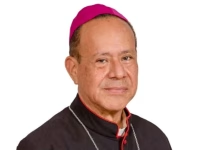
Newsroom (19/03/2026 Gaudium Press ) Reykjavik police have confirmed they are examining comments made by Father Jakob Rolland, a senior figure in Iceland’s Catholic Church, following remarks that may contravene the nation’s 2023 ban on conversion therapy. The priest’s controversial statements about homosexuality have triggered widespread criticism and a potential legal review under Article 227b of Iceland’s Penal Code.
The investigation was launched after Rolland, the chancellor of the Catholic Church in Iceland and a French-born cleric who has lived in the country for decades, appeared on Icelandic state broadcaster RÚV in early March. During the interview, Rolland claimed that individuals who wish to “abandon” homosexual behavior lack adequate help or support in today’s society. “Those who wish to abandon this lifestyle receive no help,” he told the network, describing what he saw as a gap in spiritual and psychological resources for people seeking such change.
Rolland further said that some people had turned to the Church to “stop” being homosexual, adding that homosexual churchgoers “cannot find psychologists or social workers to help them.” His comments immediately raised alarms among advocates and lawmakers, who said the sentiments could violate the country’s strict laws against practices viewed as attempts to alter a person’s sexual orientation or gender identity.
Under Iceland’s 2023 law, Article 227b criminalizes those who use “coercion, deception, or threats” to subject anyone to treatment aimed at suppressing or changing sexual orientation, gender identity, or expression. The law positioned Iceland as one of the few nations that have explicitly outlawed conversion therapy nationwide.
When pressed during the interview about whether the Church’s actions amounted to conversion therapy, Rolland framed his view in theological terms. “Conversion – change of heart – this is a key word in the daily life of Catholic people,” he said. “We are constantly turning away from what is evil towards what is good.” He described the Church’s support as primarily spiritual — participation in worship, prayer, sacraments, and conversation — while maintaining that “all Christians are called to control their sexual impulses according to the moral teachings of the Church.”
However, his suggestion that spiritual counseling could be used by those seeking to “stop” being gay has drawn fierce opposition. Helga Vala Helgadóttir, a parliamentary sponsor of the 2023 conversion therapy ban, urged police to investigate. “This is a crime and should be investigated as such,” said Bjarndís Helga Tómasdóttir, chairwoman of the LGBTQ organization Samtökin 78. She added that even informal discussions intended to suppress sexuality “constitute suppression therapy, no matter how organized it is.”
Among Iceland’s political leaders, Foreign Minister Þorgerður Katrín Gunnarsdóttir — herself among the small Catholic minority in Iceland — distanced herself from Rolland’s statements. “I’m sorry if my church is considering breaking the law,” she stated, calling on the Church “not to go against diversity or the law.”
The issue sparked debate in the Alþingi, Iceland’s Parliament. Social Democratic Alliance MP Sigmundur Ernir Rúnarsson posed a series of questions to the government: “What is the message to gay and lesbian people in the country? What is the message to their families? What is the message to all Icelanders who want to live in a free and democratic society that believes in human rights and enacts laws to ensure them?”
Father Rolland, who once changed his name from Jacques to Jakob in an effort to adopt a more Icelandic identity, has previously clashed with the country’s progressive social norms. In 2019, he told a reporter he would refuse to officiate a same-sex marriage even if it meant imprisonment. “If they wanted to press charges, I’d say, ‘Do it.’ If I go to prison, then I go to prison, but it won’t change my position,” he said at the time.
The Catholic Church counts roughly 14,000 members in Iceland, many of them immigrants from countries such as Poland. For decades, it has occupied a small but vocal place in the nation’s religious landscape, now increasingly at odds with Iceland’s strong human rights framework. As police continue their inquiry, the case of Father Rolland encapsulates a broader question now confronting Icelandic society — how to balance freedom of religion with the legal protection of LGBTQ identities in one of the world’s most equality-driven nations.
- Raju Hasmukh with files from Crux Now
Related Images: