





















Polish bishops reaffirm marriage as man and woman amid EU ruling, as cities begin recognizing same-sex unions and debate intensifies.
Newsroom (29/05/2026 Gaudium Press ) Poland’s Catholic bishops have issued a firm defense of the country’s constitutional definition of marriage, emphasizing that upholding it is not an act of exclusion but a reaffirmation of longstanding legal and cultural principles. Their statement comes as several Polish cities begin implementing a significant policy shift by registering same-sex unions contracted abroad, following a ruling by the Court of Justice of the European Union (CJEU).
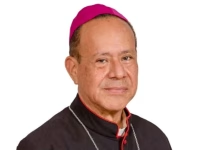
In a May 22 statement, the Family Council of the Polish Bishops’ Conference (KEP), led by Archbishop Wiesław Śmigiel, stressed that maintaining the traditional understanding of marriage does not contradict respect for individuals. “Respect for each person does not mean giving up the truth about marriage that the Church has been preaching from the beginning,” the council said, framing the issue as one rooted in enduring doctrine rather than contemporary political pressures.
The bishops’ statement comes in response to developments in major Polish cities, including Warsaw and Wrocław, which have begun transcribing foreign same-sex marriage certificates into the national civil registry. This move follows a pledge by Prime Minister Donald Tusk to comply with a November 2025 CJEU ruling requiring European Union member states to recognize such unions when legally contracted in another member country.
At the heart of the bishops’ argument is Article 18 of the Polish Constitution, which defines marriage as a union between a man and a woman. The provision also states that the family, motherhood, and parenthood are entitled to special protection and care by the state. According to the episcopate, this constitutional language is not merely symbolic but foundational.
“This is not a formality,” the statement emphasized, warning that “expansive interpretations of law may lead to the weakening of the constitutional understanding of marriage.” The bishops argued that such fundamental issues should not be addressed through legal reinterpretation that could lead to broader social and constitutional consequences.
The Church’s position also invoked broader historical and cultural considerations, describing the traditional understanding of marriage as deeply embedded in Poland’s legal system and heritage. It further linked this perspective to the wider Christian conception of marriage that has shaped European views on human identity and social organization for centuries.
While defending their stance, the bishops also called for restraint in the ongoing debate. They urged that discussions about marriage should proceed “with responsibility, calm, and genuine concern for the common good,” signaling concern over potential polarization as legal and societal norms evolve.
The developments in Poland reflect wider tensions across Central Europe, where questions of marriage, identity, and EU legal authority continue to generate political and cultural friction. In neighboring Slovakia, similar issues have emerged following a high-profile same-sex marriage conducted abroad.
Slovak lawmaker Michal Šabo recently married his male partner in Hainburg, Austria, where same-sex marriage is legal. He has since expressed his intention to seek recognition of the union in Slovakia. However, the country’s constitution has, since 2014, defined marriage exclusively as a union between a man and a woman. A September 2025 amendment further reinforced this framework by formally recognizing only two sexes: male and female.
According to former Slovak minister Milan Krajniak, any effort to secure recognition of such marriages would likely result in legal challenges. He warned that the issue could escalate into a court case, suggesting that activists are aiming to reshape the legal landscape through judicial means rather than democratic consensus. Krajniak also criticized progressive movements, asserting that they seek societal acceptance of their worldview rather than mere tolerance.
Meanwhile, broader European legal dynamics continue to influence national policies. In April, the CJEU ruled against Hungary’s 2021 law that limited the promotion of LGBT and gender-related content to minors. The court found that the legislation breached the European Union’s foundational values, adding another dimension to the evolving legal environment around identity and rights within the bloc.
Together, these developments underscore a growing divide between national constitutional frameworks and supranational legal obligations. As EU institutions assert their authority in shaping member state policies, countries like Poland and Slovakia face the challenge of reconciling domestic legal traditions with broader European directives.
For Poland’s bishops, the response is clear: the constitutional definition of marriage remains a cornerstone of national identity and legal order. Whether this position can coexist with rising European legal integration will likely remain a central question in the region’s political and cultural discourse.
- Raju Hasmukh with files from CNA
Related Images: