








Vatican seminar explores how to train future priests to accompany couples from secular realities to sacramental marriage and deepen the Church’s munus docendi.
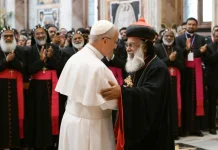
Newsroom (01/05/2026 Gaudium Press) In the quiet shade of the Vatican Gardens, inside the Renaissance walls of Casina Pio IV, a small but charged question preoccupied some of the Church’s leading theologians and pastoral formators on 28 April: How can future priests truly “lead from darkness to light, from the biological to the celestial, from the world to God” when it comes to marriage? That guiding image framed a one‑day study session promoted by the Dicastery for Laity, Family and Life on the theme Sacrament of Marriage, Faith and the Munus Docendi. At stake was not only doctrine, but how the Church teaches, and who the priests are that will teach it in the next generation.
A crisis of formation, not just of faith
Cardinal Kevin Farrell, Prefect of the Dicastery, opened the day by sketching the cultural landscape in which the sacrament of marriage now unfolds. Over recent decades, the family has ceased to be taken as a given and become a test case for individual freedom. Couples increasingly form as “individual experiments” rather than definitive bonds; marriage is no longer seen as necessary for starting a family, and cohabitation has become for many the assumed laboratory for testing a relationship, even when it does not lead to a more stable commitment.
These shifts are not simply private choices; they prompt an urgent ecclesial question, Farrell stressed. Dioceses and bishops, he said, describe in their ad limina visits deep difficulties in reaching baptized families who have drifted from the Church. The demand is clear: the Church’s munus docendi—its mandate to teach—must become more fecund so that new generations of priests can, indeed, “generate faith” in children and young people, nurture the Christian vocation to marriage, and walk alongside families in the moral and spiritual challenges of our age.
The gap between theology and lived reality
The seminar brought together dicasteries of the Roman Curia, seminary rectors, theology professors, and formators of future priests. The shared concern was that the problem is no longer a lack of doctrinal material. In many seminaries and pontifical universities, solid theological reflection on the sacrament of marriage already exists. Yet, as Farrell noted, this teaching often remains abstract, disconnected from the lived experience of families and from the broader cultural currents reshaping intimacy, commitment, and identity.
In practice, this gap makes it hard for priests to connect with young people who view marriage as either obsolete, economically unfeasible, or emotionally risky. Many couples who approach the Church to marry do not arrive with a mature or even a nominal faith; for some, the notion of sacramental grace is barely present. Pastoral experience shows that where there is little preparation for faith, the sacrament itself can be reduced to a ritual of convenience, and later crises easily lead to separation rather than to a deeper conversion.
From kerygma to didaskalia: A new pedagogy
Building on this diagnosis, the day’s reflections moved from description to pedagogy. The rectors and theologians argued that the Church’s language about marriage must mature beyond mere exhortation (parenetic discourse) and even beyond proclamation (kerygmatic discourse). They pointed to a further need: the return of a didaskalic‑formative language, one that actively trains hearts and minds through sustained accompaniment.
In this light, priestly formation cannot be reduced to transmitting a set of rules or catechetical truths about marriage. It must include the art of walking alongside engaged couples, listening to their fears and hopes, and gradually disposing them to receive the grace of Christ. As the Dicastery recalled, Amoris laetitia already calls for broader, interdisciplinary training of seminarians on engagement and marriage, not just on doctrine. This means integrating psychological, cultural, and pastoral insights into the core formation path.
Young people, affectivity, and the sacrament
A particular emphasis of the seminar fell on adolescence and young adulthood. Don Andrea Bozzolo, rector of the Pontifical Salesian University, underscored the need for “special attention to affective and sexual education of adolescents and young people.” For him, this is not an optional add‑on but a pastoral priority: if young people cannot integrate sexuality with love, commitment, and transcendence, the very possibility of sacramental marriage becomes opaque or even alienating.
Here the priest’s role is twin‑fold. On the one hand, he must help young people decode a culture saturated with images of relationships that are provisional, utilitarian, or purely emotive. On the other, he must offer a coherent vision of marriage as a path of holiness, in which body, love, and the will of God are not in opposition, but in harmony. This demands, in turn, that seminarians themselves receive formation in communication, empathy, and the practical skills of conversation and discernment.
The transmission of faith in a fragile Church
The seminar also confronted the broader erosion of intergenerational faith transmission. Citing Pope Leo XIV (in an April 2025 homily), the Dicastery recalled that “in the family, faith is transmitted together with life, from generation to generation.” But the same Pope warned that families today often struggle to pass on that faith and may even be tempted to withdraw from the task. In such a context, the Church does not supplant the family but walks at its side, offering formation, support, and encouragement.
Statistics from the Annuarium Statisticum Ecclesiae 2021 underline this shift: between 1991 and 2021, baptisms of children under seven dropped by 31.1 percent, and Catholic marriages fell by 48 percent. These figures, Farrell noted, need not paralyze the Church, but help it to see the urgency of a renewed evangelization of families. The upcoming tenth anniversary of Amoris laetitia and of the Ratio Fundamentalis Institutionis Sacerdotalis, along with Pope Leo XIV’s 19 March 2026 announcement to gather the presidents of episcopal conferences in October 2026, create a timely horizon for this discernment.
Towards priest‑teachers of the domestic Church
The central intuition of the seminar was that priests must become “teachers of faith” and “authentic spiritual fathers,” capable of generating Christian families. This requires more than a one‑off course on marriage theology. It calls for a systematic rethinking of both initial formation and ongoing priestly training, so that the nexus between faith and marriage is not taken as a given, but attentively explored in light of contemporary anthropologies, family fractures, and mixed‑faith or irregular situations.
From the small circle of theologians and bishops in Casina Pio IV, the message emerged clearly: the sacrament of marriage is not a relic to be defended, but a living pedagogy of grace. To announce it credibly, the Church must form presbyters who can accompany men and women from the “biological” concerns of everyday life to the “celestial” horizon of the divine. In that movement—from darkness to light—the priest’s own formation must become as demanding as it is prayerful, as doctrinally grounded as it is pastorally intelligent.
- Raju Hasmukh with files from L’Osservatore Romano (Italian)
Related Images: