












Opus Dei begins a three-year spiritual journey toward its 2030 centenary, centered on prayer, friendship, and the sanctification of work.
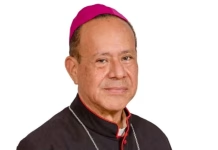
Newsroom (20/03/2026 Gaudium Press ) As Opus Dei nears its 100th anniversary, the Catholic institution founded by Saint Josemaría Escrivá is preparing for a milestone not only of history, but of renewal. In a letter released on the Solemnity of Saint Joseph, Bishop Fernando Ocáriz, the Prelate of Opus Dei, announced a three-year itinerary of spiritual preparation that will begin in October 2026 and culminate in February 2030—marking a hundred years since the Work’s founding.
“Everything is done and everything remains to be done,” Monsignor Ocáriz wrote, quoting Saint Josemaría’s familiar reflection. The phrase captures both gratitude and an open horizon: the Work was divinely inspired, yet remains ever unfinished in its mission to serve the world through holiness in daily life.
A Three-Stage Journey of Renewal
The itinerary Bishop Ocáriz outlined unfolds in three distinct stages, each rooted in the founder’s spiritual legacy.
The first phase, from October 2, 2026, to October 2, 2027, will guide the faithful toward “being contemplatives in the midst of the world.” It recalls core aspects of Saint Josemaría’s vision—divine filiation, the centrality of the Eucharist, and discovering “something divine” hidden in the everyday realities of family, work, and civic life.
The second year, continuing until October 2, 2028, will focus on “friendship and trust.” For Saint Josemaría, personal relationships were not peripheral but central to Christian mission. Monsignor Ocáriz reminds the faithful that “in our vocation, friendship is the privileged place for evangelization, for in the bonds of friendship we share the Gospel heart to heart.”
The concluding stage, set between October 2, 2028, and February 14, 2030, will center on the sanctification of work. In an era marked by technological and cultural shifts, the Prelate invites reflection on Saint Josemaría’s threefold call—“to sanctify work, to sanctify ourselves through work, and to sanctify others through work.” This message, Ocáriz adds, gains special relevance today, when the very meaning of work and its human dimension are being redefined.
Facing Challenges with Gratitude and Hope
In his letter, Monsignor Ocáriz did not overlook the challenges facing the Prelature. Among them, he named the difficulty of communicating the beauty of the call to apostolic celibacy to younger generations, and the need to accompany the generational transition among members. These realities, he said, demand “new ways” and greater creativity in fulfilling Opus Dei’s mission.
Recent regional assemblies have identified renewed evangelization among the young and a fuller participation of supernumeraries as priorities. Yet even amid these difficulties, Ocáriz expressed gratitude for signs of vitality—new people seeking formation, conversions fostered through friendship, and a variety of apostolic initiatives flourishing in different parts of the world.
A Call to Rekindle the Gift
The Prelate’s reflection links Opus Dei’s centenary path with Pope Leo XIV’s recent exhortation on the Gospel passage of the Samaritan woman: “If you knew the gift of God” (Jn 4:10). The Pope recalled Saint Paul’s advice to Timothy: “Rekindle the gift of God that is in you” (2 Tim 1:6). Ocáriz interprets this as a call for creative fidelity—responding to God’s gift with personal initiative rooted in the spirit of the Work.
He also acknowledged ongoing efforts to adapt the Prelature’s Statutes, a process now in its fourth year of study by the Holy See. Though he offered no new details, his tone suggested steady progress amid discernment and dialogue.
The letter ends with a prayerful invitation: to walk toward the centenary under the patronage of Saint Joseph. “His life,” Monsignor Ocáriz writes, “was centered on contemplating, loving, and caring for Jesus and Mary, from his position as a father and worker in Galilee. We ask him to accompany us on this journey toward the Centenary.”
Founded on October 2, 1928, Opus Dei began as a small movement inspired by Escrivá’s conviction that all people are called to holiness in their ordinary lives. Women joined for the first time on February 14, 1930, and thirteen years later, the Priestly Society of the Holy Cross took shape—embedding even more deeply the founder’s vision of unity between the laity and clergy.
As its centenary draws near, the prelature appears poised not merely to commemorate its past, but to rediscover its foundational spirit—seeing, as its founder taught, “something divine” in every corner of the world.
- Raju Hasmukh with files from Infocatholica
Related Images: