
















A disruption at Velankanni Basilica reveals how devotion, politics, and sacred space collided, raising urgent questions about respect and faith.
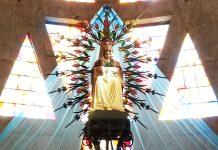
Newsroom (13/05/2026 Gaudium Press ) There is a particular kind of silence inside Velankanni’s basilica that people travel hundreds of kilometers to find. It is not merely the absence of sound, but a presence in itself—an accumulated stillness shaped by grief, hope, and generations of prayer. It is the kind of silence that asks nothing, yet gives everything.
Within that quiet, mothers close their eyes in devotion, elderly men count rosary beads, and even children—restless elsewhere—fall into an instinctive stillness, sensing something larger than themselves. It is a silence built over centuries.
That silence was broken before dawn on a recent Saturday.
In its place came chants of “TVK! TVK!”—loud, insistent, and unmistakably political. More than 500 people had gathered at the shrine near Nagapattinam, drawn by reports that TVK leader C. Joseph Vijay would arrive around 3 a.m. Whether the rumor held any truth is ultimately irrelevant. What matters is the consequence: a sacred space overtaken by anticipation, noise, and the energy of a political rally.
The crowd pressed into restricted areas. Mobile phones were raised where they are typically forbidden. The central aisle—one of the most symbolically significant spaces in a Catholic church—was occupied. The Holy Mass, a cornerstone of worship, was delayed as church authorities attempted to restore order.
Their appeals were only partially heard.
When it became clear that Vijay would not be arriving, the crowd dispersed toward the nearby beach, their disappointment captured by cameras that had followed them. What remained behind, however, was not just a disrupted service, but a deeper disturbance—one harder to quantify.
It might be tempting to dismiss the episode as hooliganism. But such a label simplifies what is, in reality, a more complex and uncomfortable phenomenon. To reduce the incident to mere misconduct allows both participants and observers to avoid asking more difficult questions about how reverence gives way to spectacle.
C. Joseph Vijay is not an ordinary figure. For many young people in Tamil Nadu, he represents something beyond traditional politics—a figure who inspires belief that feels personal, almost intimate. This kind of devotion is not inherently irrational; it is profoundly human.
But devotion, like fire, depends on context. In the right place, it warms and sustains. In the wrong setting, it overwhelms and destroys.
Those who gathered at Velankanni were not necessarily acting with malicious intent. Most were likely driven by enthusiasm, curiosity, or admiration. What failed them was not morality, but judgment—the ability to distinguish between a political gathering and a sacred space. That distinction seemed to collapse entirely.
Responsibility for that collapse does not lie with the crowd alone.
It rests, in part, with the Church, whose response has remained measured when stronger clarity may have been needed. It extends to TVK’s leadership, which cannot remain silent when its supporters inadvertently disrupt a religious sacrament. And it belongs, more broadly, to society itself, which too often applies outrage selectively—condemning transgressions in some contexts while rationalizing them in others.
The central aisle of a Catholic church is not just architectural design. It is a symbolic pathway—one traversed during life’s most significant rituals: weddings, funerals, baptisms. It carries emotional and spiritual weight for believers. Its occupation by a chanting crowd sent an unintended but unmistakable message to those gathered for Mass: that their moment of communion could wait, that their presence was secondary.
Some messages are delivered without words.
More troubling than the disruption itself is what it reflects about a broader shift. Across India, spaces once defined by introspection and transcendence are increasingly becoming arenas for assertion—places where identity is performed rather than surrendered. This pattern is not confined to one faith, region, or political ideology. It is widespread, and it is growing.
Each such incident erodes something intangible but essential. Sanctity is not easily rebuilt. It is not renewable in the way physical structures are. It depends on consistent, collective respect—and can be undermined in a single careless moment.
There is also a quieter, longer-term consequence: the impression left on children.
For those present—or those who will see footage and hear retellings—this moment becomes part of how sacredness is understood. If adults treat pilgrimage sites as venues for political enthusiasm, children will internalize that message. They may not remember the interrupted prayer or the delayed Mass. They will remember the chants.
That is what endures.
There was once a child, standing inside Velankanni Basilica, who did not understand why the air felt different but responded to it instinctively by falling silent. That child carried something home from that experience—something wordless, but lasting.
One wonders what would have been carried home if that air had instead been filled with slogans.
Velankanni has endured much in its history—natural disasters, colonial transformations, and the gradual erosion that comes with time. It will endure this as well. But endurance should not be the benchmark.
The real measure is whether such spaces can be protected—not through enforcement, but through instinctive respect. Whether individuals, left to their own judgment, will choose reverence over expression when the two come into conflict.
On that Saturday morning, the answer was no.
The more important question is whether, given another chance, it might be different.
Faith, in its simplest form, asks for very little. It asks for presence—quiet, attentive, unselfish presence. It is a demand far more difficult than travel or ritual. And it was precisely that presence which became impossible in Velankanni that morning, replaced not by hostility, but by something more subtle and perhaps more concerning: the inability to recognize when silence itself is sacred.
- Raju Hasmukh with files from UCA News
Related Images: