







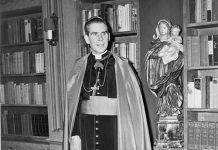




Pope Leo XIV appoints Emilio Biosca bishop of Venice, signaling continued emphasis on immigrant leadership in U.S. Catholic dioceses.
Newsroom (13/05/2026 Gaudium Press ) For nearly a year, Father Emilio Biosca Agüero has watched the congregation he leads steadily dwindle. At the Shrine of the Sacred Heart in Washington, D.C.’s Mount Pleasant neighborhood, fear has reshaped parish life.
The Capuchin parish, where Biosca has served as pastor since 2019, draws most of its 5,600 members from El Salvador. Since an intensification of federal immigration enforcement in the District last August, more than forty of those parishioners have been detained or deported. In one recent stretch, six individuals were arrested by Immigration and Customs Enforcement (ICE), including a church usher en route to evening Mass, a man preparing for marriage, and a participant in confirmation classes.
Attendance has dropped by roughly twenty percent. Once-full pews beneath the basilica’s mosaic dome now sit half empty. Some parishioners attend Mass virtually, too afraid to leave their homes. The church stands less than three miles from the White House, a geographic reminder of how national policy is shaping local lives.
On the same day the struggles of his parish continue, Biosca received news that will transform his ministry. Pope Leo XIV has appointed him the next bishop of the Diocese of Venice, Florida. The announcement, delivered by Monsignor Većeslav Tumir of the Apostolic Nunciature in the United States, marks the retirement of Bishop Frank Dewane, 76, who has led the diocese since 2007.
Biosca, 61, brings a distinctly international profile to his new role. A Capuchin Franciscan of the Province of Saint Augustine in Pittsburgh, he entered the order in 1987 and was ordained in 1994. His ministry spans continents: twelve years as a missionary in Papua New Guinea and another twelve in Cuba, serving communities in Havana, Santa Clara, and Manzanillo. Fluent in Spanish and Tok Pisin, Biosca has become a prominent figure in Washington’s Latino Catholic community during his tenure at Sacred Heart.
The Diocese of Venice, which he will soon lead, covers a large area of southwest Florida, including Fort Myers, Naples, and Sarasota. Politically, the region is firmly conservative; every county in the diocese voted for Donald Trump in the 2024 election. At the same time, it is home to a rapidly expanding Hispanic Catholic population, including Cuban, Mexican, and Central American communities.
Biosca’s appointment is part of a clear and accelerating pattern under Pope Leo XIV. In just five months, the pontiff has named four bishops with deep ties to Latin America to lead U.S. dioceses. Recent appointments include Manuel de Jesús Rodríguez, a Dominican-born priest assigned to Palm Beach; John Jairo Gómez of Colombia, named bishop of Laredo; and Evelio Menjivar-Ayala, a former undocumented Salvadoran refugee appointed to Wheeling-Charleston.
These decisions are not isolated. According to a tally published on May 7, eleven of the twenty-six bishops Leo had appointed to U.S. dioceses by early May were born outside the United States—approximately forty-two percent. Biosca’s selection brings the total to twenty-seven. The proportion significantly exceeds the roughly one-in-four share of foreign-born clergy among active U.S. priests, suggesting a deliberate effort to reshape episcopal leadership.
Geography further underscores the pattern. Many of the dioceses receiving immigrant or immigrant-rooted bishops are located in regions where immigration enforcement has been particularly visible or politically charged. From the southern border in Laredo to Florida’s coastal strongholds and West Virginia’s deeply conservative terrain, Leo’s appointments align closely with areas grappling most directly with the realities of migration policy.
The pope has offered little ambiguity about his priorities. Last November, U.S. bishops pledged support for migrants facing mass deportations. Within days, Leo publicly criticized the treatment of migrants in the United States as “extremely disrespectful.” His episcopal choices appear to translate that rhetoric into institutional direction.
Yet the strategy extends beyond immediate political context. Demographic shifts within American Catholicism present a longer-term imperative. Hispanic Catholics now make up thirty-six percent of all adult Catholics in the United States and constitute a majority among Catholics under thirty. Historically, however, the episcopate has not reflected that reality. Of roughly 200 active Latin Rite bishops at the time of Leo’s election, fewer than thirty were Hispanic.
While Pope Francis began addressing this imbalance, Leo has moved more rapidly. His appointments suggest an effort to align Church leadership more closely with the communities filling its pews—a pattern with historical precedent. Waves of Irish and Italian immigration in earlier centuries similarly reshaped the composition of American Catholic leadership.
For Biosca, the transition from Washington to Florida will be both geographic and pastoral. He leaves behind a parish marked by absence and anxiety, where many faithful remain unable or unwilling to attend Mass in person. In Venice, he will inherit a growing and diverse diocese facing its own intersection of faith, culture, and politics.
Before he departs, however, he will stand once more before the congregation at Sacred Heart. Some of his parishioners will be there. Others will watch remotely, constrained by fear. His appointment, while personal, forms part of a broader narrative unfolding across the American Church.
Taken together, the pattern of appointments signals a clear direction. Pope Leo XIV is shaping a leadership structure that reflects the lived experience of migrant communities and the demographic future of Catholicism in the United States. The trajectory is consistent and deliberate—and, as Biosca’s appointment suggests, still unfolding.
- Raju Hasmukh with files from Letters from Leo Substack
Related Images: