








Tensions rise as Spain’s government, bishops, and Benedictines clash over the Valley of the Fallen ahead of Pope Leo’s June visit.
Newsroom (19/05/2026 Gaudium Press ) When Pope Leo arrives in Spain this June, he will step into a politically and ecclesiastically charged conflict centered on one of the country’s most contentious historic sites: the Valley of the Fallen, officially renamed the Valley of Cuelgamuros. The dispute, involving the Spanish government, Church authorities, and a community of Benedictine monks, has exposed fractures over memory, authority, and the limits of state intervention in religious spaces.
A Monument of Reconciliation — or Division
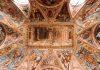
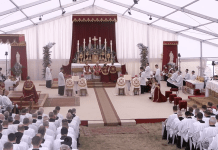
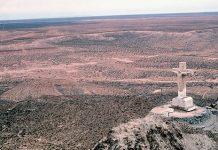
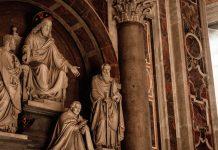
Constructed under the rule of General Francisco Franco after the Spanish Civil War, the Valley of the Fallen was conceived as a symbol of reconciliation. Commissioned in 1940, the complex combines powerful Catholic imagery with monumental architecture: a basilica carved into rock, a Benedictine abbey, and a towering 152-meter cross, the largest in the world.
More than 30,000 war dead are buried there, including both Nationalist and Republican fighters. Supporters have long presented the site as a place of unity, where prayers for reconciliation are offered for all victims of the conflict.
Yet critics argue that the monument remains inseparable from the Franco regime that created it. They contend that its symbolism exalts a dictatorship and frames the Nationalist victory as divinely sanctioned. Additional controversy surrounds claims about labor used during construction, with detractors alleging forced inmate labor, while defenders maintain that workers were volunteers who received compensation and sentence reductions.
The presence of Franco’s own remains at the site—until their exhumation in 2019—further amplified tensions, with the government arguing that the site had become a focal point for far-right pilgrimage.
Government Push for “Resignification”
At the center of the current conflict is the Spanish government’s effort to “resignify” the monument—transforming it into a space of democratic memory rather than a perceived relic of dictatorship. In April 2025, authorities launched an international design competition to redefine the site’s purpose and presentation.
The winning proposal envisions significant external changes, including the removal of the grand staircase leading to the basilica and the construction of a vast portico described as a “horizontal fissure” across the esplanade. This architectural intervention aims to encourage dialogue and pluralism while diminishing the monument’s rigid, axial symbolism.
Visitors would enter through a circular vestibule connecting both the basilica and a new visitor center—an arrangement that has already raised questions about whether it infringes on agreements ensuring independent access to the place of worship.
Interior changes are described as minimal, though the installation of interpretive panels in side chapels is planned to reshape the narrative of the space.
Church Denials and Leaked Correspondence
The Spanish bishops’ conference initially distanced itself from the project, insisting that the Church was neither its promoter nor its driving force. Officials also criticized the government for advancing plans without sufficient consultation and for potentially disregarding religious sensitivities.
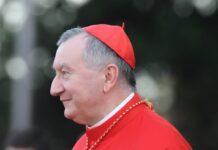
However, leaked correspondence between Madrid’s Archbishop, Cardinal José Cobo, and Justice Minister Félix Bolaños suggests a more complex reality. The letters, dated March 4–5, 2025, indicate that key elements of the resignification were discussed and coordinated before the project was publicly announced.
The documents reveal that Church authorities agreed to limit the basilica’s strictly liturgical space to the altar and seating area, reclassifying other sections—such as the nave and dome—as open to intervention, provided changes remain compatible with worship.
These disclosures have fueled criticism over transparency and raised doubts about the consistency of official Church statements. While public messaging emphasized minimal involvement, the correspondence points to active negotiations, reportedly conducted in coordination with the Holy See.
Vatican Role: Ambiguous and Contested
The Vatican’s precise role remains a point of contention. Spanish government officials have suggested that an agreement exists involving the Holy See and that the Vatican supports transforming the site into a symbol of democratic memory.
By contrast, the Spanish bishops’ conference maintains that the Vatican did not formally sign any agreements, though it participated in discussions. Statements from the Archdiocese of Madrid have alternated between acknowledging Vatican involvement and downplaying its specificity.
The contradictions have only deepened uncertainty over who ultimately holds authority in the negotiations—and whether the Church’s internal governance structures have been fully respected.
Benedictine Monks Challenge Authority
Complicating matters further is the position of the Benedictine community residing at the site. The monks argue that neither the Spanish bishops nor the Archdiocese of Madrid have the legal standing to represent them. As a sui iuris abbey directly subject to the Holy See, they claim autonomy in decisions affecting the monastery and basilica.
In November 2025, the monks filed a civil complaint seeking to halt the resignification process. Their legal argument rests on multiple foundations: the basilica’s status as a sacred and inviolable place under the 1979 agreement between Spain and the Holy See, and Vatican decrees establishing the abbey “in perpetuity.”
A 2020 legal report cited by Church authorities reinforces their position, asserting that only the abbey’s prior may represent it in legal matters. Any agreement signed by other ecclesiastical figures, the report suggests, could be considered null and void.
The complaint has temporarily frozen the project and cast doubt on whether any future modifications can proceed without the monks’ consent.
Escalating Stakes Ahead of Papal Visit
The dispute has already triggered further tensions. Reports indicate that the Spanish government has considered requesting the removal of the Benedictine community altogether—a move that would mark a dramatic escalation in church-state relations.
At stake is not only the future of a single monument, but broader questions about historical memory, religious freedom, and legal authority in a secular democracy.
As Pope Leo prepares to visit Spain, the Valley of the Fallen stands as a potent symbol of unresolved history—and a test case for how modern Europe navigates the intersection of politics, faith, and the legacy of the past.
- Raju Hasmukh with files from The Pillar
Related Images: