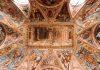
















Transparent barriers now shield St. Peter’s Altar after repeated acts of desecration, marking a sobering moment for Vatican security.
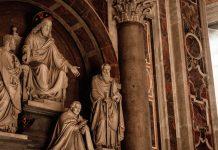
Newsroom (20/03/2026 Gaudium Press ) For centuries, the altar of St. Peter’s Basilica has stood as one of Catholicism’s holiest sites, a focal point for the faithful and a symbol of continuity from St. Peter himself. Today, visitors entering the world’s most famous church encounter a startling new sight: transparent barriers now encircle the Altar of the Confession. Installed by the Fabbrica di San Pietro, these polycarbonate panels are meant to safeguard the sacred space after a troubling series of desecrations that have shaken the Vatican.
The decision emerged as an act of necessity. Repeated intrusions and acts of vandalism forced the Fabbrica—the Vatican body responsible for managing the basilica—to implement a measure that both protects the sanctity of the altar and respects the integrity of its architectural heritage. The new barriers, officials explain, are “completely reversible and independent,” requiring no anchoring to the basilica’s existing structures and designed to be removed during major liturgical celebrations.
The panels are crafted from transparent polycarbonate to ensure what the Fabbrica describes as a “minimal visual impact.” Even so, their presence signals something deeper: a moment of reckoning in an age when attacks on sacred spaces—whether in Rome, Paris, or Toronto—are becoming disturbingly common. Despite increased security checkpoints and constant patrols, the basilica has witnessed several acts of desecration over the past two years.
In October, a man urinated on the altar. Only months earlier, another individual climbed onto it and hurled six candlesticks to the ground. The year before, a Polish visitor partially undressed and mounted the altar with an anti-war message written across his back. Each act required the Vatican to respond not just with security measures but with solemn penitential rites—liturgical gestures of reparation mandated by canon law after grievous offenses that scandalize the faithful.
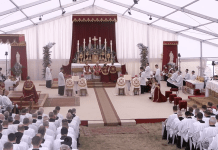
According to the Ceremonial of Bishops, a church becomes desecrated when “gravely injurious acts” are carried out within it, degrading its sacred character and making it unfit for worship until purification rites are completed. In the Vatican’s most guarded basilica, these ceremonies were celebrated twice last year alone.
The installation of anti-desecration barriers is thus both symbolic and practical. It underscores the Church’s resolve to protect its holiest spaces, even as it confronts a global rise in anti-Catholic acts. Reports suggest similar attacks have occurred with alarming frequency across France, Italy, Spain, Canada, and the United States—often without media attention.
The sight of transparent barriers surrounding St. Peter’s Altar may appear jarring to the pilgrims who have long flocked there seeking proximity to the tomb of the Apostle. Yet under the bright basilica lights, the panels barely glimmer—a quiet reminder that reverence, like glass, can be both fragile and enduring.
Security officials emphasize that these barriers are temporary. They will stand only as long as necessary to deter intruders and preserve the sanctity of the altar. Yet their mere existence speaks volumes about a changing world. If even the Vatican’s heart can be breached, the message is sobering: no sanctuary, however sacred, can be taken for granted.
- Raju Hasmukh with files from INfocatholica
Related Images: