














Archbishop Georg Gänswein says SSPX hardliners rejected Benedict XVI’s outreach and urges Rome to restore flexibility on the Latin Mass.
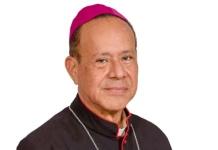
Newsroom (06/07/2026 Gaudium Press ) Archbishop Georg Gänswein, the longtime private secretary of Pope Benedict XVI and now Apostolic Nuncio to the Baltic States, has offered a blunt assessment of the Society of Saint Pius X (SSPX), arguing that hardline elements within the movement have rejected reconciliation with Rome and become even more entrenched than they were during Benedict XVI’s pontificate.
Reflecting on the ongoing divisions between the Vatican and the traditionalist group founded by Archbishop Marcel Lefebvre, Gänswein expressed disappointment that Benedict XVI’s effort to restore full communion failed despite significant gestures from the Holy See. According to the archbishop, Benedict spent years seeking to heal the rupture because he believed unity at the altar was essential for the life of the Church.
Gänswein’s comments came as debate intensified following the public reading at Écône of a text asserting that Church authorities since the Second Vatican Council had acted in a manner contrary to the faith and sacred tradition. For the former papal secretary, such claims demonstrate a conception of tradition that differs fundamentally from the Catholic understanding embraced by the Church.
He argued that many within the SSPX effectively treat Catholic tradition as having ended with the pontificate of Pius XII, viewing subsequent developments in the Church primarily through the lens of error. In his view, this approach represents a rigid interpretation of tradition that leaves little room for legitimate doctrinal and ecclesial continuity after the Second Vatican Council.
Benedict XVI’s Failed Reconciliation Effort
Drawing on his years at Benedict XVI’s side, Gänswein recalled the late pope’s determination to act as a bridge-builder. He pointed to Benedict’s 2009 decision to lift the excommunications of four SSPX bishops as a significant attempt to foster reconciliation and create the conditions for renewed dialogue.
According to Gänswein, Benedict approached the issue pastorally, believing that those who sincerely desired reconciliation with the Church should be given the opportunity to return to full communion. The pope saw his actions as those of a spiritual father seeking peace rather than division.
However, Gänswein believes those efforts were ultimately rejected by influential factions within the movement. He contends that a radical current within the SSPX opposed reconciliation from the beginning and continues to resist it today. Rather than moving closer to Rome over time, he argues that parts of the movement have become increasingly hardened in their positions.
While acknowledging that grace can bring change over time, he said current developments suggest a growing distance from the unity desired both by Benedict XVI and by Pope Leo.
More Than a Liturgical Dispute
A central theme of Gänswein’s assessment is his conviction that the conflict with the SSPX cannot be reduced to disagreements over liturgy.
He stressed that the existence of communities fully united with Rome that celebrate the traditional Latin Mass demonstrates that the central issue is not the Tridentine liturgy itself. As an example, he pointed to the Priestly Fraternity of Saint Peter, whose members celebrate according to the older liturgical books while maintaining full obedience to the pope.
Gänswein also noted that the Second Vatican Council’s liturgical reforms did not eliminate Latin from the Church’s worship. Furthermore, he highlighted the fact that Archbishop Lefebvre himself signed Sacrosanctum Concilium, the Council’s Constitution on the Sacred Liturgy, during the council proceedings.
These realities, he suggested, show that attachment to the traditional liturgy does not necessarily imply opposition to the post-conciliar Church or rejection of papal authority.
Criticism of Restrictions on the Latin Mass
Despite his criticism of the SSPX, Gänswein also delivered a notable critique of the Vatican’s current policy regarding the traditional Latin Mass.
He argued that Rome could adopt a more flexible, generous, and pastoral approach toward Catholics who wish to celebrate or attend Mass according to the 1962 Roman Missal. Such a move, he believes, would not only remove a frequent point of contention exploited by the SSPX but also contribute to greater harmony within the Church.
In this context, Gänswein directly questioned the wisdom of Traditionis Custodes, the document issued by Pope Francis that imposed restrictions on the broader access to the traditional Latin Mass previously granted by Benedict XVI through Summorum Pontificum in 2007.
The archbishop described the decision as a mistake and argued that erroneous decisions can and should be corrected. In his assessment, the restrictions reversed a policy that had produced positive results over the course of more than a decade.
Defending the Legacy of Summorum Pontificum
Gänswein rejected the argument that Benedict XVI’s liberalization of the traditional liturgy primarily fostered division within the Church.
While acknowledging that some abuses accompanied the implementation of Summorum Pontificum, he maintained that isolated problems should not have led to broad limitations affecting all faithful attached to the older form of the Roman Rite. He invoked the traditional principle that abuse of a practice does not negate its legitimate use.
According to Gänswein, a decade of experience demonstrated that Benedict’s policy had borne substantial fruit. He also maintained that a majority of bishops supported preserving the openings established by Summorum Pontificum rather than restricting them.
For the archbishop, restoring greater freedom for the celebration of the traditional Latin Mass would help recover what he described as a damaged liturgical peace within the Church.
A Dual Message
Gänswein’s remarks present a dual challenge. On one side, he offers a forceful criticism of SSPX leaders whom he believes have rejected repeated efforts at reconciliation and chosen a path of increasing separation from Rome. On the other, he argues that the Vatican should revisit restrictions on the traditional Latin Mass and recover the more accommodating approach championed by Benedict XVI.
His comments reflect a continuing conviction that ecclesial unity requires both fidelity to the Church’s authority and a pastoral willingness to accommodate legitimate liturgical diversity. In his view, reconciliation with traditionalist Catholics remains possible, but only if the divisions surrounding authority and communion are addressed while fostering a more peaceful liturgical environment within the Church.
- Raju Hasmukh with files from Corriere della Sera
Related Images: