
















Nigerian Catholic bishops criticize the reintegration of repentant bandits, urging justice for victims amid kidnappings, killings and displacement.
Newsroom (03/07/2026 Gaudium Press ) Catholic bishops in southwestern Nigeria have strongly criticized the reintegration of so-called “repentant bandits” into society and security structures, describing the policy as a serious miscarriage of justice and an affront to victims of violent crimes.
The condemnation comes amid growing concerns over insecurity across the country and follows the abduction of dozens of pupils and teachers from schools in Oyo State. Church leaders argue that while victims continue to suffer trauma, loss and uncertainty, authorities appear increasingly willing to rehabilitate perpetrators without ensuring accountability.
In a statement issued on 22 June and titled “Gone for Too Long, Bring Them Home Now,” the bishops of the Ibadan Ecclesiastical Province called for the immediate release of 39 pupils and seven teachers kidnapped from three schools in Esiele, Oriire Local Government Area of Oyo State in May.
“It is over a whole month since 39 learners and seven teachers were kidnapped,” the bishops stated.
They drew attention to the harsh conditions allegedly endured by the captives, noting that the children have spent more than a month in the forest without proper shelter, adequate nutrition or protection from the elements.
The attack that led to the abductions was particularly brutal. According to the bishops, a teacher and a motorcyclist were killed during the kidnapping, while another teacher was later beheaded in the forest.
The statement was jointly issued by bishops from the Archdiocese of Ibadan and the Dioceses of Ekiti, Ilorin, Ondo and Oyo. The church leaders expressed concern over what they described as the inability of President Bola Tinubu’s administration to effectively curb escalating violence throughout Nigeria.
Central to their criticism was the government’s approach to former bandits who claim to have renounced criminal activity. The bishops argued that rehabilitation and reintegration efforts, when pursued without meaningful justice for victims, risk undermining public confidence in the rule of law.
“The ongoing reintegration of so-called repentant bandits into security agencies and society, while victims of crime and their relatives are neglected or treated with disdain, rubs dirt on the face of justice,” the bishops said.
They maintained that genuine justice requires accountability and insist that those responsible for kidnapping, banditry and other violent crimes should face legal consequences rather than receive rehabilitation opportunities without adequate restitution.
According to the bishops, failing to hold offenders accountable may embolden criminal groups and weaken national efforts to confront insecurity. They warned that policies perceived as rewarding perpetrators could send a damaging message to law-abiding citizens while deepening the anguish of victims and their families.
Beyond criticism, the church leaders proposed a series of reforms aimed at strengthening Nigeria’s security architecture. Their recommendations included improved intelligence gathering, enhanced monitoring of forests and ungoverned territories, increased deployment of modern security technology and the creation of state police forces.
They argued that state policing, supported by proper oversight and safeguards, would allow for more effective community-based intelligence gathering, quicker responses to emerging threats and stronger cooperation between security agencies and local populations.
The bishops emphasized that Nigeria’s security challenges vary significantly across regions and therefore require decentralized solutions tailored to local realities. In their view, sustainable peace, national healing and unity can only be achieved when justice, accountability and victim support become central pillars of security policy.
Violence and Displacement in Taraba State
Similar concerns have been raised in northern Nigeria, where church leaders report a worsening humanitarian and security crisis.
The Diocese of Wukari in Taraba State has appealed for stronger government intervention after reporting widespread violence, deaths and displacement over the past year.
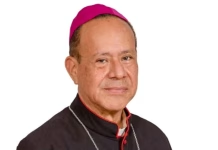
According to Bishop Mark Maigida Nzukwein, violence in the region has claimed the lives of 80 Catholics and led to the destruction of more than 200 church communities since September 2025. The attacks have reportedly displaced approximately 90,000 people.
The bishop attributed many of the assaults to suspected Fulani militia groups. He said attackers often strike in the early hours of the morning while residents are asleep, killing indiscriminately and setting homes and harvested crops on fire.
Nzukwein also alleged that armed groups have seized farmland belonging to local communities and violently prevented residents from returning. He further reported incidents involving killings, sexual violence and attacks on farmers.
“There have been instances where they block the roads and kill unsuspecting and harmless farmers with impunity,” he said.
“Most recently, the militiamen have resorted to harvesting the farm produce of displaced communities and feeding same to their animals.”
Describing the situation as an existential threat, the bishop warned that the crisis continues to endanger both lives and religious freedom in southern Taraba State. He said the violence has hindered community development while creating major obstacles to the growth of Christian communities in affected areas.
Although he welcomed certain government security interventions, Nzukwein called for expanded operations in areas experiencing persistent attacks, including Chanchanji Ward and parts of Takum, Ussa and Donga local government areas.
He urged authorities to intensify efforts to protect vulnerable communities and fulfill their constitutional responsibility to safeguard lives and property.
“As a matter of urgency, adequate security personnel should be mobilised and deployed to the hinterlands where this carnage is taking place unabated,” he said.
The bishop further called for the immediate arrest and prosecution of both perpetrators and enablers of violence, regardless of their ethnic, political or religious affiliations.
In addition to security measures, Nzukwein appealed for humanitarian assistance for internally displaced persons. He urged governments, aid organizations, non-governmental organizations, philanthropists and other stakeholders to provide essential relief items, including food, bedding, toiletries, medical care and temporary shelter.
He also advocated dialogue involving traditional rulers, religious leaders, security agencies and political authorities as part of broader efforts to achieve lasting peace in the region.
Warning that continued inaction could have serious consequences, the bishop suggested that international assistance may become necessary if authorities fail to guarantee the safety of affected populations.
The combined appeals from church leaders in southwestern and northern Nigeria underscore growing frustration with persistent insecurity and a perceived lack of justice for victims. As kidnappings, killings and displacement continue to affect communities, the bishops argue that restoring public trust will require not only stronger security measures but also a commitment to accountability and support for those who have suffered the consequences of violence.
- Raju Hasmukh with files from The Tablet UK
Related Images: