















We must be vigilant so as not to become complacent regarding our purpose in this life.
Newsroom (20/07/2026 Gaudium Press ) The Gospel for this Sixteenth Sunday in Ordinary Time presents us with the parable of the wheat and the tares, narrated by the Divine Master. This parable invites us to reflect on two fundamental aspects of our spiritual life: purity of intention and vigilance.
Context of the Parable
First, it is necessary to keep in mind the context in which Our Lord found himself. Last Sunday, the Gospel presented us with the sequence of seven parables of the Savior (cf. Mt 13:1-23), spoken on the shores of the Sea of Galilee, where neither the roar of engines nor the clamor of the modern world could compete with the voice of Jesus. Only the rhythmic murmur of the waves and the whisper of the wind offered humble musical accompaniment to his saving words.
Since the region’s irrigation system favored agriculture in the surrounding area, it is likely that the audience consisted of people familiar with the imagery Jesus used. Building upon the elements already employed in the parable of the sower—as we saw last Sunday—Jesus continues to develop another parable, to elucidate some further mysteries of the Kingdom of Heaven.
The Enemy’s Hatred of the Farmer
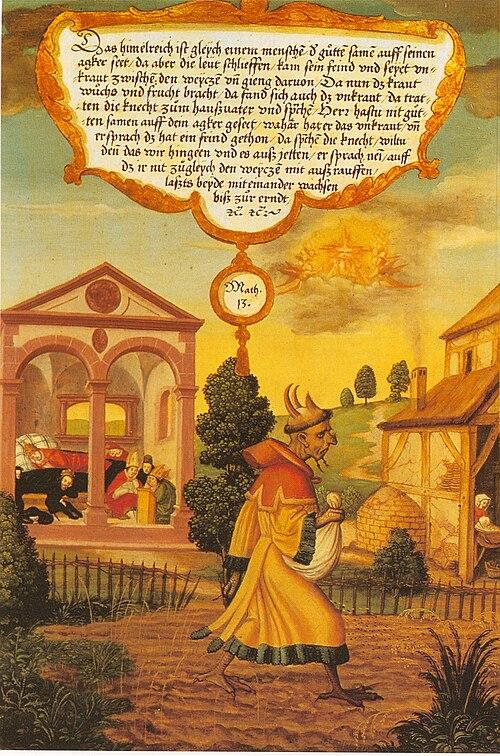
“Jesus told them another parable: ‘The kingdom of heaven is like a man who sowed good seed in his field. But while everyone was sleeping, his enemy came and sowed weeds among the wheat, and went away’” (Matthew 13:24-25).
It is important to note that the enemy arrived after the seed had already been sown. Why didn’t the adversary act before the sowing, directly damaging the soil to prevent the crop? Because his hatred wasn’t directed at the harvest itself, but at the one who tended it. Similarly, the devil works with us by mixing the weeds of pride with the wheat of good works.
It can happen that someone does something very good and praiseworthy, but without purity of intention. For example, a person who dedicates themselves to studying the Catechism not with the intention of glorifying God and doing good to souls, but to be praised for their knowledge.
How can we know if an action is performed with pure intention? “Every good tree bears good fruit, but a bad tree bears bad fruit. A good tree cannot bear bad fruit, nor can a bad tree bear good fruit. Every tree that does not bear good fruit is cut down and thrown into the fire. Thus, by their fruit you will recognize them” (Matthew 7:17-20).
On the contrary, if, despite our efforts to practice virtue and avoid sin, we feel weeds sprouting within us, let us not lose heart! This trial is necessary because, through it, we recognize our complete dependence on the grace and help of our Creator, without which the seed of pride rooted in our hearts cannot be overcome. Furthermore, it is through difficulties like these that God gives value to our spiritual life, purifying it as gold is tested by fire (cf. 1 Peter 1:7).
Our Purpose on This Earth
Another important aspect of this parable is that the enemy only arrived while the people were sleeping. Our soul, too, is a field of sowing that we must constantly tend. We must be vigilant so as not to neglect our purpose.
What is the ultimate end of every human being? As the Catechism teaches us, we must love, praise, and know God, and through this, save our souls. Hence the importance of vigilance over our actions and intentions throughout our lives.
May the Blessed Virgin, the archetypal model of purity of intention, intercede for us before the Lord of the harvest, so that we may always be mindful of our intentions and never be discouraged by any difficulty or temptation.
By Kaio Calixto
The post “Parable of the Wheat and the Tares: Symbol of the Spiritual Life” appeared first on Gaudium Press Español.
Related Images: