








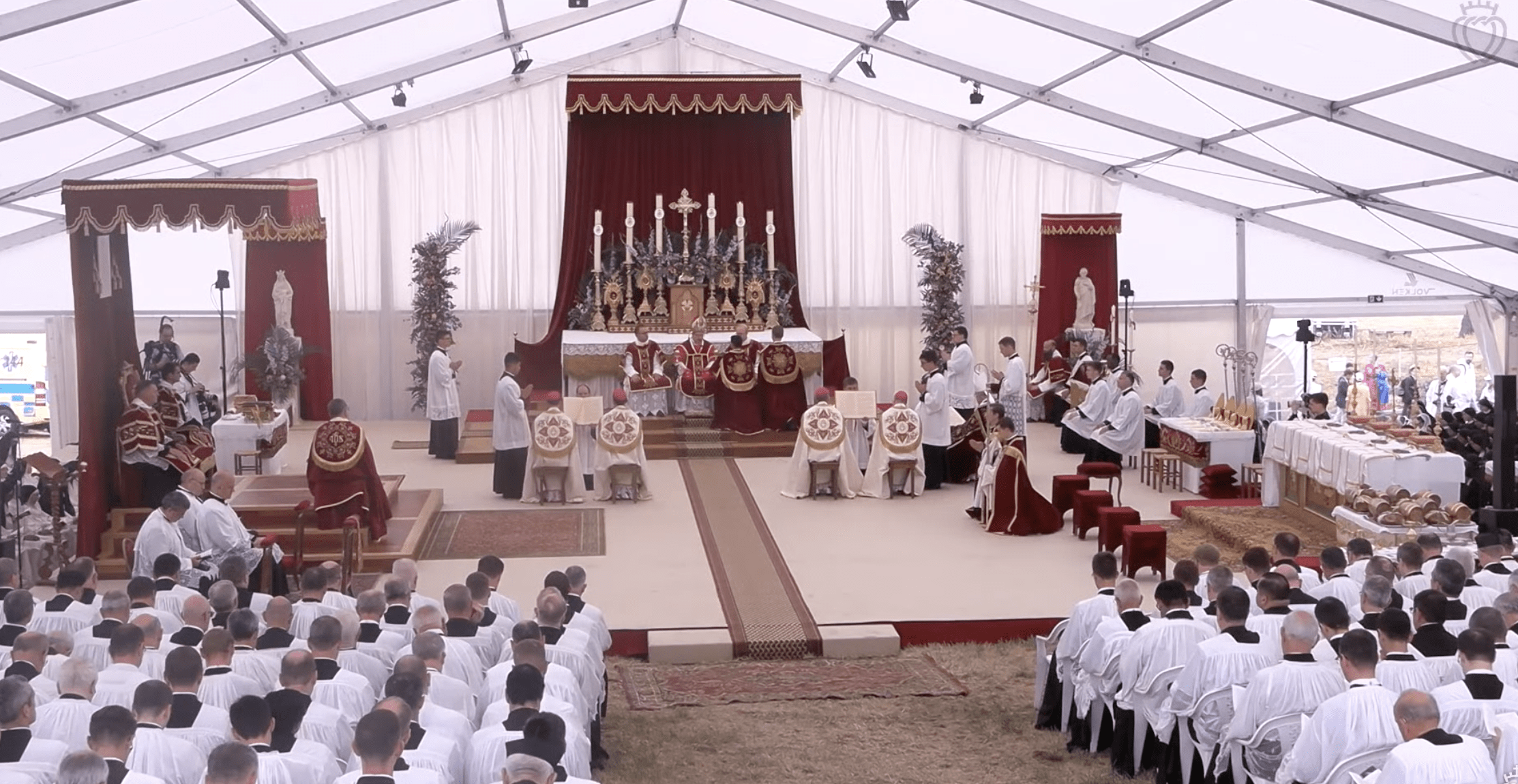
SSPX consecrates four bishops without papal mandate, deepening crisis for Pope Leo XIV and raising imminent risk of formal schism.
Newsroom (01/07/2026 Gaudium Press ) Under a clear morning sky in the Rhône Valley, thousands gathered on July 1 for a ceremony that now threatens to fracture the Catholic Church once again. In a deliberate act of defiance, the Priestly Fraternity of Saint Pius X (SSPX) consecrated four new bishops without a papal mandate, directly challenging the authority of Pope Leo XIV and placing the Vatican on the brink of formally declaring a schism.
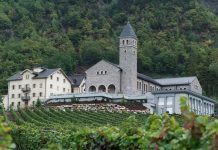
The event unfolded at the SSPX’s International Seminary in Ecône, the same location where Archbishop Marcel Lefebvre carried out illicit episcopal consecrations in 1988—an act that led to one of the most serious ruptures in modern Church history. Thirty-eight years later, the symbolism was unmistakable, and the implications potentially just as grave.
A Crisis Early in Leo XIV’s Pontificate
Not yet two years into his pontificate, Leo XIV now faces one of the most delicate and defining crises of his ministry. A schism within the Church is always considered a tragedy, but in this case it carries a personal dimension: the Pope belongs to the Augustinian order, the same religious family as Martin Luther, whose actions sparked the Protestant Reformation.
Despite a direct and urgent appeal from the Pope warning of the “extremely serious sin” involved, the SSPX proceeded with the consecrations. According to canon law, such acts without papal approval constitute a schismatic offense.
The Vatican has not yet issued its formal response, but a declaration of schism is widely expected.
The Ceremony: Ritual Precision, Canonical Defiance
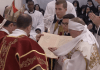
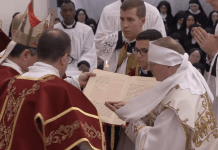
The ceremony itself followed the traditional rites of episcopal consecration with meticulous precision—yet lacked its essential requirement: authorization from the Pope.
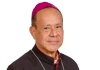
Presided over by Spanish Bishop Alfonso de Galarreta, assisted by Swiss Bishop Bernard Fellay—both figures tied to the 1988 consecrations—the rite unfolded before an estimated 17,000 faithful from nearly seventy countries.
The four new bishops—Pascal Schreiber (Switzerland), Michael Goldade (United States), Michel Poinsinet de Sivry (France), and Marc Hanappier (France)—were presented as auxiliaries intended to “serve the Church.” In practice, however, their consecration marks a decisive escalation in the SSPX’s long-standing conflict with Rome.
The liturgy, conducted entirely in Latin and according to the 1962 Roman Missal, included the laying on of hands, anointing with holy chrism, and the formal bestowal of episcopal insignia. The newly consecrated bishops concelebrated Mass and received Communion from the same Host and Chalice as the consecrator, symbolizing unity within their priesthood—even as their status within the wider Church remains contested.
Echoes of 1988
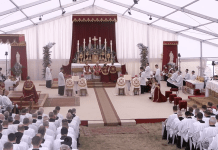
Nearly every element of the ceremony appeared designed to evoke the 1988 rupture. The feast day—the Most Precious Blood of Christ—was identical. The throne used by Bishop de Galarreta had belonged to Lefebvre. Even the setting mirrored the earlier event, down to the large tent erected on the Ecône grounds.
The atmosphere blended solemnity with a sense of occasion. Pilgrims arrived hours in advance, many in traditional attire, filling the meadow with folding chairs and watching the proceedings on large screens. The SSPX even offered commemorative items, including a specially branded wine labeled “Cuvée des Sacres.”
Yet beneath the pageantry lay a clear message: continuity with Lefebvre’s legacy and resistance to Rome.
Justification and Doctrinal Divide
In his homily, SSPX Superior General Father Davide Pagliarani defended the consecrations as a response to a “state of necessity,” arguing that Church authorities since the Second Vatican Council have departed from authentic tradition.
“We consider it a sacred duty toward the Church and souls,” he said, “to proceed with the consecration of bishops fully faithful to holy tradition.”
Pagliarani rejected the idea that the act constituted a break with the Church, calling it a “false dilemma” to choose between fidelity to the faith and ecclesial communion. At the same time, his remarks underscored a profound doctrinal rupture, particularly regarding religious freedom and other teachings of Vatican II.
In a striking paradox, the newly consecrated bishops pledged to “fight schismatic heretics,” even as their own actions risk placing them formally outside Church communion.
The Canonical Stakes
While the rite itself is considered valid in sacramental terms, its illegitimacy under canon law carries serious consequences. The bishops involved may face excommunication, and a formal declaration of schism would further isolate the SSPX.
For the estimated 600,000 faithful associated with the Fraternity, the situation remains complex. Attendance at SSPX ceremonies does not automatically incur excommunication unless accompanied by a conscious rejection of papal authority. This distinction, clarified by Church authorities in previous decades, continues to apply.
However, a formal schism could lead to stricter measures. Concessions previously granted—such as faculties for confession and marriage—may be revoked, further deepening the divide.
A Church at a Crossroads
As the Te Deum rang out across Ecône and the newly consecrated bishops imparted their first blessings, the immediate atmosphere was one of triumph among attendees. But beyond the Swiss meadow, the broader Church now awaits Rome’s response.
The SSPX has long existed in a canonically irregular state, but this latest act represents a direct challenge to papal authority at the highest level. If the Vatican confirms a schism, the consequences will extend far beyond Ecône, reshaping the relationship between traditionalist movements and the institutional Church.
For Pope Leo XIV, the moment is both institutional and deeply personal: a test of authority, unity, and the enduring tension between tradition and obedience within Catholicism.
- Raju Hasmukh with files from ACI Prensa and Infovaticana
Related Images: