












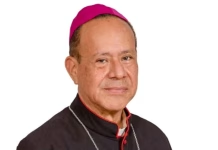

Jesuit Brother Guy Consolmagno, who served as Director of the Vatican Observatory from 2015 until September 19, 2025, shared profound insights into the intersection of astronomy and theology
Newsroom (23/09/2025, Gaudium Press ) In an exclusive interview with Vaticanstate.va, Jesuit Brother Guy Consolmagno, who served as Director of the Vatican Observatory from 2015 until September 19, 2025, shared profound insights into the intersection of astronomy and theology, the evolution of the Vatican Observatory, and its contributions to modern science. With a career spanning decades, Consolmagno emphasized that beauty and joy in astronomy are not merely aesthetic experiences but signs of God’s presence, guiding both scientific inquiry and spiritual reflection.
A Legacy of Scientific Evolution
The Vatican Observatory, or Specola Vaticana, founded in 1891 by Pope Leo XIII, has undergone significant transformation over its 130-year history, mirroring broader changes in scientific practice. Consolmagno noted that early research was tightly controlled by the Observatory’s director, focusing on limited projects. This began to shift in the 1970s under Fr. Patrick Treanor and accelerated under Fr. George Coyne, who granted astronomers greater independence to pursue individual research.
Coyne’s tenure was marked by the construction of the Vatican Advanced Technology Telescope (VATT) in Arizona, a project that consumed much of the Observatory’s resources in the 1990s, limiting active research to a small team. However, Coyne’s recruitment of new Jesuit astronomers laid the groundwork for a research boom. By the time Fr. José Funes took over, the Observatory had relocated to modern facilities in the Papal Gardens in 2009, boasting an enhanced meteorite lab and an expanded network of “Adjunct Astronomers”—external scientists affiliated with the Specola. Today, the Observatory supports a dozen Jesuit astronomers working in fields like stellar spectroscopy, meteoritics, and minor planet observations, complemented by adjuncts whose expertise broadens its scope.
Consolmagno proudly stated, “It would be hard to find an area of modern astronomical research where the Specola is not present.” Beyond observational astronomy, the Observatory has made strides in the history and philosophy of science, with notable contributions from adjuncts like Ileana Chinnici and Christopher Graney, whose award-winning books explore astronomy’s historical roots, and Louis Caruana and Fr. Giuseppe Tanzella-Nitti, who delve into the philosophy and theology of science. The Specola’s output of peer-reviewed papers has tripled over the past three decades, fulfilling Pope Leo XIII’s mandate to demonstrate the Church’s commitment to rigorous science.
Significant Discoveries Under Consolmagno’s Tenure
When asked about the Observatory’s most impactful contributions during his directorship, Consolmagno highlighted several highly cited papers. A 2017 study on galaxy gas stripping, led by Bianca Poggianti with contributions from Specola astronomer Alessandro Omizzolo, has been cited 330 times, according to the NASA ADS Database. Other notable works include Chris Corbally’s contributions to the LAMOST stellar survey (cited 123 times) and a meteorite physical properties review co-authored by Consolmagno and Robert Macke (cited 105 times). A 2018 paper by Richard D’Souza on the Andromeda galaxy’s evolution, published in Nature and featured on the cover of Sky and Telescope, has garnered 112 citations.
Consolmagno also pointed to emerging research with long-term potential. Gabriele Gionti and Matteo Galaverni’s cosmological calculations, published in a prestigious physics journal, offer fresh perspectives on the universe’s earliest moments. Meanwhile, Robert Macke’s work on the physical properties of asteroid Bennu samples from NASA’s recent mission, alongside his contributions to the Lucy mission studying Trojan asteroids, promises to shape our understanding of asteroids and their potential interactions with Earth.
Bridging Astronomy and Theology
Consolmagno’s reflections on the relationship between astronomy and theology are deeply rooted in the Vatican’s mission. Quoting Saint John Paul II, he noted that science and faith are mutually purifying: “Science can purify religion from error and superstition; religion can purify science from idolatry and false absolutes.” He emphasized that science cannot prove God, nor can scripture answer scientific questions, as scientific understanding evolves while theological truths remain eternal.
Yet, Consolmagno finds that science enriches his faith by offering “poetic metaphors” for the divine. The beauty and joy he encounters in astronomy—whether in the elegance of a galaxy or the precision of a meteorite’s composition—are, to him, signs of God’s presence. “Knowing what beauty and joy feel like allows me to recognize them in my prayer,” he said, “and vice versa, getting to know them in prayer allows me a sense of what to look for in my science.”
Addressing Modern Astronomy’s Challenges
Consolmagno identified a growing challenge to astronomy: waning societal support for science. While the past 70 years saw robust government backing for research, particularly in the U.S., Europe, Japan, and China, this support is now at risk. Beyond funding, he pointed to a deeper cultural shift where the concept of objective truth is increasingly questioned. “Many people fear dealing with uncomfortable truths that challenge their privilege,” he said, noting that both science and religion, as defenders of truth, face this cultural attack.
The Vatican Observatory counters this trend by standing as a beacon for the intrinsic value of knowledge. “It insists that pure knowledge of God’s creation is worthwhile in and of itself,” Consolmagno said. By providing stable resources and a platform for truth-seeking, the Specola challenges societal prejudices that prioritize financial gain over intellectual pursuit.
Reconciling Science and Scripture
On reconciling scientific cosmology with Church teachings, Consolmagno offered a clear distinction: “The Church teaches God created the universe; science tells me how it was done.” He noted that scripture, written over a millennium, reflects the evolving “best science” of its time, but its core message—God as the deliberate, loving creator—remains constant. The Genesis creation story, culminating in the Sabbath, invites humanity to delight in God’s creation, a principle that aligns with the Observatory’s mission.
A Life Shaped by Faith and Science
Consolmagno’s journey into astronomy and religious life was inspired by his Catholic education in the 1950s and 1960s, where science was encouraged, and by role models like Fr. George Coyne, a Jesuit astronomer. His time in the Peace Corps in Kenya solidified his love for teaching astronomy, leading him to join the Jesuit order. A pivotal moment came during his philosophical studies, when reading Athanasius’s On the Incarnation illuminated the connection between loving creation and loving its Creator.
A Lasting Contribution
Reflecting on his contributions, Consolmagno highlighted his work revitalizing the Vatican Observatory’s meteorite collection. Over two decades, he developed methods to measure meteorite physical properties, work that has proven foundational for asteroid research and remains relevant despite evolving theoretical models. By sharing this data and the collection with the scientific community, he fostered collaborations that advanced meteoritics globally.
Beyond science, Consolmagno’s career has showcased the Vatican’s commitment to knowledge for its own sake. Representing the Holy See at international forums, including a 2018 United Nations conference and leadership roles in organizations like the International Astronomical Union, he has elevated the Vatican’s presence in global science.
Looking Ahead
Though stepping down as director, Consolmagno remains active at the Specola, continuing his meteoritics research and public outreach through talks and potential books. As president of the Vatican Observatory Foundation, he will spearhead fundraising to support the VATT and educational initiatives, including summer schools and programs for scientists and educators. His work continues to embody Pope Leo XIII’s vision: showing the world that the Church champions good science, driven by a love for truth and creation.
- Raju Hasmukh with files from vaticanstate.va
Related Images: