














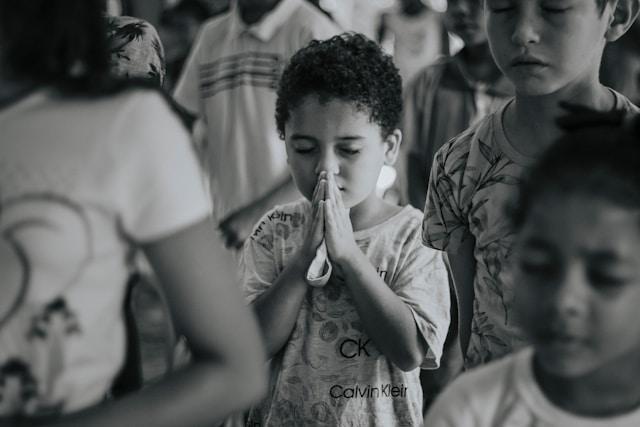
A Chinese priest criticizes rules banning minors from religious worship, warning of deeper societal consequences amid rising youth crises.
Newsroom (27/05/2026 Gaudium Press ) A priest living in the People’s Republic of China has issued a striking critique of administrative restrictions that effectively bar minors from participating in religious life, raising broader concerns about constitutional rights, social values, and the well-being of younger generations.
His reflection, shared with AsiaNews, comes at a time when the Catholic Church marked the annual Day of Prayer for the Church in China. Speaking during the Regina Caeli prayer last Sunday, Pope Leo XIV urged unity among China’s faithful, invoking the intercession of Mary Help of Christians, venerated at the Shrine of Sheshan. He called on believers to remain resilient witnesses to their faith amid daily struggles, becoming “seeds of hope and peace.”
Yet for many Chinese Catholics, that witness is increasingly complicated by strict enforcement of regulations that prohibit individuals under the age of 18 from attending religious activities. Officially framed as “protective administrative procedures” and applied across all religions, these measures have sparked debate over whether they constitute a violation of basic freedoms.
A Contradiction in Practice
According to the priest, the policy reveals a troubling contradiction in contemporary Chinese society. While minors are able to enter shopping malls freely, consume online entertainment late into the night, and access a vast array of unregulated digital content, they are often barred from even stepping inside a church.
At some church entrances, signs reportedly state plainly: “Minors not allowed.”
“Who could be threatened by a child sitting calmly in church?” the priest asks. He describes situations where children seeking only to accompany their parents, listen to hymns, or quietly observe are turned away.
The comparison, he suggests, highlights a deeper tension between governance and fundamental rights. What is presented as routine administration, he argues, oversteps legal boundaries.
Constitutional Questions
Central to the critique is Article 36 of China’s Constitution, which affirms that citizens enjoy freedom of religious belief. The text does not include any age-based limitation.
The priest emphasizes that children are, first and foremost, citizens. As such, they should share in the same legal protections, including the right to spiritual development, access to culture, and personal dignity.
“If a child is not even allowed to enter a religious building,” he writes, “then who will respect their spiritual world?”
His appeal reframes the issue beyond theology, grounding it instead in legal consistency and civic rights.
Youth in Crisis
The reflection also ties the ban to wider social concerns. Across China, public discourse has increasingly focused on issues such as teenage depression, anxiety, school bullying, and what many describe as a growing confusion of values.
In that context, the priest argues, excluding children from religious spaces removes one of the few environments historically associated with reflection, moral education, and emotional grounding. Churches, he notes, have traditionally offered spaces where individuals encounter ideas of compassion, forgiveness, moderation, and respect for life.
The result is a paradox: society expresses concern about the lack of “spiritual strength” among youth while simultaneously restricting their access to spiritual formation.
“Is this not a contradiction?” he asks.
Fear and the Future
The priest’s reflection suggests that the restrictions reflect a deeper unease about the role of faith in shaping young minds. He distinguishes between legitimate concerns—such as preventing coercion or exploitation—and blanket prohibitions that deny children exposure to religious culture altogether.
“Avoiding imposition” and “banning entry to church,” he argues, are fundamentally different.
He cautions that a society confident in its values should not fear young people asking existential questions: Why do we live? What is truth? What is good and evil?
Such questioning, he suggests, is foundational to the development of mature citizens and strong civilizations.
A Measure of Civilization
Expanding his argument, the priest frames the issue as a measure of societal development. The true strength of a nation, he contends, lies not only in economic growth or urban infrastructure, but also in the moral and spiritual formation of its people.
“All great civilisations understand,” he writes, “that the future of a nation depends not only on skyscrapers, but on whether the new generation has a soul.”
In this view, restricting children’s access to religious spaces reflects misplaced priorities—allowing immersion in consumerism and entertainment while fearing engagement with questions of meaning and purpose.
A Closing Warning
The reflection ends with a stark warning: the greatest risk is not that children might encounter faith too early, but that they may never encounter it at all.
“What is truly dangerous,” he concludes, “is an age that systematically deprives children of the opportunity to connect with truth, goodness, and beauty.”
If a quiet child sitting in a church becomes a source of unease, he suggests, the issue lies not with the child—but with the condition of the society itself.
- Raju Hasmukh with files from Asianews.it
Related Images: