















Bishop Edmilson Amador defends Afro-Brazilian rite at Guarulhos Cathedral, citing Vatican II’s call for dialogue and religious freedom.
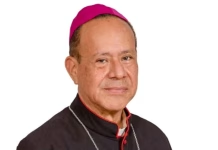
Newsroom (27/03/2026 Gaudium Press ) The Bishop of Guarulhos, Dom Edmilson Amador Caetano, has publicly defended the authorization of the “washing of the Guarulhos cathedral,” a traditional Afro-Brazilian religious rite performed on March 21 in front of the city’s cathedral. The event, marking the National Day of Afro-Brazilian Traditions, sparked debate among Catholics and drew criticism on social media from those who viewed the ceremony as inappropriate at a Catholic site.
In a statement released on March 25, Bishop Edmilson cited the guiding principles of the Second Vatican Council to explain his decision, underscoring the Church’s commitment to mutual respect and dialogue with non-Christian faiths. “We live under the guidance of the Second Vatican Council, which in the Declaration Nostra Aetate speaks of the seeds of the Word of God present in all non-Christian religious expressions, as well as the need to live in a spirit of fraternity with all religions,” the bishop said.
He further referenced the Vatican II document Dignitatis Humanae, which emphasizes the right to religious freedom for all communities. “It speaks masterfully about the right to religious freedom for all communities in society,” he noted, positioning his statement within the broader framework of Catholic teaching on intercultural and interreligious respect.
Respectful Coordination and Canonical Context
According to Bishop Edmilson, the washing ceremony was a “peaceful and respectfully coordinated” event, organized in dialogue with the Church to ensure that it did not disrupt any liturgical activities. “The act took place in a public space—even though the front of the church belongs to the cathedral—that is, a space common to all,” he explained. The cathedral’s doors remained open throughout, and the Catholic worship area was “fully respected.”
Canon Law No. 1210 states that only acts serving worship, piety, or religion are permitted in sacred places. However, as the bishop pointed out, the rule also grants that “the Ordinary may accidentally permit other acts or customs that are not contrary to the sanctity of the place.” The bishop’s authorization, therefore, fell within canonical discretion, underlining the importance of discernment and peaceful coexistence in shared spaces.
The Challenge of Tolerance Amid Criticism
Despite the clarity of his theological and legal reasoning, the bishop faced notable backlash. “Several Catholics from Guarulhos and outside expressed their opposition to the event on social media,” he said, acknowledging that some comments were “offensive to participants of Afro-Brazilian religions and to Catholics” who supported the decision.
Dom Edmilson framed his defense as part of a broader struggle against religious intolerance. “In this world marked by wars, even those of religious origin, and in a country where non-Catholic religious manifestations were officially oppressed in the past… it is not up to Catholics to propagate ideas of repression against non-Christian religions,” he stated firmly.
He clarified that the event was not an interfaith celebration nor an instance of religious syncretism, but a gesture rooted in civic respect and peaceful cooperation. “It was a peaceful act respectfully agreed upon with the Church, so that there would be no disturbance during any celebration in the cathedral,” he reiterated.
An Appeal for Coexistence
Concluding his note, Bishop Edmilson urged Catholics to live their faith authentically while respecting diversity in the public square. “Let us live our Christian and Catholic faith in our communities and, whenever necessary, manifest it in a celebratory way in public places. We have a right to do so,” he wrote, reaffirming the Church’s role in promoting fraternity without compromising its own convictions.
The bishop’s statement stands as a reflection of contemporary Brazil’s efforts to reconcile Catholic tradition with the country’s vibrant religious pluralism — a principle deeply rooted in the spirit of Vatican II.
- Raju Hasmukh with files from ACI Digital
Related Images: