







Pope Leo XIV begins migrant route pilgrimage in Canary Islands, spotlighting justice, solidarity, and rising deaths on Atlantic crossings.
Newsroom (04/06/2026 Gaudium Press ) Pope Leo XIV is set to embark on a symbolic and deeply political “pilgrimage” tracing the paths taken by migrants seeking entry into Europe—routes marked equally by hope, suffering, and death. His journey begins in Spain’s Canary Islands and will culminate weeks later in Lampedusa, two of the most significant gateways into Europe for those fleeing poverty, war, and environmental collapse.
The pontiff’s decision reflects a clear message: support for migrants is “a matter of justice,” echoing his remarks made in Algeria earlier this year. By physically traveling these routes, Leo XIV seeks to confront both the human tragedy unfolding on Europe’s borders and the moral responsibility of wealthier nations.
Canary Islands: Gateway and Graveyard
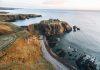
The first stop of the Pope’s journey is the Canary Islands, an Atlantic archipelago located just over 100 kilometers from the northwest coast of Africa. It is here that one of the world’s deadliest migration routes ends. According to the International Organization for Migration, one in seven migrant deaths globally occurs on this Atlantic passage.
In 2024 alone, the region witnessed nearly 10,000 deaths at sea alongside 47,000 recorded arrivals. Bishop José Mazuelos Pérez of the Canary Islands describes the waters as “a cemetery for civilization,” criticizing what he calls Western indifference to the unfolding humanitarian disaster.
The Pope’s visit, scheduled from June 6 to June 12, will conclude his time in Spain. Over two days in the archipelago, he is expected to meet migrants, humanitarian workers, and local communities, emphasizing solidarity with those “overwhelmed” by the crisis.
A Crisis That Demanded Attention
The origins of the visit trace back to early 2025, when an unprecedented surge in arrivals brought nearly 4,000 unaccompanied minors to the islands. Many arrived exhausted, traumatized, and without access to stable futures.
Local authorities criticized the Spanish government for failing to provide adequate protection systems and reception resources. In response, Bishop Mazuelos Pérez and his colleagues wrote directly to Pope Francis, urging intervention. Although that visit was postponed due to Francis’s hospitalization, Leo XIV has now taken up the appeal.
The bishop describes the Canary Islands as both “a beacon of hope” and a warning signal to the global North. While the region has experienced rapid economic growth due to tourism, it also embodies a deep social contradiction: prosperity alongside humanitarian strain.
The “Pier of Shame” and the Crossroads of Survival
A key moment in the Pope’s visit will take place at the port of Arguineguín on Gran Canaria—often referred to as the “pier of shame.” At times, as many as 3,000 migrants have been packed into makeshift facilities there, with tents and overcrowded centers still common.
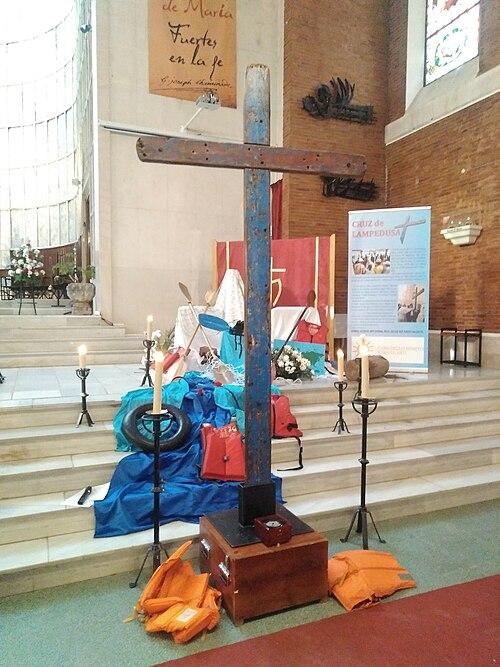
Leo XIV will meet survivors of the Atlantic crossing, listen to their testimonies, and honor those who died at sea by laying a wreath in the ocean. A cross, constructed from remnants of migrant boats, will also be erected, echoing Lampedusa’s “Gateway to Europe” memorial.
These fragile, overcrowded boats—many departing from Morocco, Senegal, or Gambia—face perilous ocean currents. Journeys can last from 48 hours to 11 days, often with insufficient food and water. Survivors have described the experience simply as “hell on the waves.”
Root Causes: War, Exploitation, and Climate Collapse
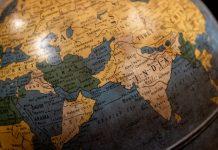
Migration flows to the Canary Islands are driven by a complex web of crises. Mali, currently experiencing renewed conflict, is the leading country of origin. More broadly, the western Sahel region is marked by instability, authoritarian governance, terrorism, food insecurity, and climate change.
Economic factors also play a critical role. In Senegal, the collapse of the fishing industry—partly attributed to foreign competition—has pushed many young people to leave. The phenomenon was vividly illustrated during the 2006 “cayuco crisis,” when 31,000 migrants arrived using traditional fishing boats.
Bishop Mazuelos Pérez highlights the role of organized crime networks, noting increasing links between human trafficking and drug smuggling. Echoing earlier papal teachings, he argues that migration is a product of globalization and must be addressed through a commitment to global justice.
Politics Under Scrutiny
The bishop has also been sharply critical of political responses to migration. He accuses right-wing parties of exploiting fear and promoting narratives of invasion, while criticizing left-wing actors for offering rhetoric without practical solutions.
European policy, he argues, must move beyond border fortification. “Sealing borders is not the answer,” he warns, calling instead for coordinated international solutions grounded in the common good.
Leo XIV has similarly advocated a dual principle: the right to migrate and the right to remain. Ensuring the latter requires investment in development and stability in countries of origin.
The Challenge of Integration
Although overall arrivals have declined by more than a third in the past year, the number of unaccompanied minors continues to rise. Many come from Mali, Senegal, and Morocco, often sent by families hoping to secure better futures.
Yet without proper systems in place, these young migrants face uncertain prospects. Upon turning 18, many are left without support. The Catholic Church has stepped in through initiatives like the “Corridors of Hospitality,” which transfer migrants to mainland Spain for education and employment opportunities through Caritas programs.
“Our goal is to ensure they are not abandoned,” says Mazuelos Pérez, emphasizing the importance of integration through training, housing, and work.
Toward Lampedusa and Beyond
The Pope’s journey will continue on July 4 with a visit to Lampedusa, another key migration entry point. The date carries symbolic weight, marking the 250th anniversary of the U.S. Declaration of Independence for the first American pontiff.
In 2025, Lampedusa recorded nearly 40,000 arrivals, while 1,314 deaths were documented in the central Mediterranean. Like the Canary Islands, it stands as both a refuge and a reminder of the human cost of migration.
A Moral Reckoning
By walking these routes, Pope Leo XIV is transforming geography into testimony. The pilgrimage is not merely pastoral—it is political, ethical, and urgent. It challenges Europe and the wider world to confront the realities of migration not as an abstract issue, but as a human drama unfolding at its borders.
At stake, as the bishop underscores, is nothing less than human dignity—and the moral identity of modern society itself.
- Raju Hasmukh with files from Avvenire
Related Images: