


























New York diocese and four Catholic sister communities sue state officials, arguing assisted-suicide law violates religious freedom rights.
Newsroom (21/07/2026 Gaudium Press) The Diocese of Rockville Centre and four communities of Catholic religious sisters have filed a lawsuit against New York Attorney General Letitia James and the state’s commissioner of health, arguing that a newly signed physician-assisted suicide law will force them to participate in practices that directly conflict with their religious beliefs.
The lawsuit was brought by Bishop John O. Barres and the Carmelite Sisters for the Aged and Infirm, the Dominican Sisters of Hawthorne, the Missionary Sisters of St. Benedict, and the Little Sisters of the Poor. Together, the organizations provide care for elderly individuals and terminally ill patients across New York and maintain that Catholic teaching prohibits any involvement in physician-assisted suicide.
The legal challenge comes after Democratic Gov. Kathy Hochul signed legislation legalizing physician-assisted suicide in February. The law is scheduled to take effect in August. While the legislation includes limited exemptions for certain health care facilities and providers, the plaintiffs contend those protections are insufficient and still require participation in the assisted-suicide process.
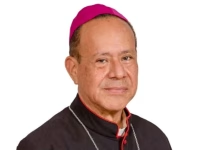
“We will never submit to New York’s culture of death,” Barres said in a statement released through attorneys with the Becket Fund, a religious liberty legal organization representing the plaintiffs.
The bishop described assisted suicide as “a grave moral failure” that places vulnerable populations, including the elderly, disabled individuals, and people suffering from mental or emotional illness, at risk of abuse and manipulation. He argued that Catholic institutions are called to accompany the sick and dying through compassionate care rather than facilitate actions intended to end life.
State officials had not publicly responded to the lawsuit at the time a request for comment was made.
Dispute Centers on Scope of Religious Exemptions
According to the lawsuit, the central issue is not only the legalization of physician-assisted suicide itself but also the obligations imposed on health care providers and facilities that object to the practice on religious grounds.
The suit argues that New York’s opt-out provisions are among the most restrictive in the United States. Although many of the Catholic-run facilities involved in the lawsuit qualify for certain exemptions, they remain subject to requirements they say make them complicit in the process.
Under existing regulations, providers must offer counseling to terminally ill patients about available end-of-life care options, including an explanation of the benefits and risks associated with those choices. The plaintiffs maintain that the new law extends those obligations to physician-assisted suicide, forcing physicians and nurse practitioners either to discuss the availability of the procedure or to direct patients to someone willing to provide it.
The lawsuit further alleges that health care professionals covered by the exemptions would still be expected to assist in determining whether patients qualify for assisted suicide. This could include referrals for mental health evaluations and other assessments connected to the process.
Facilities that refuse direct participation in assisted suicide would nevertheless be required, according to the complaint, to refer patients to another provider or institution that will facilitate it. The plaintiffs argue that such referrals constitute participation in conduct their faith regards as morally impermissible.
Additional concerns outlined in the lawsuit include requirements related to death certification. The complaint states that providers must sign death certificates listing the patient’s underlying illness as the cause of death rather than the medication used to end the patient’s life.
The plaintiffs also argue that the law may restrict their ability to discipline or dismiss employees who act in accordance with the assisted-suicide law, even when those actions conflict with institutional policies grounded in Catholic teaching.
One of the plaintiffs, the Missionary Sisters of St. Benedict, faces a separate challenge. According to the lawsuit, the community does not qualify for the law’s limited opt-out protections and therefore could be required to permit both the prescribing and ingestion of life-ending drugs on its property.
Adele Keim, senior counsel at Becket, said the law effectively requires religious facilities to guide patients through the assisted-suicide process and permit significant portions of that process to occur within their institutions.
“They will not do that,” she said, arguing that such participation would violate their deeply held religious convictions.
Religious Communities Cite Long Tradition of End-of-Life Care
The religious organizations involved in the case emphasize that caring for the elderly and dying has been central to their mission for generations.
Keim noted that Catholic sisters have provided end-of-life care in New York for more than a century. She said their approach is rooted in accompanying patients during their final days, a practice they view as an expression of Catholic teaching and compassion.
Sister Justyna Owsiejko of the Missionary Sisters of St. Benedict said her community’s mission is to provide aging residents with a peaceful and supportive environment during the last stage of life.
“New York is trying to force us to abandon that vocation and help our residents commit suicide,” she said in a statement. “That is something we will never do.”
Mother Alice Marie Monica of the Little Sisters of the Poor echoed those concerns, noting that her community has cared for elderly and dying individuals for nearly 200 years.
“Our calling is to protect and care for needy seniors, not steer them toward suicide,” she said. “We will remain true to that mission, whatever the cost.”
First Amendment Claims at the Heart of Lawsuit
The lawsuit argues that the law violates the First Amendment’s protections for the free exercise of religion by compelling Catholic organizations to participate in actions that contradict Church teaching. Catholic doctrine holds that human life must be protected from conception until natural death and rejects measures intended to intentionally end life.
The plaintiffs also contend that the law infringes on freedom of speech by requiring health care providers to counsel patients about physician-assisted suicide and discuss it as a medical option.
According to the complaint, the sisters’ faith teaches that death should neither be artificially prolonged through burdensome interventions that provide no reasonable benefit nor intentionally accelerated through actions designed to cause death.
Instead, the lawsuit states, their mission is to remain present with those who are dying, offering care, comfort, and companionship while respecting what they describe as the natural end of life.
The case sets up a significant legal confrontation between New York’s newly enacted physician-assisted suicide framework and religious organizations that argue the law compels conduct and speech contrary to their faith. As the law’s August implementation date approaches, the courts will be asked to determine whether the state’s requirements can coexist with constitutional protections for religious liberty.
- Raju Hasmukh with files from EWTN News
Related Images: