
























Two newly discovered sermons by Augustine explore the Witch of Endor story, offering fresh insight into faith, evil, and divine power.
Newsroom (14/07/2026 Gaudium Press ) A routine scholarly inquiry has led to the discovery of two previously unknown sermons by Augustine of Hippo, one of Christianity’s most influential theologians, offering fresh insight into a biblical passage that has challenged interpreters for centuries.
The discovery began with a phone call in 2024. An employee of the Bad Doberan Monastery Association in northern Germany sought assistance in deciphering a 12th-century manuscript originally owned by Bad Doberan Abbey and now preserved at its daughter monastery in Pelplin, Poland. The request reached Professor Christian Tornau, a Latin scholar at the University of Würzburg.
What appeared at first to be a familiar collection of six sermons attributed to Augustine soon revealed an unexpected surprise. While four of the texts were already known to scholars, two had never been identified before.
“Two of the six sermons are previously undiscovered writings by Augustine,” Tornau said, describing the find as an exciting addition to the renowned theologian’s vast literary legacy.
Tornau is now working alongside Professor Dorothea Weber and Dr. Clemens Weidmann of the Corpus Scriptorum Ecclesiasticorum Latinorum (CSEL) to prepare the first critical edition of the newly recovered texts, with publication expected at the end of 2026.
A Biblical Puzzle That Troubled Early Christian Thinkers
The newly discovered sermons focus on one of the most theologically difficult episodes in the Old Testament: the story of the Witch of Endor in 1 Samuel 28.
The narrative unfolds on the eve of battle between King Saul and the Philistines. Facing uncertainty and finding that God no longer responds to his prayers, Saul disguises himself and secretly seeks out a woman known for practicing necromancy. He asks her to summon the spirit of the prophet Samuel, who had already died. The woman succeeds, and Samuel appears, delivering a grim prophecy: Saul will lose the battle and soon die.
For early Christian theologians, the episode posed a serious challenge. If a necromancer could truly summon the spirit of a prophet, what did that imply about divine authority and the limits of human power? The account raised profound questions about theodicy—the problem of how an omnipotent God permits troubling events to occur.
Two competing explanations emerged within Christian tradition. One argued that the woman deceived Saul through an illusion and that Samuel never actually appeared. The other maintained that God allowed the event to happen as a final act of judgment and warning before Saul’s death.
Augustine’s Unusual Teaching Method
According to accounts of the discovery, Augustine’s newly recovered sermons engage directly with both interpretations.
The first sermon, delivered during a Sunday service, presents the theological dilemma and introduces the rival explanations without resolving the issue. Rather than offering an immediate answer, Augustine left the question open.
Only in a second sermon, preached on the following Wednesday, did he return to the subject and further examine the competing possibilities.
This approach is particularly revealing. Instead of seeking a quick resolution, Augustine appears to have encouraged his congregation to wrestle with the problem over several days. The method reflects a pedagogical style frequently associated with the North African bishop—one that invited reflection and intellectual engagement rather than simple acceptance.
The sermons demonstrate Augustine’s willingness to explore uncertainty and complexity, allowing difficult questions to remain unresolved while examining them from multiple perspectives.
Verifying the Discovery
Given Augustine’s enormous influence, scholars approached the discovery with caution.
Over the centuries, numerous texts attributed to Augustine have later been identified as spurious. Establishing authenticity was therefore essential before announcing the significance of the find.
In the autumn of 2025, a summer school in Vienna brought together 20 Latin scholars to evaluate the manuscripts and assess their authorship. Their verdict was unanimous: the sermons are genuine works of Augustine.
According to Tornau, several factors supported that conclusion. The structure of the arguments, the author’s style, the use of humor, and the willingness to present multiple interpretations without forcing a definitive answer all closely align with Augustine’s known writings.
“The style, humor and content also clearly indicate that the sermons in the manuscripts were actually written by Augustine,” Tornau noted.
A Manuscript with Its Own Mysteries
The physical manuscript raises questions of its own.
As a 12th-century copy, it was produced nearly seven centuries after Augustine’s lifetime. Scholars believe the manuscript may descend from an earlier copy once housed at Amelungsborn Abbey in Lower Saxony.
The theory remains unconfirmed, particularly because the abbey’s original library was destroyed during the Thirty Years’ War, eliminating much of the evidence that might establish a definitive chain of transmission. Nevertheless, researchers regard the proposed origin as plausible.
Expanding a Remarkable Legacy
Tornau has been careful not to overstate the scale of the discovery. He compares it to the much larger Mainz discovery of 1990, which added 30 previously unknown Augustinian writings to the scholarly record.
“This is not a sensational find like the 30 writings of St. Augustine that were discovered in Mainz in 1990,” he said. “But we are supplementing Augustine’s extensive body of writings with two further exciting texts in a critical edition.”
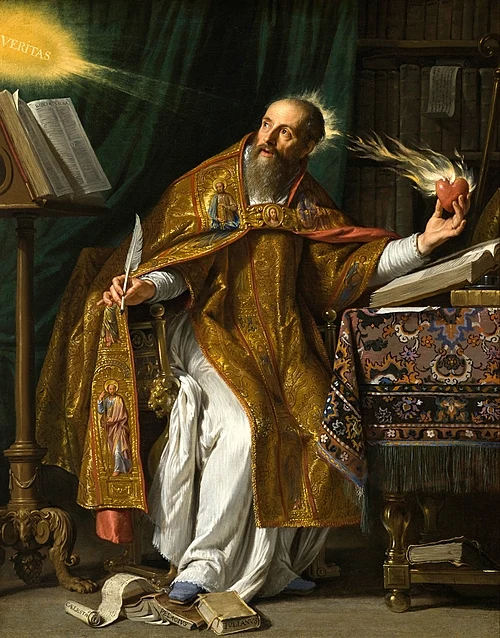
Even so, the importance of the find should not be underestimated. Augustine of Hippo, who lived from 354 to 430, produced one of the most extensive literary corpora of the ancient world. His sermons, letters, biblical commentaries, theological treatises, Confessions, and The City of God have shaped Christian thought for over 1,500 years.
The addition of two authentic sermons offers scholars new material through which to understand Augustine’s theology, preaching methods, and engagement with Scripture.
Why the Discovery Matters Today
Beyond the historical significance, the sermons provide a glimpse into Augustine’s intellectual character.
The Witch of Endor narrative touches on enduring questions about evil, divine permission, human freedom, and the mysteries of God’s actions in the world. Rather than dismissing the tension embedded in the biblical story, Augustine appears to have embraced it.
His decision to address the passage across two separate services and allow his audience time to contemplate competing interpretations reflects a deep confidence in the value of thoughtful inquiry.
In an era often marked by demands for immediate answers and rigid certainty, Augustine’s approach stands out. The newly recovered sermons suggest a teacher who recognized that some theological questions resist simple solutions—and who trusted his listeners to live with ambiguity while seeking deeper understanding.
More than fifteen centuries after his death, Augustine continues to speak to new generations. Thanks to a manuscript preserved across centuries and rediscovered through careful scholarship, two previously unheard voices from his pulpit are now joining that conversation once again.
- Raju Hasmukh with files from Aleteia
Related Images: