











A 16th-century monstrance owned by Madrid’s city council will feature in Pope Leo XIV’s Corpus Christi procession, blending history and faith.
Newsroom (02/06/2026 Gaudium Press ) In a profound convergence of history, faith, and civic heritage, a nearly five-century-old monstrance will occupy a central place during the Corpus Christi celebration in Madrid, presided over by Pope Leo XIV. The sacred vessel—owned not by the Church but by the Madrid City Council—will be placed on the altar at Cibeles Square before leading the Eucharistic procession through the city’s historic center.
The liturgy will unfold with solemn reverence. After communion, Pope Leo XIV will place the consecrated host into the processional monstrance, pronounce the prescribed prayers, and incense the Blessed Sacrament. With this act, the Eucharist—believed by Catholics to be the real presence of Christ—will be carried through the streets of Madrid in a public expression of faith that has endured for centuries.
The procession itself will be more concise than usual, moving along Calle de Alcalá to the intersection with Gran Vía before returning to Cibeles. Yet despite its shortened route, the significance remains undiminished: the visible witness of Christ’s presence among His people. Upon returning, the Pope will again incense the Blessed Sacrament, recite the concluding prayers, and impart his blessing to the faithful while holding the monstrance aloft.
A Renaissance Masterpiece Rooted in Faith
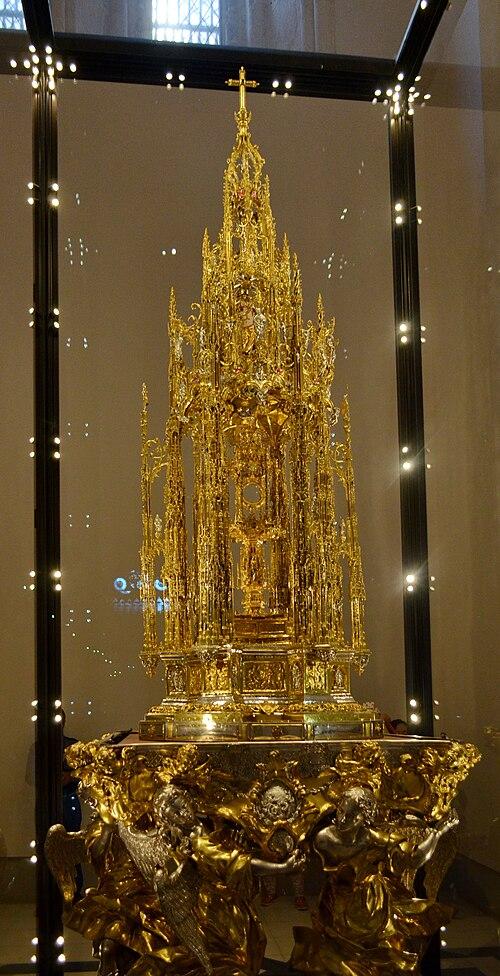
The monstrance at the heart of this celebration dates back to the 16th century, commissioned by the Madrid Council during the reign of Emperor Philip II, who established Madrid as the seat of his court. Its creation reflects a period when civic authorities actively contributed to the promotion of Catholic worship, particularly the Solemnity of Corpus Christi, one of the Church’s most important liturgical feasts.
Crafted primarily from silver and partially gilded, the monstrance is composed of three distinct elements: the litter (platform), the seat monstrance, and the portable or “sun” monstrance. Between 1568 and 1574, renowned silversmith Francisco Álvarez executed the first two components, embedding in them the artistic ideals of the Renaissance.
The structure reveals a rich theological and artistic vision. Classical architectural forms are adorned with Eucharistic symbolism such as ears of wheat and clusters of grapes—emblems of the bread and wine that become, in Catholic belief, the Body and Blood of Christ. Biblical figures, including prophets and angels, complement these motifs, creating a visual catechesis in precious metal.
The outer canopy, supported by eight Corinthian columns, features prominent depictions of the four Evangelists alongside Christ the Savior. Beneath this canopy lies the main monstrance, designed as a double structure. Its base is intricately carved with scenes from the Passion of Christ: the Last Supper, the Washing of the Feet, the Agony in the Garden, and the Arrest of Jesus. Above these scenes stands the figure of the Risen Christ, emphasizing the unity of sacrifice and resurrection at the heart of the Eucharistic mystery.
Layers of Devotion Through the Centuries
Inside the seat monstrance rests the smaller, portable sun monstrance, encircled by angels playing musical instruments. This component, added in the 19th century by artist Francisco Moratilla, demonstrates how devotion to the Eucharist continued to inspire artistic contributions long after the original structure was completed.
The combination of Renaissance craftsmanship and later additions makes the monstrance a living artifact—one that has evolved alongside the faith it serves. It is not merely an object of historical interest but an enduring instrument of worship, carrying within it the prayers and devotion of generations.
Following a comprehensive restoration and cleaning, the monstrance has been preserved under a protective glass dome at the Museum of the History of Madrid. Its reemergence for this year’s Corpus Christi celebration represents a rare moment when heritage, artistry, and liturgy intersect in a public and deeply symbolic act.
A Witness to Christ in the Heart of the City
The upcoming procession is more than ceremonial tradition. It is a proclamation of belief in the real presence of Christ in the Eucharist—carried into the streets as a sign that faith is not confined to church walls but intended to permeate public life.
That the monstrance belongs to the city council underscores a historical unity between civic identity and spiritual heritage. Madrid’s leaders, past and present, have recognized the importance of this feast as both a religious and cultural cornerstone, reflecting a broader understanding of community rooted in shared values.
As Pope Leo XIV lifts the monstrance to bless the faithful at the conclusion of the procession, the moment will echo centuries of devotion. The same vessel that once accompanied Catholics during the height of the Spanish Renaissance will once again carry Christ through the city—reminding believers of the enduring truth at the heart of Corpus Christi: “I am with you always.”
In this way, the ancient monstrance becomes not just a relic of the past, but a radiant symbol of living faith in the present.
- Raju Hasmukh with files from ACI Prensa
Related Images: