















Israel declines visa renewal for West Bank priest Louis Salman, raising concerns over religious freedom and tensions with Christian communities.
Newsroom (13/05/2026 Gaudium Press ) The Israeli government’s decision not to renew the visa of Fr. Louis Salman, a Catholic priest serving in the West Bank, has intensified concerns about rising tensions between Israeli authorities and the region’s Christian minority.
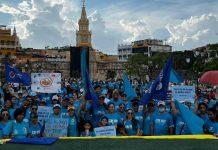
Fr. Salman, who led youth ministry efforts among Palestinian Christians, was ordered to leave the country before May 11 without any official explanation. According to sources close to the situation, he had been interrogated by Israeli officials in late April, after which Church authorities advised him to depart for his safety. He returned to his native Jordan following a farewell Mass attended by hundreds in Beit Sahour, near Bethlehem.
Local Catholics described Salman as a deeply committed pastor whose work had helped sustain Christian youth engagement. As chaplain of the Youth of Jesus’ Homeland ministry, he organized regular initiatives, including summer camps and a major pilgrimage to Rome in 2025 for the Jubilee of Hope.
Lack of Transparency and Legal Uncertainty
No formal reason has been provided by Israeli authorities for the visa denial, leaving Church officials and observers uncertain about the legal grounds for the move. The Latin Patriarchate of Jerusalem, which oversees Catholic clergy in the Holy Land, has declined public comment, reportedly in preparation for a potentially prolonged legal challenge.
Sources in Jerusalem suggest this case may represent an unprecedented level of interference in the patriarchate’s internal personnel decisions. A person close to Salman confirmed he left “at the request of the patriarch, and for his own safety,” adding that the priest has chosen not to speak publicly about the situation.
Activism and Controversy
Fr. Salman was known not only for pastoral work but also for speaking out on the difficulties faced by Palestinian Christians under Israeli policies in the West Bank.
Some local reports have linked the visa decision to his role in organizing a prayer vigil for Shireen Abu Akleh, the Palestinian-American Christian journalist killed during an Israeli military operation in Jenin in May 2022. Investigations concluded Israeli soldiers were responsible for the fatal shot, though no charges have been filed.
The timing of the visa deadline—coinciding with the fourth anniversary of Abu Akleh’s death—has fueled speculation about a connection. However, a Christian source familiar with the situation emphasized that this was not the primary factor.
Instead, the source pointed to Salman’s outspoken criticism of settler activity and Israeli security measures in the West Bank, suggesting authorities pressured him to remain silent.
Pressure on Christian Communities
The controversy surrounding Salman’s departure highlights broader challenges facing Christian communities in the Holy Land.
Particular concern has focused on Taybeh, the last fully Christian town in the West Bank, where residents report months of harassment by Jewish settlers. Incidents described include vandalism, crop destruction, and arson attacks on vehicles. No arrests have been made in connection with these allegations.
“These actions directly impact the presence of Christians in the Holy Land,” said one source, noting that economic and social pressures are pushing communities to their limits.
A Climate of Escalating Incidents
Salman’s case comes amid a series of reported incidents affecting Christians in Israel and surrounding areas. These include alleged assaults on clergy, acts of harassment such as spitting near churches, and the desecration of Christian religious images.
In southern Lebanon, Israeli soldiers were implicated in two separate acts of religious desecration, prompting official condemnation and disciplinary action. Meanwhile, Israeli police drew international criticism after preventing Latin Patriarch Pierbattista Pizzaballa from celebrating Mass at the Church of the Holy Sepulchre on Palm Sunday.
The backlash from that episode led Prime Minister Benjamin Netanyahu to appoint George Deek as Special Envoy to the Christian World in April. Deek, an Orthodox Christian and former ambassador, acknowledged that acts of hostility toward Christians “offend not only Christians, but also the principles of dignity and mutual respect” upheld by Israel.
Uneven Accountability
Despite some disciplinary measures, accountability has remained inconsistent across incidents involving Christians.
No charges have been filed in the 2023 sniper killing of a mother and daughter at a Catholic compound in Gaza. Similarly, a 2025 shelling of the same church—officially attributed to a “technical error”—killed three civilians just days after a high-profile Church visit to Taybeh.
These cases have contributed to a perception among local Christians that their concerns are not being adequately addressed.
Political Context and Growing Anxiety
Many Christian leaders and observers link the deteriorating environment to shifts in Israel’s political landscape. Since the October 7, 2023 Hamas attacks, Minister of National Security Itamar Ben-Gvir has expanded access to firearms for civilians and settlers, a policy critics say risks empowering extremist elements.
Fr. Nikodemus Schnabel, abbot of the Dormition Abbey in Jerusalem, expressed alarm over Ben-Gvir’s role, noting that the minister previously defended individuals convicted of attacking Christian property.
“This man, who hates Christianity, is now in charge of my security,” Schnabel said in a recent interview, encapsulating concerns shared by many in the Christian community.
A Symbolic Departure
For many Palestinian Christians, the forced departure of Fr. Louis Salman is more than a bureaucratic matter—it is a symbolic moment reflecting deeper tensions.
His removal has underscored fears about shrinking space for religious expression, advocacy, and leadership within the Holy Land. As Church authorities weigh legal options and communities grapple with ongoing challenges, Salman’s absence leaves a notable void in a region where Christian presence is already under strain.
Related Images: