











Israeli settlers seize a Palestinian quarry in Taybeh, deepening fear, displacement, and despair in the West Bank’s last all-Christian village.
Newsroom (26/03/2026 Gaudium Press ) Since March 19, Roland Bassir has stood helplessly at the edge of his village, staring down at the quarry and concrete plant that sustained his family for two decades. The business, located on the western fringe of Taybeh — the only all-Christian village in the West Bank — has been sealed off and occupied by Israeli settlers.
That morning, around 30 extremist settlers carried out a threat issued in a video: they stormed the quarry, hoisted an Israeli flag on one of the structures, and held prayers on-site. “It’s our only livelihood,” Bassir said, nervously holding a cigarette as he gazed toward the valley. Since the incursion, he’s been too afraid to approach.
“Last week they brought a backhoe, opened a dirt road into the quarry, and placed guards around it,” he said. “Any time I try to get close, they threaten me. I can’t sleep at night. I’m miserable. They have taken everything I built in 20 years.”
Growing Fear in Taybeh
Since October 7, 2023 — the start of the Israel-Hamas war — Bassir says “problems with settlers” have escalated. A neighbor, who requested anonymity, described how settlers recently broke into a horse stall, stole a horse and its colt, and kept them despite the owner presenting proof of ownership to Israeli police.
Father Bashar Fawadleh, the parish priest of Taybeh’s Christ the Redeemer Church, says the quarry takeover signals “attempts to impose new facts on the ground.” The parish, he says, feels under siege. “We are losing our land, our fruits, our income,” he lamented. “But who can stop them? This creates fear in people’s hearts.”
That fear is spreading across nearby Christian communities. The Latin Patriarchate reports that in the Jordan Valley village of Hamamat Al-Maleh, violent settler attacks forced 11 of 13 families to flee their homes on Patriarchate-owned land. “Such acts are unjustifiable,” said Patriarchate attorney Zaki Sahlieh. “We call for restraint and the protection of all civilians.”
Checkpoints and Isolation
In Taybeh, new barriers are appearing. Residents woke recently to find a yellow gate across the village’s main road, staffed by Israeli soldiers who can shut off movement without warning. For village businesses — including the family-operated Taybeh Brewery, famous across the region — the closures have cut off access to clients in Jerusalem and Bethlehem.
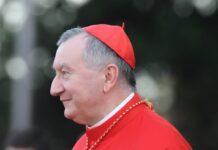
Speaking from Jerusalem, Cardinal Pierbattista Pizzaballa, Latin Patriarch of the city, said the situation in the West Bank is “deteriorating constantly,” marked by daily settler attacks and nearly a thousand checkpoints.
Taybeh’s isolation is now physical and psychological. With about 1,200 residents, the village sits between six settler outposts. Since mid-2025, settlers have reportedly torched olive groves, vandalized the ruins of the fifth-century Church of St. George, and plastered threatening graffiti nearby.
Escalation and Displacement
Human rights monitors describe a steep increase in settler violence following the start of the U.S. and Israel-Iran war on February 28. Reports from the Israeli group B’Tselem cite widespread “arson, expulsion of shepherds, destruction of crops, and blocking of access roads.”
According to Peace Now, 2025 alone saw more than 1,800 settler attacks causing injuries or property damage. At least 838 Palestinians were wounded, nine were killed, and over 22 communities displaced.
Before the rise of far-right politicians Itamar Ben-Gvir and Bezalel Smotrich, Taybeh’s relations with nearby settlements were largely peaceful, says Father Fawadleh. “Our problems are not with the settlers inside,” he noted. “It’s the fanatic mentality of those who speak of creating the ‘Kingdom of Israel’ that fuels this violence.”
The parish estimates that about 80 residents — sixteen families and ten individuals — have left Taybeh since 2023.
Holding On Through Faith
For those who remain, fear has become part of daily life. “You can’t imagine how frightening it is to live like this in your own village,” said Nadine Khoury, who returned from Boston five years ago to raise her children in Taybeh. Now, she hesitates to walk alone.
“This is the new panorama,” said Father Fawadleh. “Inside Taybeh, we live in fear and uncertainty. I can encourage my parishioners, but I can’t give them safety.” His mission now, he says, is to offer faith and hope — to resist through endurance.
“We still hope for the third day, the new resurrection,” he said. “We resist with faith because we are rooted in this land.”
- Raju Hasmukh with files from OSV News
Related Images: