





















Ihab Hassan warns of impunity behind settler violence against Palestinian Christians and introduces the Save West Bank Christians initiative.
Newsroom (12/05/2026 Gaudium Press ) Nearly a year after Israeli settler violence swept through Taybeh, the last entirely Christian village in the West Bank, Palestinian human rights activist Ihab Hassan says nothing has changed. The attacks continue, he told Vatican News this week, and those responsible have faced “no consequences” for their actions.
Vatican News last spoke with Hassan in July 2025, during a period of escalating violence that saw Israeli settlers target Taybeh. At the time, Hassan warned that without accountability, the cycle of violence would persist. “What is needed is for the settlers to be held accountable for their violence,” he said then. “If they’re not, then this will just keep happening.” Almost a year later, his concern appears unchanged—and unaddressed.
Hassan, a Palestinian Christian human rights advocate who documents and shares footage of abuses across Palestine, has continued to record attacks in and around Taybeh. These include settlers setting vehicles ablaze, smashing windows, and occupying a quarry on the western outskirts of the town. According to Hassan, the common thread running through these incidents is what he describes as “impunity.”
While the Israeli government has condemned some acts of settler violence, Hassan says these statements have not translated into meaningful action. “No real steps” have been taken, he said, either to prevent further attacks or to arrest and prosecute those responsible.
A Widening Pattern Across the West Bank
The situation in Taybeh, Hassan stressed, is not an isolated case, nor is it confined to the Palestinian Christian community. Similar attacks, he said, are taking place “across the West Bank, from Hebron to Jenin.”
Recent incidents underscore the broader pattern of violence. Last month, two Palestinians, including a 14-year-old boy, were shot dead during an attack on a school in the village of Mughayyir. Two weeks ago, the Palestinian Health Ministry reported that 16 Palestinians had been killed in the West Bank since the beginning of the year.
For Hassan, these events reflect more than sporadic acts of violence. He argues they are enabled by broader policies. “What is really empowering these settlers is the policy of the Israeli government,” he said, pointing to Israel’s recent approval of a record 34 new settlements in the West Bank. All are considered illegal under international law, and, according to Hassan, function as “launch bases” for settler attacks on nearby Palestinian towns and villages.
An Existential Threat to Christian Communities
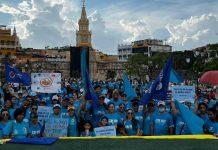
The worsening humanitarian situation has prompted new efforts to draw international attention to the plight of Palestinian Christians. Hassan is now involved in a project called Save West Bank Christians, an initiative founded by American filmmaker and philanthropist Jason Jones.
The project aims to highlight what Hassan describes as an “existential” threat facing the Holy Land’s ancient Christian communities amid the expansion of illegal settlements and ongoing violence. Taybeh, as the last all-Christian village in the West Bank, has come to symbolize these concerns, but Hassan emphasizes that Christian families across the region feel increasingly vulnerable.
Importantly, Hassan insists the initiative is not about political alignment. “We’re not asking for any political stance,” he said. “All we are asking for is solidarity, for Christians around the world to put pressure on those responsible to stop these attacks.”
Fear and Silence on the Ground
Hassan’s work often brings him into direct contact with affected families, whose testimonies illustrate the human cost behind the statistics. He recalled a recent phone call with a family in Jalud, near Nablus, whose home had been attacked by Israeli settlers.
“They told me that they think the settlers will soon attack again,” Hassan said. According to him, the family believes that no one is taking action to protect them. “They said that, if they die, nobody will notice.”
For Hassan, these words encapsulate the sense of abandonment felt by many Palestinian communities—Christian and Muslim alike—living under the threat of settler violence. Without accountability, he warns, that sense of fear will only deepen, and the attacks will continue, unnoticed and unpunished.
- Raju Hasmukh with files from Vatican News
Related Images: