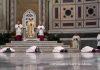

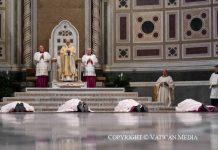










Bishop Enrico Trevisi recalls the Foibe massacres, denouncing Tito’s communist persecution and urging Italians to remember Trieste’s silent tragedy.
Newsroom (12/02/2026 Gaudium Press ) Italy’s Day of Remembrance—is a solemn commemoration held each February 10—Monsignor Enrico Trevisi, Bishop of Trieste, dedicated his inaugural homily to one of the darkest and least-discussed tragedies in postwar Europe: the Foibe massacres. Preaching in a city scarred by successive waves of totalitarian violence, Trevisi called on Italians not to forget “the pain buried beneath the rocks of our lands.”
In an interview with il Giornale, the bishop condemned the communist hatred unleashed by Tito’s partisans, stressing that religious freedom was among the many casualties. “Many priests were murdered, thrown into karst chasms together with thousands of civilians,” he said, invoking an episode long obscured by political silence.
The Forgotten Massacre
The foibe—deep, funnel-shaped sinkholes unique to the karst regions of Istria and Venezia Giulia—became mass graves between 1943 and 1945. In these pits, Yugoslav communist partisans executed and disposed of thousands of Italians. Historians estimate between 5,000 and 10,000 victims, though exact figures remain disputed. Among them were civil servants, teachers, landowners, soldiers, and Catholic priests, accused of being “bourgeois” or simply “Italian.”
The killings occurred in two main phases. The first wave followed Italy’s 1943 armistice, when partisan forces moved into Istria amidst political chaos. The second, and bloodier, came in May 1945, as Tito’s troops occupied Trieste and Gorizia, extending their control across the northeastern frontier.
Trieste: A City Trapped Between Tyrannies
“Trieste is the quintessential victim of totalitarianism,” Bishop Trevisi observed. In the 20th century, the city endured three oppressive regimes: Fascist Italy, Nazi Germany, and finally Communist Yugoslavia. Each left indelible marks on its people and culture. Germany’s brief occupation in 1943 even brought the only crematorium installed on Italian soil.
“So much evil has been done in these lands,” the bishop lamented. He noted how, for decades, Italy’s collective memory excluded the Foibe tragedy. “When I was in school, I never read about it. Entire generations grew up without learning what happened here,” he said. Only in 2004 did the Italian Parliament officially establish Remembrance Day to honor the victims and the exiles who followed.
The Giulian-Dalmatian Exodus
Violence in the region set off one of the largest migrations in modern Italian history. Between 250,000 and 350,000 Italians from Istria, Fiume (today’s Rijeka), and Dalmatia fled between 1943 and 1954, as Yugoslavia consolidated its borders. Families abandoned homes, churches, and the very soil of their ancestors in what amounted to ethnic cleansing. Their displacement reshaped communities in both Italy and the emigrant colonies abroad.
Many who resettled in Argentina, including relatives of Pope Francis, kept the memory alive. Monsignor Trevisi recalls that the Pope knew the pain of exile: “At Santa Marta, he once hummed a Triestine hymn learned from his father. He remembered the suffering of these people.”
Faith Under Fire
Bishop Trevisi highlighted a lesser-known aspect of the tragedy: the religious persecution that accompanied the political terror. “Tito’s partisans killed not only out of nationalism but also ideology,” he explained. “Christians were among the most vulnerable targets.”
The Catholic Church, a spiritual and cultural anchor in the region, resisted communist indoctrination. As a result, priests were branded as “reactionaries” or “collaborators” and executed. One such martyr was Father Francesco Bonifacio, murdered by partisans and never found. His disappearance, Trevisi said, symbolizes “the countless graves hidden beneath these karst pits.”
The Dangers of Absolutized Ideology
When asked why such brutality erupted, the bishop answered: “Because these regimes professed an ideology with pagan roots that crushed man and freedom of conscience.” His warning resonates still in a Europe where ideological extremes—whether nationalist or revolutionary—often erased humanity in the name of purity or progress.
“The Foibe remind us,” Trevisi concluded, “that when ideology becomes absolute, it no longer sees the human face. It only knows how to destroy.”
Today, as Italy commemorates its Day of Remembrance, Trieste stands as both a witness and a symbol—its land still concealing the bones of ordinary lives consumed by the century’s political nightmares. Through memory, Bishop Trevisi suggests, perhaps reconciliation can finally take root where horror once ruled.
- Raju Hasmukh with files from Infocatholica
Related Images: