













Brazilian bishop says youth can embrace traditional liturgy, citing Catholic pluralism and rising “unchurched” trends among young adults.
Newsroom (20/04/2026 Gaudium Press ) At a press conference during the 62nd Assembly of the National Conference of Bishops of Brazil (CNBB) in Aparecida, Bishop Joel Portela Amado of Petrópolis underscored what he described as a fundamental principle of Catholic identity: pluralism. Speaking on April 17, the bishop affirmed that young people have a legitimate right to engage with more traditional forms of liturgical expression, emphasizing that “Catholicism is plural by nature.”
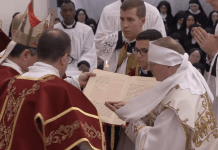
The remarks came in response to a question raised by a journalist from TV Rede Vida regarding what some observers describe as a resurgence of traditionalist practices within Catholic Masses. The journalist pointed to visible signs of this trend, including young attendees kneeling to receive communion and women wearing veils—gestures often associated with earlier liturgical customs.
Bishop Joel acknowledged the presence of such expressions but urged a broader sociological and pastoral lens in interpreting them. He referenced demographic data from the 2022 census, noting that individuals between the ages of 19 and 39 represent the largest group identifying as having no formal religious affiliation. However, he clarified that this does not necessarily indicate a loss of belief in God.
“It’s not that they don’t believe in God,” he said. “The evangelical side calls them ‘unchurched.’ I prefer this expression. They believe in God in heaven, but they don’t have a mediation on earth, a path to the Church.”
Within this context, the bishop suggested that the apparent gravitation toward traditional liturgical forms among some young people may reflect a deeper search for meaning and structure. In what he described as “times of emptiness,” individuals may look to historical expressions of faith—practices they themselves did not directly experience—as sources of identity and spiritual grounding.
This dynamic, he argued, should not be viewed as problematic but rather as part of the Church’s inherent diversity. “Does it have the right to be this way? Yes,” Bishop Joel stated, reiterating that Catholicism’s plural nature accommodates a range of spiritual expressions, particularly in what he called a “profoundly plural world.”
At the same time, he offered a caution against exclusivity. While affirming the right of individuals to live out their faith according to personal convictions and sensibilities, he stressed that such expressions must not be imposed on others or elevated as the sole legitimate form of practice.
“While there is a right to live and express one’s faith in one’s own way, according to one’s own personality, on the other hand, in the name of love and brotherhood, one cannot impose this on others or believe that only one is right,” he said.
The discussion reflects broader questions facing the Catholic Church in Brazil and beyond, as it navigates shifting cultural landscapes, generational changes, and evolving patterns of belief and belonging. Within this environment, the balance between tradition and diversity remains a central and ongoing conversation.
- Raju Hasmukh with files from ACI Digital
Related Images: