










A critical analysis of Sarah Mullally’s Vatican visit raises questions about truth, ecumenism, and the integrity of Catholic-Anglican relations.
Newsroom (30/04/2026 Gaudium Press ) Recent events at the Vatican have reignited a long-standing debate within Christian ecumenism: can genuine unity be achieved without a shared commitment to doctrinal truth? The visit of Sarah Mullally, the Anglican archbishop of Canterbury, has prompted concern among some observers who question whether gestures of goodwill have come at the expense of theological clarity.
At the center of the controversy is the Catholic Church’s historically firm position on Anglican orders. The papal document Apostolicae Curae declared them “null and void,” a judgment rooted in the theological and political shifts of the Anglican Reformation. While Anglicanism has since evolved and sought closer relations with Rome, critics argue that these developments do not alter the foundational issues surrounding its ecclesial identity.
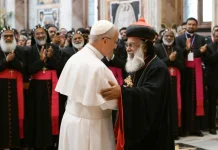
Against this backdrop, the Vatican’s reception of Mullally appeared to signal a different tone. According to reporting by Edward Pentin, the visit included a private audience with Pope Leo XIV and, notably, an invitation for Mullally to offer a blessing in the Clementine Chapel of St. Peter’s Basilica—a site traditionally associated with apostolic authority. For some, these gestures carried implications that extend beyond diplomacy, raising questions about consistency with established Catholic teaching.
Mullally herself represents a complex figure within Anglicanism. Her personal and professional journey—from a career in nursing to becoming the first woman archbishop of Canterbury—has been marked by a notable theological evolution. Once aligned with conservative evangelicalism, she has moved toward more progressive positions, including support for abortion rights and the blessing of same-sex unions. Observers such as George Conger have pointed to this shift as emblematic of broader trends within the Anglican establishment, where theological flexibility often coincides with institutional advancement.
Critics argue that these positions place Mullally at odds with longstanding Catholic teachings on the sanctity of life and the nature of marriage. In this light, her warm reception at the Vatican is seen not merely as an ecumenical gesture, but as a moment that risks blurring important doctrinal distinctions.
Beyond the specifics of Mullally’s visit, the episode raises broader questions about the nature of ecumenism itself. Historically, the Catholic Church has emphasized that unity must be grounded in truth, even when that truth is difficult or costly to uphold. This principle is evident in sacramental theology, where reconciliation requires an honest acknowledgment of error as a precondition for healing.
Some critics contend that a similar standard should apply at the institutional level. Anglicanism’s historical rejection of key Catholic doctrines—including the authority of the Pope and elements of sacramental theology—remains a significant obstacle to unity. While modern ecumenical efforts often prioritize dialogue and mutual respect, there is concern that avoiding these points of tension may ultimately undermine the integrity of the process.
The historical context further complicates matters. The English Reformation involved not only theological divergence but also the dissolution of Catholic institutions and the transfer of Church property. While contemporary ecumenism does not seek to relitigate these events, critics suggest that meaningful reconciliation requires at least some acknowledgment of this legacy.
At its core, the debate centers on the relationship between truth and charity. Is it more loving to emphasize common ground, or to confront differences directly? For those uneasy with the Vatican’s approach, the concern is that an emphasis on cordiality may inadvertently obscure the very truths that, in Christian teaching, are meant to set believers free.
The visit of Sarah Mullally thus becomes more than a diplomatic encounter; it serves as a case study in the challenges of modern ecumenism. If unity is pursued without a clear foundation in shared doctrine, critics warn, it risks becoming symbolic rather than substantive—a performance of harmony that leaves deeper divisions unresolved.
In this view, authentic reconciliation requires more than gestures. It demands a willingness to engage honestly with history, doctrine, and disagreement, trusting that truth—not sentiment—offers the surest path toward lasting unity.
- Raju Hasmukh with files from National Catholic Register
Related Images: