









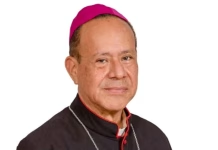


USCCB President Archbishop Paul Coakley condemns the attempted shooting at the White House Correspondents’ Dinner and urges prayers for national leaders as details emerge about the suspect and his manifesto.
Newsroom (27/04/2026 Gaudium Press ) Archbishop Paul S. Coakley, president of the United States Conference of Catholic Bishops (USCCB), has strongly condemned the attempted shooting at the White House Correspondents’ Dinner, urging Americans to pray for the nation’s leaders and reaffirming that “there is no place for violence” in society.
The incident unfolded Saturday night at the Washington Hilton Hotel when Cole Thomas Allen, a 31-year-old teacher and video game developer from California, attempted to enter the event armed with a shotgun, a pistol, and several knives. Allen opened fire before reaching the ballroom, where President Donald Trump, the First Lady, Vice President JD Vance, and nearly 2,000 attendees were gathered. Secret Service agents subdued the attacker before he could reach the main hall.
One agent was struck by a bullet but survived due to a bulletproof vest. No other injuries were reported. President Trump was evacuated and later confirmed that all attendees were safe.
This marks the third known attempt or threat against Trump since July 2024, following a shooting at a campaign rally in Butler, Pennsylvania, and a separate incident involving an armed individual at a golf course.
Manifesto Raises Religious Concerns
Just minutes before the attack, Allen reportedly sent a manifesto of more than 1,000 words to family members. According to reports, the document identified government officials as “targets” and framed the attack as a response to perceived wrongdoing by the administration.
Particular attention has focused on a section addressing Christian moral objections to violence. Responding to the idea of “turning the other cheek,” Allen argued that such teachings apply only to personal suffering, not when others are oppressed, asserting that inaction could amount to complicity.
President Trump described the document as “very anti-Christian,” stating in an interview that the suspect exhibited “strong hatred” toward Christians and had a history of concerning behavior known to his family.
Acting Attorney General Todd Blanche said investigators believe Allen was specifically targeting members of the administration, including the president. Although the suspect has not cooperated with authorities, officials are analyzing evidence from electronic devices, his residence in California, and interviews with acquaintances.
Security Lapses Under Scrutiny
The attack has prompted renewed criticism of security measures at high-profile events. Allen had reportedly stayed at the same hotel shortly before the dinner and claimed in his manifesto that he was able to bring weapons inside without detection.
Witnesses also questioned the event’s screening procedures, noting that entry verification appeared limited to simple ticket screenshots. Secret Service Deputy Director Matthew Quinn acknowledged that the attacker intended to cause “a national tragedy.”
Church Leaders Call for Peace
In his statement, Archbishop Coakley expressed gratitude that the incident did not result in greater harm and called for unity and prayer.
“Let us all pray for our elected leaders and public servants that they may receive God’s blessings,” Coakley said. “Because human life is a precious gift, there is no place for violence of any kind in our society.”
Other Catholic leaders echoed the call for reflection and action. Bishop David Bonnar of Youngstown emphasized the need to address gun violence and foster respect for human life, urging Americans to “look deeper into the human heart” to build unity rather than division.
Bishop Robert Barron of Winona-Rochester also condemned the broader climate of hostility, pointing to “viciousness and tribalism” in political discourse as contributing factors to violence. He reminded the public of the Christian call to love one’s enemies, including ideological opponents.
A Broader Pattern of Political Violence
The attempted attack comes amid a series of high-profile acts of political violence in the United States. In 2025, conservative commentator Charlie Kirk was assassinated in Utah, while Minnesota state Representative Melissa Hortman and her husband were killed in their home in a separate attack. Hortman, a Catholic, had served as speaker of the Minnesota House.
Authorities say Allen remains in custody at a hospital undergoing psychiatric evaluation and is expected to appear in federal court.
As investigations continue, religious and civic leaders alike are calling for a renewed commitment to civil discourse, public safety, and the dignity of human life.
- Raju Hasmukh with files from Infocatholica and CNA