


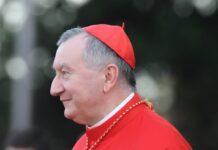






Pope Leo XIV’s Africa trip reveals a forceful papacy confronting tyranny, corruption, and democracy’s fragility on a global stage.
Newsroom (24/04/2026 Gaudium Press ) Andrea Tornielli, editorial director of the Vatican’s media operation, is pushing back against a narrative that has trailed Pope Leo XIV since the earliest days of his pontificate.
The pope, he insists, has not changed.
“If one revisits the speeches from his first year as pope, it becomes clear that Leo has always been strong in substance,” Tornielli told The Washington Post. The recent surge of attention, he suggested, reflects less a transformation in Leo than a shift in how closely the world is listening. “Certainly, President Trump’s messages and [Leo’s] measured responses have drawn media attention. But this strength in the Pope’s words was there even before; perhaps the media did not always notice it.”
For those who have followed closely, the argument is familiar. But over eleven days spanning Algeria, Cameroon, Angola, and Equatorial Guinea — a journey of roughly 17,700 kilometers, eighteen flights, and homilies delivered in four languages — Pope Leo XIV delivered something harder to ignore: a papacy that now commands attention.
Whether the pope has grown louder or the world has finally grown quiet enough to hear him remains open to debate. What is no longer in dispute is that the label of a “quiet pope” no longer fits. By the time Leo stepped onto the tarmac in Malabo, that characterization had collapsed under the weight of his own words.
“The idea of the ‘quiet Pope Leo’ is a 2025 story,” as one recent assessment put it. “The 2026 Pope Leo is altogether different. He is speaking out, more comfortable in his own skin.”
That evolution — or recognition — comes into sharp focus when placed against the political and moral themes that defined his African tour. Two threads, in particular, stand out: a sustained defense of democracy and an increasingly direct condemnation of corruption and authoritarianism.
Leo himself has urged caution in interpretation. Speaking to reporters while flying from Cameroon to Angola, he noted that much of his rhetoric has been filtered through layers of “commentary on commentary.” His speeches, he insisted, must be read within the context of the audiences he addressed.
That insistence is fair. But it invites a more difficult question: how do those same words reverberate beyond their immediate setting?
Midway through the trip, on April 14, Leo addressed the Pontifical Academy of Social Sciences with a warning that extended far beyond the walls of Rome. Democracy, he wrote, “remains healthy only when rooted in the moral law and a true vision of the human person.” Without that foundation, it risks collapse into “either a majoritarian tyranny or a mask for the dominance of economic and technological elites.”
Power, in his formulation, is not an endpoint but a responsibility — “true power comes from virtue, not strength.” Though written for scholars, the message travels easily across borders, applying wherever political authority begins to confuse dominance with wisdom.
Two days later in Bamenda, at the center of Cameroon’s Anglophone conflict, the pope abandoned abstraction for accusation.
“The world is being ravaged by a handful of tyrants,” he declared, condemning “the masters of war” who invest billions in destruction while neglecting the basic needs of healing, education, and restoration. The context was immediate and tangible: a separatist conflict that has killed more than 6,500 people and displaced over 650,000 since 2017. In a rare gesture, an Anglophone separatist alliance announced a three-day ceasefire in honor of his visit.
Leo later clarified that his reference to “the masters of war” was directed at the conflict before him, not at distant political figures. Yet the moral framework he invoked resists geographic containment. No papal homily exists in isolation from the broader conscience of the Church, and the critique inevitably echoes beyond Cameroon.
In Equatorial Guinea, that critique sharpened further.
Preaching in Mongomo before an estimated 100,000 faithful — and in the presence of President Teodoro Obiang, the 83-year-old autocrat who has ruled for 47 years, alongside his son, a convicted French embezzler and current vice president — Leo delivered a message that functioned as both sermon and indictment.
He called for a society “capable of engendering a new sense of justice,” one committed to serving “the common good rather than private interests” and to “bridging the gap between the privileged and the disadvantaged.” In a nation where oil wealth sustains opulence for a few while nearly half the population lives in poverty, the setting transformed his words into a direct confrontation.
At the Basilica of the Immaculate Conception, Leo drew on Augustine — whose ancient Hippo had marked the first stop of his journey — to contrast the City of God with the earthly “lust for power and worldly glory that leads to destruction.” He warned against the “proliferation of armed conflicts” fueled by the exploitation of oil and mineral wealth.
The following day, standing in the rain at Bata Prison before six hundred inmates, he turned to the meaning of justice itself. “True justice seeks not so much to punish as to help rebuild the lives of victims, offenders, and communities wounded by evil,” he said, confronting conditions that the U.S. State Department has described as marked by torture, overcrowding, and deplorable sanitation.
For some observers, including Equatorial Guinean exiles, the visit raised concerns that the presence of a pope might serve to legitimize an entrenched regime. History offers precedent for such fears. Authoritarian leaders have long sought symbolic validation through proximity to religious authority.
Leo’s response was not procedural but rhetorical. From the altar, within sight of the very figures such concerns centered upon, he declined to dilute or soften the demands of Catholic social teaching. The homilies themselves became the rebuttal.
A pontiff being co-opted does not speak that way.
Alongside these public confrontations, the trip also carried quieter dimensions. In visiting an African church connected to the history of the slave trade, Leo reflected on his own Afro-Creole heritage, linking his personal story to the broader historical memory of the continent.
That duality — moral force paired with personal rootedness — has come to define a papacy increasingly difficult to categorize as reserved or restrained.
When Leo declined to engage directly with the president of the United States, he explained that his purpose in Africa was pastoral, not political commentary. The homilies in Bamenda and Mongomo were drafted weeks before Donald Trump criticized him as “WEAK on Crime, and terrible for Foreign Policy.” They were not written with American politics in mind.
And yet, their implications travel.
The conditions Leo described — the fragility of democracy, the seduction of power, the distortions of wealth and violence — are not confined to any single region. They form a diagnosis that, while delivered in African contexts, resonates wherever political systems strain under the weight of their own contradictions.
Tornielli’s defense, then, may be less about correcting a misunderstanding than about clarifying a timeline. The substance of Leo’s papacy has remained consistent. What has changed is the volume at which it is being heard.
- Raju Hasmukh with files from Letters from Leo Substack
Related Images: