

















Tickets for Fulton Sheen’s September 2026 beatification are selling fast, as organizers cite high venue and production costs.
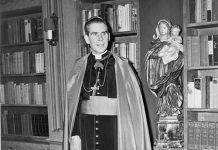
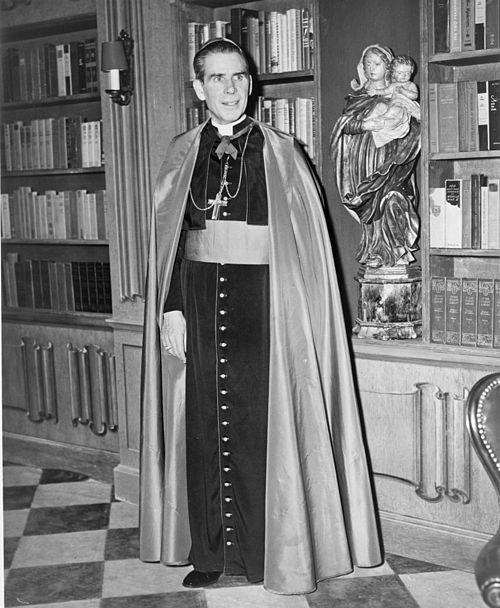
Newsroom (25/06/2026 Gaudium Press ) Tickets for the September 24, 2026, beatification of Venerable Fulton J. Sheen are in high demand, with thousands claimed shortly after their release on June 23. The surge underscores widespread interest in the influential 20th-century archbishop, whose pioneering role in Catholic media continues to resonate with the faithful.
The beatification Mass will take place at The Dome at America’s Center in St. Louis, a venue selected for its vast capacity and national prominence. With more than 67,000 seats available—excluding floor space—the 1.7 million-square-foot stadium offers organizers the ability to accommodate a significantly larger crowd than traditional ecclesiastical settings.
Bishop Louis Tylka of Peoria, Illinois, whose diocese oversees Archbishop Sheen’s sainthood cause, said the decision to host the ceremony in such a large venue was deliberate. “We could have done this event in our cathedral, where there would have been 800 people,” he explained. “But we’re trying to maximize people’s participation.” The move reflects a broader desire to make the historic moment accessible to as many attendees as possible, rather than limiting attendance due to space constraints.
However, the scale of the venue comes with considerable financial implications. Ticket prices, ranging from $15 to $25, were set in response to what Bishop Tylka described as the “substantial costs” associated with staging an event of this magnitude. Daily rental fees for The Dome alone exceed six figures. In 2023, for instance, the United Football League’s St. Louis Battlehawks paid $100,000 per game to use the facility—a figure that only accounts for basic access.
“All that does is open the doors,” Bishop Tylka noted, emphasizing that rental fees do not cover the operational expenses required to run a major event. These additional costs include audiovisual systems, electrical support, public safety measures, insurance, medical services, cleaning crews, and concessions. Each component contributes to the overall financial burden of staging a large-scale liturgical gathering.
Complicating matters further are labor requirements tied to the venue. According to The Dome’s technical specifications, most services are provided by local union workers, including carpenters, electricians, decorators, projectionists, and stagehands. Among these is Stagehands Local 6 of the International Alliance of Theatrical Stage Employees (IATSE). As of June 10, hourly wages for riggers ranged from more than $36 to over $47, with additional premiums for overtime and overnight work.
Even discounted services—such as those offered by the production company supporting the beatification—must adhere to union labor standards, adding another layer of cost. “The production company had given us a discount,” Bishop Tylka acknowledged, but noted that contractual obligations still require hiring qualified union personnel for essential event operations.
Ticketing itself introduces additional expenses. The Dome contracts with Ticketmaster, the global ticketing platform owned by Live Nation Entertainment, to manage distribution. While the base ticket price is determined by event organizers, service fees are incorporated into the listed price to cover transaction processing and logistical costs. Bishop Tylka noted that these fees, alongside possible facility charges, are necessary components of large event management and are not retained entirely by Ticketmaster.
To offset expenses, organizers are pursuing multiple funding avenues, including sponsorships. At the same time, the pricing structure has been designed to remain accessible. Reduced rates are available for seminarians and school groups, while a donor has covered the cost of tickets for many consecrated religious.
“A person who’s willing to pay $25 for a ticket helps us to be able to offset the cost of inviting seminarians, religious and school groups,” Bishop Tylka said. However, he cautioned that even generous donations may not fully cover all attendees in these categories.
Despite the introduction of ticketing, Bishop Tylka stressed that the practice does not equate to charging for participation in a liturgy, which is prohibited under canon law. Instead, the requirement is driven by practical considerations. “Ticketing for the event is required because of the realities of crowd control, security and the expenses of putting on an event,” he said.
The Dome itself has a history of hosting major religious gatherings. In 1999, it was the site of a papal Mass celebrated by St. John Paul II, which at the time became the largest indoor gathering in the United States. Today, the venue—often referred to as “The Battledome” due to its role as home field for the St. Louis Battlehawks—continues to serve as a hub for large-scale events, from sports to conventions.
As preparations for Archbishop Sheen’s beatification continue, the strong demand for tickets highlights both the enduring influence of the beloved archbishop and the logistical complexity of organizing a national-level religious event. For Bishop Tylka and his team, balancing accessibility with financial sustainability remains a central challenge.
“All those things have to be accounted for,” he said. “And they’re just not free.”
- Raju Hasmukh with files from OSV News
Related Images: