









Thousands mark Corpus Christi in Spain with processions, highlighting faith, unity, and Eucharistic devotion across Toledo, Seville, and Granada.
Newsroom (04/06/2026 Gaudium Press ) Thousands of faithful gathered across Spain this Thursday to celebrate Corpus Christi, one of the most significant solemnities in the Catholic liturgical calendar. From Toledo to Seville and Granada, Eucharistic processions transformed city streets into expressions of faith, drawing together worshippers, clergy, religious communities, and public officials in a shared affirmation of belief in the Real Presence of Christ in the Eucharist.
This year’s celebrations carried an added sense of anticipation, with repeated references to the forthcoming visit of Pope Leo XIV to Spain. Church leaders used the occasion to call for a renewal of faith, stronger ecclesial unity, and deeper commitment to charity in what they described as an increasingly secularized and fragmented society.
Toledo: A City Defined by Corpus Christi
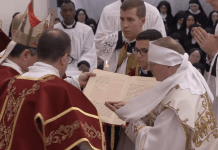
In Toledo, where Corpus Christi is deeply woven into the city’s identity, the Primate Cathedral hosted a solemn Eucharistic celebration in the Hispano-Mozarabic rite. The Mass was presided over by the Archbishop of Toledo and Primate of Spain, Monsignor Francisco Cerro Chaves, during a significant year marking the eighth centenary of the cathedral’s construction.
In his homily, Archbishop Cerro emphasized the centrality of the Eucharist in Christian life, affirming that “we cannot live without the Eucharist celebrated, received in communion, and adored.” He underscored the enduring presence of Christ in the sacrament and highlighted the upcoming papal visit as an opportunity for spiritual renewal.
The archbishop also reflected on the unique relationship between the city and the celebration itself. “Toledo cannot be understood without the Eucharist, without Corpus Christi, nor can Corpus Christi be understood without Toledo,” he said.
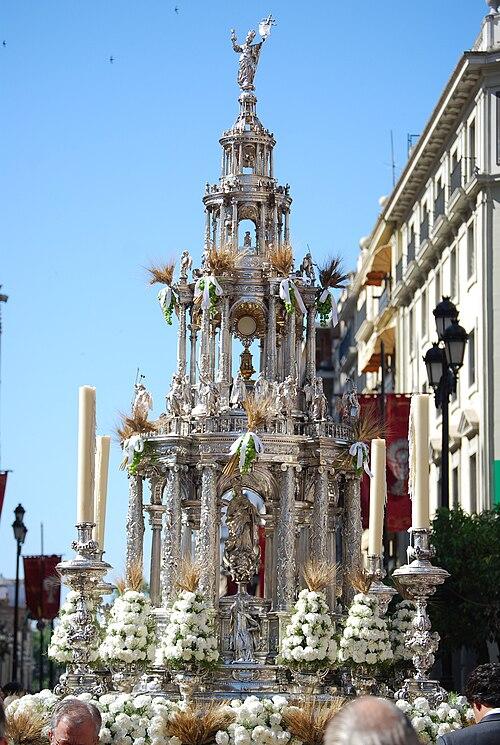
Following the Mass, the renowned Arfe Custody—a masterpiece of religious art—was carried through the historic center. Streets adorned with decorated balconies provided a backdrop as thousands accompanied the Blessed Sacrament, continuing a tradition that has defined Toledo for centuries.
Seville: The Eucharist at the Heart of the Church
In Seville, the solemnity began with a Eucharistic celebration in the Cathedral, presided over by Archbishop José Ángel Saiz Meneses. His homily focused on reaffirming the theological significance of the Eucharist, rejecting any notion that the celebration is merely symbolic or cultural.
“To speak of Corpus Christi today is not to speak of just another devotion,” he stated. “It is to speak of the heart of the Church, the heart of the priesthood, the heart of every parish.”
Archbishop Saiz Meneses stressed that the procession is not simply a folkloric tradition but a public profession of faith. He encouraged renewed emphasis on Sunday Mass attendance, Eucharistic adoration, and the strengthening of parish life.
After the liturgy, the Arfe Monstrance joined the procession through the city’s historic streets, accompanied by thousands of participants. The event once again demonstrated Seville’s longstanding devotion and the enduring role of religious tradition in public life.
Granada: Linking Eucharist, Charity, and Unity
Granada’s observance of Corpus Christi stood out for its emphasis on social harmony and charity. The city witnessed a large turnout at the Cathedral and along the procession route, where the Custody was accompanied by the Sacramental Squad—popularly known as “The White Legion of God.”
Petals and floral carpets lined the streets as the procession passed, creating a visually striking setting for the celebration. Archbishop José María Gil Tamayo used the occasion to address broader societal challenges, urging unity in a context marked by polarization.
“The Eucharist leads us to strengthen charity among all as an expression of our love for God,” he said, highlighting the coincidence of Charity Day with Corpus Christi. He encouraged support for Caritas and reminded the faithful not to overlook those facing poverty, loneliness, or exclusion.
The celebration also featured the participation of the Cathedral’s Seises—a revived tradition—and included many children who had recently received their First Communion, symbolizing continuity across generations.
A Shared Faith in a Changing Society
Despite regional differences in tradition and expression, the celebrations in Toledo, Seville, and Granada shared a common message: the Eucharist remains at the center of Christian life. The processions, marked by ornate monstrances and vibrant public participation, served as visible affirmations of faith in the Real Presence of Christ.
In a social climate shaped by secularization, the continued vitality of Corpus Christi celebrations underscores their enduring significance within Spanish Catholic identity. As monstrances moved from churches into public squares, they carried with them a centuries-old tradition that continues to resonate with believers.
The Solemnity of Corpus Christi not only commemorates the Eucharist but extends its adoration beyond church walls. Through these processions, the faithful publicly express a belief that has long been described as the source and summit of Christian life—demonstrating that, even in modern times, the presence of God in the streets remains a powerful and unifying reality.
- Raju Hasmukh with files from Infovaticana
Related Images: